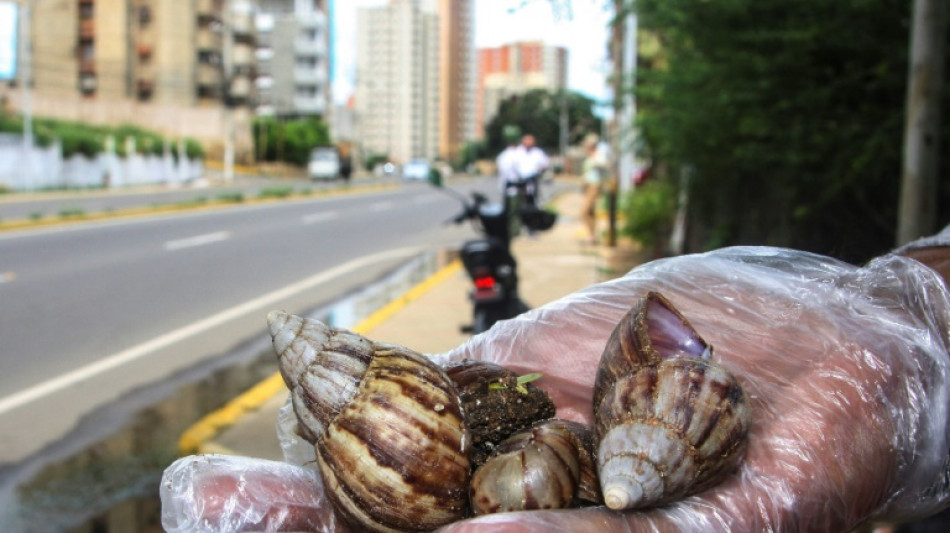
'Voracious' giant snails spark alarm in Venezuela / Photo: Luis BRAVO - AFP

 Jazeera Paints showcases housing solutions at Build Your House 2026 in Qatar

 Google drags down Wall Street stocks

 Does White House ask AI to shape policy? Democrats want the receipts

 ECB holds rates steady after Lagarde says to quit early

 ECB chief Lagarde to step down early, triggering succession race

 VW says 'no time to lose' to slash costs after 5.8 billion euro loss

 Oil majors reap bumper profits as Mideast war drives prices

 Taiwan says Pakistan briefly closed airspace to Taiwanese flights

 Samsung logs record quarterly profits despite investor AI jitters

 Shares in Google owner Alphabet plummet on profit miss, ad slowdown

 US Fed holds interest rates steady despite 'too high' inflation

A "plague" of giant African snails that pose potential health risks to humans is causing alarm in Venezuela where sustained rains have facilitated their proliferation.
The first colonies of the sub-Saharan Achatina fulica snail were discovered at the beginning of November on the shores of Lake Maracaibo in western Venezuela.
Since then, more snails have been found in agricultural areas in the region, as well as in neighboring Tachira state.
"Specific sites have been verified... where approximately 350 to 400 snails are being collected per day," Rafael Ramirez, the mayor of the city of Maracaibo, told AFP.
He said authorities were working hard combat the snails.
The giant African snail is considered an invasive species because of its reproductive capacity -- up to 600 eggs every two weeks -- and its relatively long lifespan of six years on average.
It can be devastating to crops and also carries parasites that can cause meningitis, encephalitis and intestinal disorders in humans.
The snail has been present in Venezuela since 1997 with the last plague detected in 2017 although in smaller quantities, said Jose Sandoval, director of wildlife at the Azul Ambientalista NGO.
"This will be unstoppable because they are big and already adults: They have already laid eggs," said Sandoval.
"We are faced with an invasion, a plague, and so it is hard to eradicate them when they reach these numbers, but they can be controlled."
Sandoval took AFP on an eradication mission in Maracaibo in which he collected 437 snails in just two hours.
He said the prolonged rainy season was to blame for the snails' reappearance and rapid reproduction.
"They will remain until March, they will damage crops... they are voracious," he added.
H.Meyer--CPN