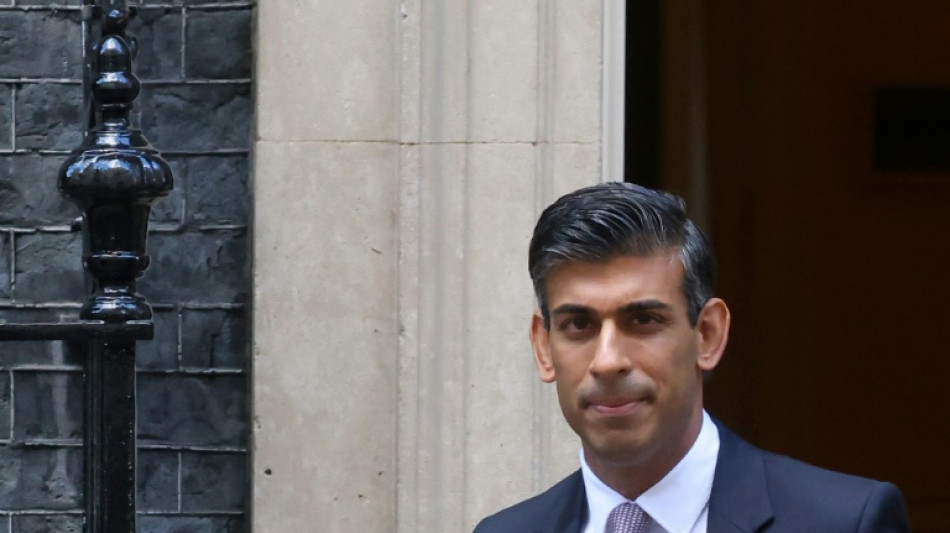
More UK misery as economy contracts in third quarter / Photo: Hollie Adams - AFP

 Jazeera Paints showcases housing solutions at Build Your House 2026 in Qatar

 Google drags down Wall Street stocks
 Does White House ask AI to shape policy? Democrats want the receipts
 ECB holds rates steady after Lagarde says to quit early

 ECB chief Lagarde to step down early, triggering succession race
 VW says 'no time to lose' to slash costs after 5.8 billion euro loss

 Oil majors reap bumper profits as Mideast war drives prices

 Taiwan says Pakistan briefly closed airspace to Taiwanese flights

 Samsung logs record quarterly profits despite investor AI jitters

 Shares in Google owner Alphabet plummet on profit miss, ad slowdown

 US Fed holds interest rates steady despite 'too high' inflation

Britain's economy shrank in the third quarter as inflation soars, official data showed Friday, likely confirming it is already in a recession, dealing a fresh blow to new Prime Minister Rishi Sunak.
The Bank of England has said the UK economy would also contract in the current final quarter, meaning the economy was in a recession that it warned could last until mid-2024.
Friday's data comes ahead of the Conservative government's crucial budget announcement next week aimed at bringing much-needed economic and political stability to Britain.
Sunak, in charge for less than three weeks, has already faced questions over his political judgement after expressing regret on Wednesday for appointing a disgraced ally.
Britain's Office for National Statistics on Friday said the nation's economy contracted 0.2 percent in the July-September period -- in part hit by businesses closing for the funeral of Queen Elizabeth II.
Output had grown modestly in the second quarter, the statistics office confirmed.
- 'Tough road ahead' -
Following Friday's data and ahead of his budget, finance minister Jeremy Hunt said he was "under no illusion that there is a tough road ahead -- one which will require extremely difficult decisions to restore confidence and economic stability".
Preparing the country for tax hikes and spending cuts in Thursday's fiscal announcement, he added that the Tory government needed to "balance the books and get debt falling".
"There is no other way," he said, if Britain was to "achieve long-term sustainable growth".
Finance spokeswoman for the main opposition Labour party described the third-quarter GDP numbers as "extremely worrying".
"We're already set to be near the bottom of global league tables on growth, but all the Tories offer yet again is austerity," Rachel Reeves added.
As well as a recession, Britain is facing a cost-of-living crisis with UK inflation at a four-decade high above 10 percent.
The country is on course for a winter of mass strikes, including by nurses, as workers in the public and private sectors demand pay increases to match inflation and shortfalls to wage rises seen in recent years.
"The sharp rise in energy and other consumer prices has contributed to a squeeze on household finances, which is expected to have pushed the UK economy into a recession from the third quarter of this year," Yael Selfin, chief economist at KPMG UK, said following Friday's data.
The technical definition of recession is two quarters of contraction in a row.
GDP meanwhile contracted 0.6 percent in September, with output worsened by a public holiday for the queen's funeral.
The month also saw the start of Liz Truss's incredibly short spell as prime minister.
Hitting out over her time in office, former finance minister Kwasi Kwarteng on Thursday said he had warned the former prime minister to "slow down" on tax cuts that triggered economic turmoil and caused her downfall.
Kwarteng, appointed chancellor of the exchequer after Truss succeeded Boris Johnson, made a series of unfunded tax cut announcements in late September.
His budget panicked the markets, sent the pound crashing to an all-time low against the dollar and triggered emergency buying of UK government bonds by the Bank of England.
Truss was forced to resign in mid-October after less than 50 days in office -- becoming the shortest-serving prime minister in Britain's history.
burs-bcp/rfj/rox
M.P.Jacobs--CPN