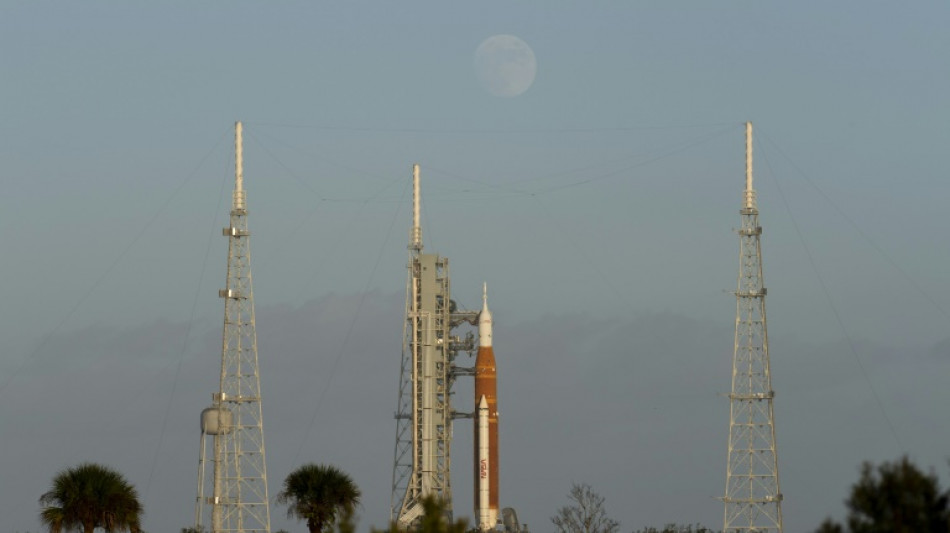
NASA Moon rocket launch delayed again, this time by storm / Photo: Joel KOWSKY - NASA/AFP/File

 ECB says has tools to calm markets as French debt worries rise

 IMF says engaging with Iraq on preparing new bailout program

 US economy posts strong growth, inflation stubbornly high in challenge to Trump

 French businessman takes over 2030 Winter Olympics amid leadership turmoil

 Stock markets diverge on corporate earnings, tech jitters

 TotalEnergies profit hits record on high oil prices

 Afghanistan opium poppy cultivation surges despite Taliban govt ban: UN

 Microsoft beats expectations fueled by Azure cloud business

 Shares in Google owner Alphabet sink on profit miss, ad slowdown

 Pioneering US labor leader Dolores Huerta dies at 96

 US Fed holds interest rates steady despite surging inflation

 US labor leader Dolores Huerta dead: family

NASA again rescheduled its long-delayed uncrewed mission to the Moon on Tuesday as Tropical Storm Nicole churned toward the east coast of Florida, officials said.
A launch attempt, which had been scheduled for November 14, will now take place on November 16, Jim Free, a senior official at the US space agency, said on Twitter.
It is the third delay of the highly-anticipated launch in as many months.
"Our people are the most important aspect of our mission," wrote Free, who is NASA's Associate Administrator for Exploration Systems Development. "Adjusting our target launch date for #Artemis I prioritizes employee safety and allows our team to tend to the needs of their families and homes."
The Atlantic Ocean storm was expected to develop into a hurricane Wednesday near the Bahamas, before making landfall in Florida either later that evening or early Thursday, the National Hurricane Center said.
A hurricane warning has been issued near the Kennedy Space Center, where the rocket -- NASA's most powerful ever -- is to blast off.
With Nicole gaining strength, "NASA... has decided to re-target a launch for the Artemis I mission for Wednesday, Nov. 16, pending safe conditions for employees to return to work, as well as inspections after the storm has passed," the agency said in a statement Tuesday evening.
NASA added that a launch occurring during a two-hour window that opens at 1:04 am EST (0604 GMT) on November 16 would result in a splashdown on Friday, Dec. 11.
A back-up launch date has been set for November 19.
NASA said it would leave the giant SLS rocket on the launch pad, where it had been placed several days before.
After two launch attempts were scrubbed this summer because of technical problems, the rocket had to be returned to the Vehicle Assembly Building to protect it from Hurricane Ian.
Last week, the 322-foot (98-meter) rocket was rolled back out on a giant platform known as the crawler-transporter designed to minimize vibrations.
Earlier Tuesday, Nicole was packing sustained winds near 65 miles per hour (100 kilometers per hour) with higher gusts and was expected to strengthen even further, according to the NHC.
Some experts have voiced concern that the rocket, which is estimated to cost several billion dollars, could be damaged by debris from the hurricane if it remains exposed.
"As far as staying at the pad, we want to see peak winds less than 74.1 knots, and that's kind of the key requirement that we're tracking," said chief rocket engineer John Blevins.
The SLS rocket is designed to withstand 85 mile-per-hour (74.4-knot) winds at the 60-foot level with structural margin, NASA said. It is designed to also withstand heavy rains at the launch pad and the spacecraft hatches have been secured to prevent water intrusion.
The uncrewed mission, dubbed Artemis 1, will bring the United States a step closer to returning astronauts to the Moon five decades after humans last walked on the lunar surface.
The goal of Artemis 1, named after the twin sister of Apollo, is to test the SLS rocket and Orion crew capsule that sits on top.
Mannequins are standing in for astronauts on the mission and will record acceleration, vibration, and radiation levels.
M.Davis--CPN