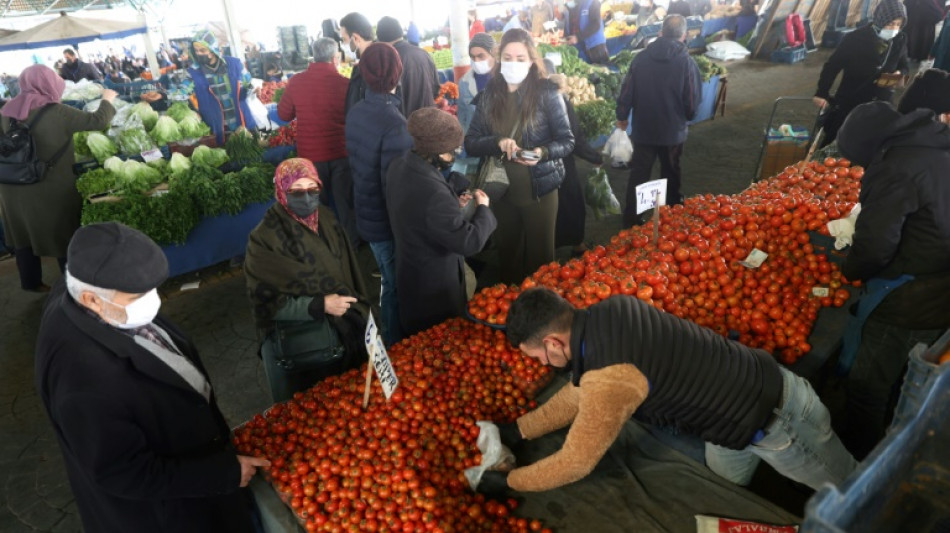
Turkish inflation tops 85%, highest since 1997 / Photo: Adem ALTAN - AFP/File

 ECB holds rates steady after Lagarde says to quit early

 ECB chief Lagarde to step down early, triggering succession race

 VW says 'no time to lose' to slash costs after 5.8 billion euro loss

 Oil majors reap bumper profits as Mideast war drives prices

 Taiwan says Pakistan briefly closed airspace to Taiwanese flights

 Samsung logs record quarterly profits despite investor AI jitters

 Shares in Google owner Alphabet plummet on profit miss, ad slowdown

 US Fed holds interest rates steady despite 'too high' inflation

 Airbus aims for record deliveries despite disappointing quarter

 Real Madrid, La Liga apology over Mbappe shows power of Chinese market

 'Cruise for life' strands passengers in Cambodia as operator goes bust

 Canada hikes rates to contain oil price surge caused by Iran war

Turkish inflation surged past 85 percent in October, its highest level since 1997, official data showed Thursday, as President Recep Tayyip Erdogan sticks to unorthodox policies to combat a cost-of-living crisis.
Central banks worldwide are raising borrowing costs in efforts to tame soaring consumer prices, but Turkey has bucked the global trend, with Erdogan calling higher interest rates his "biggest enemy".
Last month, Turkey's central bank cut its policy rate for a third consecutive time, bringing it down to 10.5 percent from 12 percent.
With an election looming next year, Erdogan argues that high rates are the cause of inflation, not the opposite, in defiance of orthodox economic theories.
Turkey's inflation has steadily risen since reaching a low of 16.6 percent in May 2021.
It hit 85.51 percent in October, according to state statistics agency TUIK, up from 83.45 percent in September.
Independent economists, however, say the rate is more than twice as high.
At the same time, the Turkish lira has plunged against the dollar.
Despite soaring consumer prices, Erdogan praised the state of the country's economy in an address to his ruling AKP lawmakers in parliament on Wednesday.
"Thank God, the wheels of the economy are turning," he said.
"Our economic model, which we have summarised as growth through investment, employment, production, export and current account surplus, is bearing fruit."
The head of the central bank, however, has said that success could not be declared.
"We cannot consider ourselves very successful in the fight against inflation," central bank governor Sahap Kavcioglu said last month.
"If there is inflation, there is a problem, it is not right to talk about success there, we know the distress of the citizens very closely, we take measures, we believe that we will see the result in a very short time," he added.
The October surge was fuelled by a 117 percent rise in transportation prices and a 99 percent jump for food.
The central bank has raised its inflation forecast for the full year from 60.4 percent to 65.2 percent.
- 'Disguise the real figure' -
Many Turks and the opposition question the credibility of the official government data.
According to a respected monthly study released by independent economists from Turkey's ENAG research institute, the annual rate of consumer price increases reached 185.34 percent in October.
Opposition leader Kemal Kilicdaroglu accused the government of hiding the real inflation while setting public employees' salaries.
"Why does TUIK (statistics agency) disguise the real figure?" he asked last month.
"Because when it gives the real figure, the pensions will be determined accordingly. Workers' wages will be determined accordingly. Civil servants' salaries will be determined accordingly. If you show it low, it will give a low raise," he argued.
Erdogan's government blames inflation on outside factors such as the global spike in food and energy prices caused by Russia's invasion of Ukraine.
The central bank is expected to cut rates again at its next policy meeting and then end the easing cycle, as Erdogan has said the rate should be in single digits.
Liam Peach, senior emerging markets economist at London-based Capital Economics, said the bank would remain "under pressure" from Erdogan for looser policy.
While the central bank has said that it will deliver one more 150-basis-point rate cut at its meeting later this month, "there is a risk of further easing beyond that, adding more downward pressure onto the lira," he said in a note to clients.
M.Mendoza--CPN