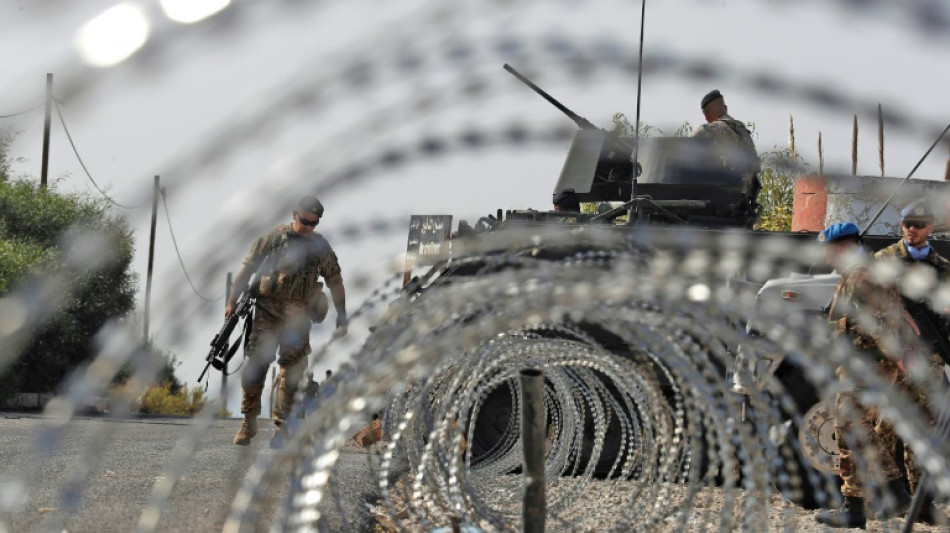
Israel, Lebanon set to sign 'historic' maritime border deal / Photo: MAHMOUD ZAYYAT - AFP

 French businessman takes over 2030 Winter Olympics amid leadership turmoil
 Stock markets diverge on corporate earnings, tech jitters
 TotalEnergies profit hits record on high oil prices
 Afghanistan opium poppy cultivation surges despite Taliban govt ban: UN

 Microsoft beats expectations fueled by Azure cloud business

 Shares in Google owner Alphabet sink on profit miss, ad slowdown

 Pioneering US labor leader Dolores Huerta dies at 96

 US Fed holds interest rates steady despite surging inflation

 US labor leader Dolores Huerta dead: family

 French firm Safran helps build aircraft wings of the future in UK factory

 World Bank warns of worsening food insecurity as commodity prices soar

Lebanon and Israel were Thursday expected to sign a US-brokered maritime border deal which would pave the way for lucrative offshore gas extraction by the neighbours that remain technically at war.
Hailed by US President Joe Biden as a "historic breakthrough", it comes as Western powers clamour to open up new gas production and reduce vulnerability to supply cuts from Russia.
The deal, which the US embassy told AFP is scheduled to be signed around 3:00pm (1200 GMT), comes as Lebanon seeks to extract itself from what the World Bank calls one of the worst economic crises in modern world history.
It also comes as Israeli Prime Minister Yair Lapid seeks to lock in a major achievement days ahead of a general election on November 1.
Hours before the scheduled signing, Lapid claimed that Lebanon's intention to ink the deal amounted to a de-facto recognition of the Jewish state.
"It is not every day that an enemy state recognises the State of Israel, in a written agreement, in front of the entire international community," he said, shortly before his government approved signing it.
Lebanon's President Michel Aoun denied that assertion, countering that "demarcating the southern maritime border is technical work that has no political implications".
- Delicate protocols -
"The agreement... will take the form of two exchanges of letters, one between Lebanon and the United States, and one between Israel and the United States," said Stephane Dujarric, spokesman for the UN Secretary General.
The letter exchange is due to take place in the southern Lebanese town of Naqura, in the presence of US mediator Amos Hochstein and the UN's special coordinator for Lebanon Joanna Wronecka.
Rafic Chelala, a spokesman for the Lebanese presidency, confirmed that the Lebanese delegation "will not ... meet the Israeli delegation".
The planned signing comes as political parties in Israel -- including Lapid's centrist Yesh Atid - jockey for position in what will be the fifth general election in less than four years.
Veteran right-winger and longtime premier Benjamin Netanyahu has his sights set on a comeback and he dismissed the maritime deal as an "illegal ploy" early this month.
London-listed Energean on Wednesday said it began producing gas from Karish, an offshore field at the heart of the border agreement, a day after Israel gave the green light.
Lebanon meanwhile will have full rights to operate and explore the so-called Qana or Sidon reservoir, parts of which fall in Israel's territorial waters, with the Jewish state receiving some revenues.
- No quick fix -
With demand for gas rising worldwide because of the energy crisis sparked by Russia's invasion of Ukraine, Lebanon hopes that exploiting the offshore field will help ease its financial and economic crisis.
But analysts caution that it will take time for production to start in Lebanese waters, meaning no quick return for a country that is desperately short of foreign exchange reserves.
Exploration has so far only been tentative -- a 2012 seismic study of a limited offshore area by the British firm Spectrum estimated recoverable gas reserves in Lebanon at 25.4 trillion cubic feet, although authorities in Lebanon have announced higher estimates.
The maritime border deal could not be signed by Lebanon without the consent of Hezbollah, a powerful Shiite faction backed by Israel's arch nemesis Iran.
Hezbollah had threatened over the summer to attack Israel if the Jewish state began extracting gas from the Karish field before reaching an agreement.
Israel and Hezbollah fought a 34-day war in 2006 and the Shiite movement is the only faction to have kept its weapons after the end of Lebanon's 1975-1990 civil war.
P.Gonzales--CPN