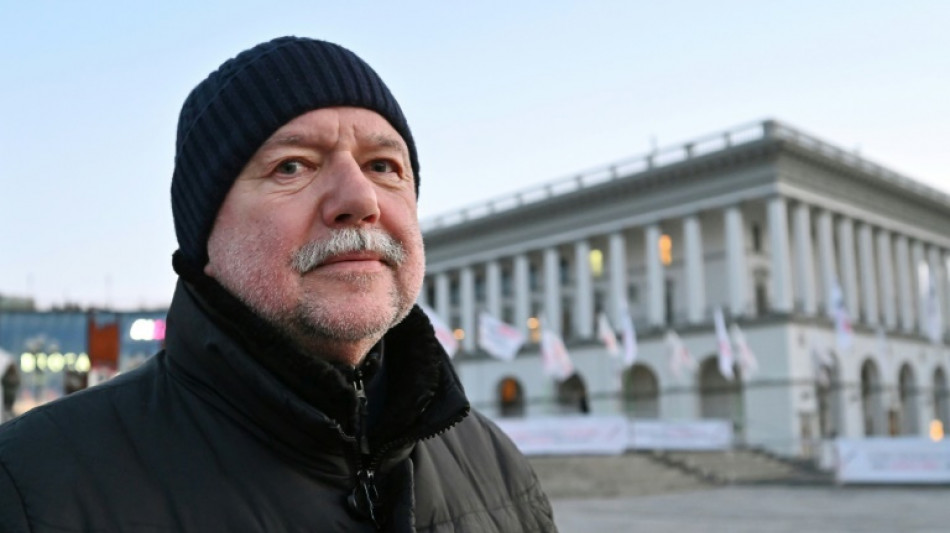
Ukraine's star author Kurkov says his native Russian should be curbed

 ستاندرد آند بورز تثبت تصنيف السعودية عند A+

 Lights out in Laos as electricity exports surge

 Steven Strogatz weighs AI mathematics advances and their consequences for researchers

 Anthropic boss calls for AI slowdown, Altman and Musk agree

 French IT giant Capgemini sells subsidiary after row over ICE links

 Quebec Brokerage Qubit Insurance Announces New Data on Coverage Shortfalls as Rebuilding Costs Rise

 Lady Gaga welcomes first child with fiance: US media

 Bhutan business bets on hazelnuts for farming future

 'Widow's Bay' and 'The Pitt' are favorites for Emmys night

 Coastal erosion forces cancellation of California music festival

 Argentina's Dirty War rears its head in Venice film

 UK lawmakers throw out bill to legalise assisted dying

 US inflation steady in August, fueling Fed rate hike expectations

 New York marks 25th anniversary of 9/11 attacks

 Nepal flood reconstruction bill to be $4.78 bn: foreign ministry

 JUMO and Standard Bank launch Social Finance Framework to scale inclusive finance in Africa

 Doomsday tech: could AI really kill us all?

 French comedy show 'Call my agent' makes film comeback

 It's all coming back: Celine Dion fans gear up for Paris return

 Researchers eye AI revolution in natural disaster forecasts

 US braces for inflation report that may push Fed to hike rates

 Musk threatens legal action over documentary

 Latin America fact-check group asks Meta not to replace verification practice

 AI Risks to Enter 60–80% of Liability and Cyber Insurance Underwriting by 2028, ScienceSoft Predicts

 Tribal Launches Campfire, Letting Business and Technical Teams Build on Salesforce Together

Ukraine's bestselling Russian-speaking author Andrey Kurkov says it is "immoral" to defend the Russian language in the ex-Soviet republic during soaring tensions with Moscow.
Kurkov's often absurdist works -- tinged with humour about the misplaced oddities of life -- have been translated into more than 30 languages and become international hits.
He is most famous for the early post-Soviet "Death and the Penguin" novel about a despondent obituary writer.
But he is also a popular political commentator who has strong views on a Ukrainian language law that Russian President Vladimir Putin is using in his attempts to cast Kyiv's pro-Western leaders as persecutors of ethnic Russians.
"In the context of our current relations with Russia, it is immoral to talk about the privileged place of the Russian language," Kurkov told AFP in Russian.
The 60-year-old native of Russia's Leningrad region outside Saint Petersburg speaks Ukrainian without an accent and has written some of his film scripts and children's books in Ukrainian.
But he views Russian as his native language and uses it for most of his works.
"I write in Russia, I speak on TV in Russian or Ukrainian. It does not create problems," he said.
"At the moment, the firm language policy is justified."
- 'Balance' -
The new language law requires Russian-language publications to be accompanied by Ukrainian versions of equal size and circulation as of last month.
Newsstands must also offer at least half their content in Ukrainian.
Human Rights Watch believes the law raises "concerns".
"The Ukrainian government has every right to promote its state language and strengthen its national identity," the New York-based rights group said.
"But it should ensure a balance in its language policy, to avoid discrimination against linguistic minorities."
Kurkov views the law as a natural progression of Ukraine's society. He also has no qualms about Russian no longer being taught in schools.
"The next generation of Ukrainians will be bilingual, but will not be able to write in Russian," he predicts.
The Soviet Union tried to build a socialist society out of 15 multi-ethnic republics that were all forced to learn Russian in schools.
"The process of Ukraine's Russification lasted for 70 years," Kurkov says. "We are witnessing the return of Ukrainian to its territories, a process that can take between 50 and 100 years."
- Collective vs individual -
Kurkov is now working on the third part of a historical detective novel about life in Kyiv in 1919.
Ukraine gained fleeting independence that year before being swallowed up by the Bolshevik Revolution.
He views the current threat of an invasion by more than 100,000 Russian troops who have surrounded Ukraine from nearly every side as one of the hard realities of life that will not permanently alter his country's course.
"There might be a war, but not a total loss of independence," he said.
Kurkov thinks Ukraine and Russia are so fundamentally different they cannot coexist.
"Russians like tsars and the one-party system, like in Soviet times or with (Putin's ruling) United Russia party now," he said.
"In Ukraine, we have 400 registered political parties. Every Ukranian wants to found his own political party because he does not agree with others."
Russians subscribe to the "collective mentality," he said. "Ukrainians are individuals."
- 'Accustomed to war' -
Kurkov's most recent translated work -- called "Grey Bees" in English -- follows the path of a beekeeper through the simmering conflict that has claimed more than 14,000 lives across swaths of Ukraine's Russian-backed separatist east.
Ukrainians have been living with this war since a 2014 pro-EU revolution toppled a government backed by Moscow that was ranked as one of the 30 most corrupt in the world.
Kurkov believes the years of tumult have steeled Ukrainians' resolve.
"There is neither psychosis nor panic. Everyone just gets on with their lives," he said.
"The real shock was in March 2014, when everyone in Ukraine watched a session of the Russian parliament overwhelmingly vote in favour of allowing the Russian army to wage war on foreign territories," he said.
The vote gave Putin the political cover needed to back the insurgency in eastern Ukraine.
"Today, people are accustomed to the fact that there is a war," he said.
T.Morelli--CPN