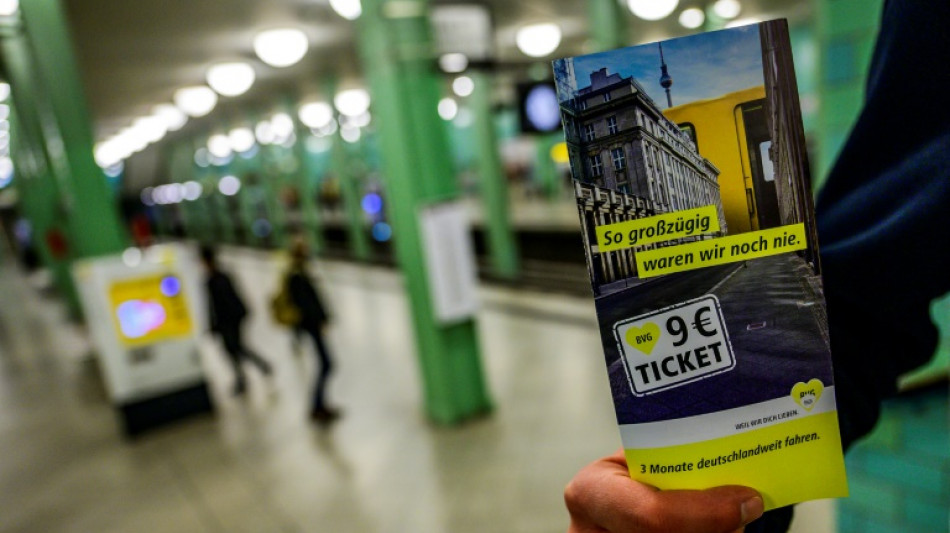
Germany agrees to replace cheap national transport ticket / Photo: John MACDOUGALL - AFP/File

 TotalEnergies profit hits record on high oil prices
 Afghanistan opium poppy cultivation surges despite Taliban govt ban: UN

 Microsoft beats expectations fueled by Azure cloud business

 Shares in Google owner Alphabet sink on profit miss, ad slowdown

 Pioneering US labor leader Dolores Huerta dies at 96

 US Fed holds interest rates steady despite surging inflation

 US labor leader Dolores Huerta dead: family

 French firm Safran helps build aircraft wings of the future in UK factory

 World Bank warns of worsening food insecurity as commodity prices soar

 Billionaire Ambani's Jio soars in market debut after India's biggest IPO

Germany on Thursday moved closer to approving a successor to a popular ultra-cheap, country-wide public transport ticket rolled out over the summer to curb inflation and cut carbon emissions.
State and federal transport ministers agreed on a 49-euro ($47) monthly pass allowing users to travel on subways, buses and regional trains anywhere in Germany.
It would replace a nine-euro monthly pass in June, July and August that proved a roaring success, selling a total of 52 million tickets in addition to benefitting 10 million who already had monthly tickets.
"We can get to work on the modalities but the main issues have been resolved -- it will be a Germany-wide ticket offering everything that the nine-euro ticket did," Federal Transport Minister Volker Wissing told reporters, pending approval by Berlin and regional governments.
Wissing said it would be likely be rolled out from January 1 and offered only as an annual subscription, renewing automatically each month, but can be cancelled at any time.
However at more than five times the special price offered in the summertime, consumer advocates have raised doubts about how attractive the new ticket will be.
The financing has also yet to be hammered out, with the federal government offering 1.5 billion euros per year from 2023 and asking states to match that amount.
Chancellor Olaf Scholz himself had said the summer tickets were "one of the best ideas" his centre-left-led coalition government had introduced, and pledged to come up with a longer-term measure.
The VDV public transport association touted the passes' pollution savings of 1.8 million tonnes -- the equivalent of the annual C02 output from almost 388,000 vehicles.
However Finance Minister Christian Lindner from the pro-business Free Democrats had baulked at the price tag of an extension, delaying the roll-out of a successor ticket.
Several cities and towns stepped into the breach with their own regional offers until a national policy can be implemented.
Germany, Europe's top economy, is struggling with soaring inflation driven by surging energy costs.
C.Peyronnet--CPN