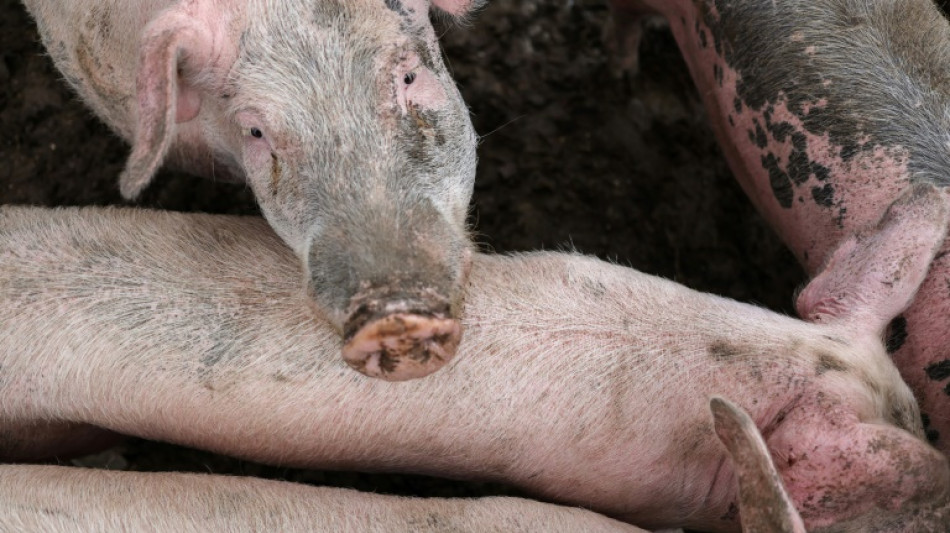
Supreme Court ponders the fate of pigs, high cost of bacon / Photo: Charly TRIBALLEAU - AFP/File

 TotalEnergies profit hits record on high oil prices

 Afghanistan opium poppy cultivation surges despite Taliban govt ban: UN

 Microsoft beats expectations fueled by Azure cloud business

 Shares in Google owner Alphabet sink on profit miss, ad slowdown
 Pioneering US labor leader Dolores Huerta dies at 96

 US Fed holds interest rates steady despite surging inflation

 US labor leader Dolores Huerta dead: family

 French firm Safran helps build aircraft wings of the future in UK factory

 World Bank warns of worsening food insecurity as commodity prices soar

 Billionaire Ambani's Jio soars in market debut after India's biggest IPO

A California law aimed at reducing animal suffering on pig farms led to some unusual exchanges Tuesday in the US Supreme Court.
Following a grassroots referendum, California passed an animal welfare measure in 2018 that bans the sale of pork from pigs that were raised in overly confined spaces.
The pork industry had gone to court accusing California -- which produces little of the pork it consumes -- of restricting interstate commerce and trying to impose its values on other US states.
The sector fears that California will effectively set national standards for conditions in which farm animals, including cows and chickens, are kept, thus raising ham and bacon prices for consumers.
Pork producers, after being rejected by state courts, turned to the Supreme Court, which seemed baffled by the case.
For nearly two hours, the nine justices pondered the criteria that would allow comparable cases to be resolved in the future.
The result was a series of highly political hypothetical scenarios.
Progressive Justice Elena Kagan wondered what would happen if Democratic states banned the sale of goods made by non-unionized workers.
Her conservative colleague Amy Coney Barrett imagined that they would ban goods from companies that did not fund medical care for their transgender employees.
Judge Brett Kavanaugh, meanwhile, speculated that Republican states might ban products created by undocumented immigrants.
Perplexity peaked when Justice Sonia Sotomayor noted that the pork market was already regulated.
"We have marketed already pork marked as organic, crate-free, antibiotic-free and beta-agonist free," she said. "I have no idea what that means, but I know it's there. I've seen it in supermarkets."
The high court will return a decision before June 30.
L.Peeters--CPN