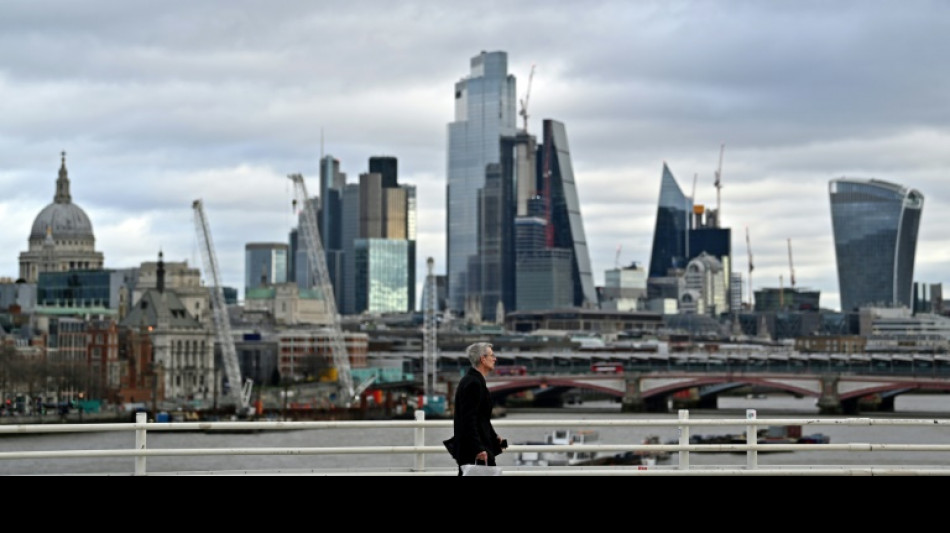
UK avoids recession in boost for under-fire Truss / Photo: JUSTIN TALLIS - AFP/File

 Afghanistan opium poppy cultivation surges despite Taliban govt ban: UN

 Microsoft beats expectations fueled by Azure cloud business

 Shares in Google owner Alphabet sink on profit miss, ad slowdown

 Pioneering US labor leader Dolores Huerta dies at 96

 US Fed holds interest rates steady despite surging inflation

 US labor leader Dolores Huerta dead: family

 French firm Safran helps build aircraft wings of the future in UK factory

 World Bank warns of worsening food insecurity as commodity prices soar

 Billionaire Ambani's Jio soars in market debut after India's biggest IPO

 AI chip giant SK hynix posts seven-fold surge in quarterly operating profit

Britain is not yet in recession, revised data showed Friday in a boost for under-fire Prime Minister Liz Truss, but its economy may still face a downturn on soaring interest rates.
Gross domestic product expanded 0.2 percent in the second quarter, the Office for National Statistics, an upgrade from its previous estimate of a 0.1-percent contraction.
Even if the economy has contracted in the current third quarter that ends Friday, it would mean the UK had avoided two successive quarters of contraction -- the technical definition of a recession.
The turnaround follows a rough week for Truss as the country's borrowing costs have soared while the pound took beating in the markets after her government announced a controversial stimulus plan.
But the country's economy remains fragile, with Friday's data also revised to show that it was still below pre-Covid levels.
- 'Calamitous week' -
"In what has been a calamitous week for the UK economy, there was a rare glimmer of hope... (with it) defying expectations of a recession -- for now," said Interactive Investor analyst Richard Hunter.
"Sterling has also found some cautious support ... although the jitters will remain as the government continues to justify and explain the implications of its fiscal largesse."
Investors were spooked this week by the huge amount of borrowing likely needed for a UK budget seen as benefitting the rich more than the poorest during the cost-of-living crisis.
Less than a month into the job, Truss is already deep in a financial crisis.
Truss and finance minister Kwasi Kwarteng were Friday expected to meet with Britain's fiscal watchdog, the Office for Budget Responsibility, as they seek to reassure jittery markets.
The pound on Monday collapsed to an all-time low at $1.0350 on fears the budget would make sky-high inflation worse and cause the Bank of England (BoE) to hike its main interest rate even more aggressively.
Having recovered in recent days, the pound on Friday jumped a further one percent against the dollar in the wake of the data.
The upbeat GDP figure came two days after the BoE carried out emergency action to snap up government bonds, whose yields had soared following the budget of debt-fuelled tax cuts.
And the central bank is forecast to hike its interest rate far beyond the current 2.25 percent, which compares with a record-low 0.1 percent less than a year ago, as markets fear ever-higher inflation on budget fallout.
This in turn could see businesses closing and home-owners defaulting on their mortgages.
- 'Good news, bad news' -
Despite growth in the latest quarter, the UK economy is 0.2 percent smaller than its pre-pandemic size, the ONS added Friday.
The statistics office previously had the UK economy at 0.6 percent larger than in 2019.
"The good news is that the economy is not already in recession," said Capital Economics analyst Paul Dales.
"The bad news is that contrary to previous thinking, it still hasn't returned to pre-pandemic levels."
The ONS also said the UK economy slumped 11 percent in 2020 on fallout from the Covid pandemic.
It then rebounded with 7.5-percent growth in 2021.
D.Philippon--CPN