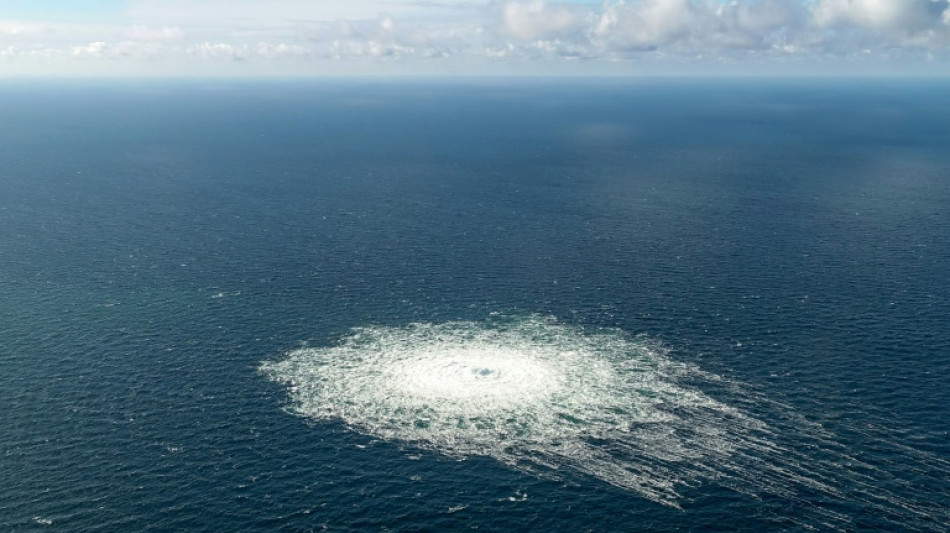
Fourth leak detected at Russian gas pipeline to Europe / Photo: Handout - DANISH DEFENCE/AFP

 Afghanistan opium poppy cultivation surges despite Taliban govt ban: UN

 Microsoft beats expectations fueled by Azure cloud business

 Shares in Google owner Alphabet sink on profit miss, ad slowdown

 Pioneering US labor leader Dolores Huerta dies at 96

 US Fed holds interest rates steady despite surging inflation

 US labor leader Dolores Huerta dead: family

 French firm Safran helps build aircraft wings of the future in UK factory

 World Bank warns of worsening food insecurity as commodity prices soar

 Billionaire Ambani's Jio soars in market debut after India's biggest IPO

 AI chip giant SK hynix posts seven-fold surge in quarterly operating profit

A fourth leak has been detected in undersea gas pipelines linking Russia to Europe, the Swedish Coast Guard said Thursday, after explosions were reported earlier this week in what NATO called "reckless" sabotage.
The Nord Stream 1 and 2 pipelines link Russia to Germany, and have been at the centre of geopolitical tensions as Russia cut gas supplies to Europe in suspected retaliation against Western sanctions following Moscow's invasion of Ukraine.
The Swedish Coast Guard confirmed Thursday there were four leaks in total on the pipeline in the Baltic Sea -- two on the Swedish side and two on the Danish side. Three leaks were previously reported.
While the pipelines -- operated by a consortium majority-owned by Russian gas giant Gazprom -- are not currently in operation, they both still contained gas.
On Thursday, NATO declared that the damage was "the result of deliberate, reckless and irresponsible acts of sabotage".
"These leaks are causing risks to shipping and substantial environmental damage," the Western military alliance said in a statement.
Russia has denied it was behind the explosions -- as did the United States, saying Moscow's suggestion it would damage the pipeline was "ridiculous".
Russia's security service launched an "international terrorism" investigation into the gas leaks, saying the damage had caused "significant economic damage to the Russian Federation".
It said Thursday suspects a foreign state of being behind the leaks.
The UN Security Council will meet Friday to discuss the matter.
- 'Constant' gas flow -
The vast leaks have caused underwater gas plumes, with significant bubbling at the surface of the sea several hundred metres wide, making it impossible to immediately inspect the structures.
Seismic institutes on Tuesday reported they had recorded "in all likelihood" explosions in the area, prior to the leaks being detected.
A Swedish Coast Guard search and rescue vessel was patrolling the area.
"The crew reports that the flow of gas visible on the surface is constant," the agency said in a statement.
Danish authorities said the leaks will continue until the gas in the pipelines is exhausted, which is expected to occur on Sunday.
Fatih Birol, executive director of the International Energy Agency (IEA), said at a symposium in Paris that to him it was "very obvious" who was behind the leaks.
He said natural gas shortages in the wake of the war in Ukraine could make for a tough winter in Europe.
"In the absence of a major negative surprise, I think Europe, in terms of natural gas, can survive this winter with a lot of bruises in our bodies in terms of prices, economy and social issues, but we can go through that," Birol said.
According to climate groups, Nord Stream 1 and 2 contained some 350,000 tonnes of natural gas -- methane.
Greenpeace says the leaks could have the effect of almost 30 million tonnes of CO2, or more than two-thirds of the annual emissions of Denmark.
U.Ndiaye--CPN