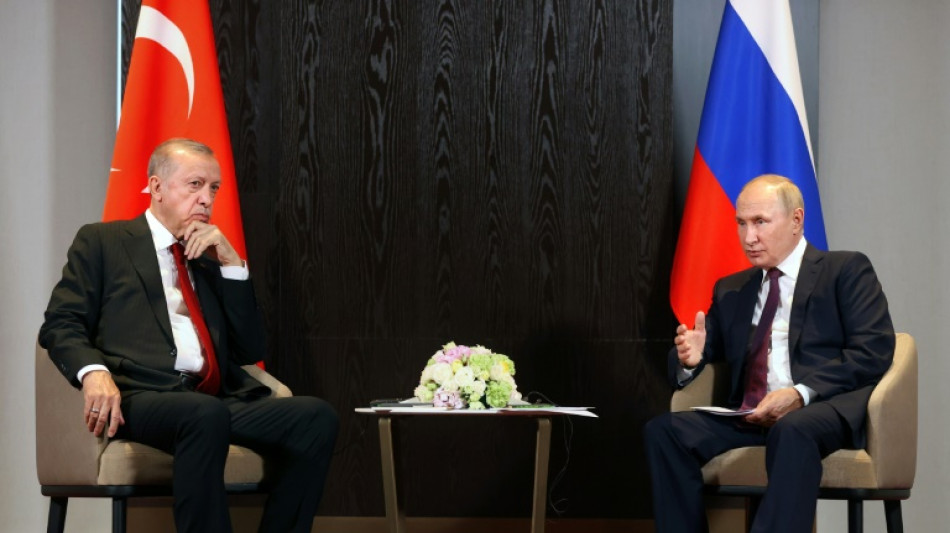
Turkey bows to US pressure, cuts Russian bank ties / Photo: Alexandr Demyanchuk - SPUTNIK/AFP

 Samsung logs record quarterly profits despite investor AI jitters

 Shares in Google owner Alphabet plummet on profit miss, ad slowdown

 US Fed holds interest rates steady despite 'too high' inflation

 Airbus aims for record deliveries despite disappointing quarter

 Real Madrid, La Liga apology over Mbappe shows power of Chinese market

 'Cruise for life' strands passengers in Cambodia as operator goes bust

 Canada hikes rates to contain oil price surge caused by Iran war

 Nintendo producer 'all nervous' as Zelda classic remake hits shelves

 Three killed by storm in southern India

 Two hundred 'Cruise for life' passengers stranded in Cambodia

 Billionaire Ambani's Jio jumps 21% in market debut after record India IPO
Turkey's booming wartime trade with Moscow took a giant step back on Wednesday with confirmation that the last three banks still processing Russian payments were pulling out under pressure from Washington.
The decision follows weeks of intensifying pressure from the United States for NATO member Turkey to limit its booming economic relations with Russia.
The US Treasury warned last week that Turkish banks working with Russian Mir bank cards "risk supporting Russia's efforts to evade US sanctions" and could face economic penalties themselves.
Two private Turkish lenders that began processing Mir after Turkish President Recep Tayyip Erdogan met Russian counterpart Vladimir Putin in August suspended the transactions earlier this month.
But three state lenders -- Halkbank, Vakifbank and Ziraatbank -- still worked with the cards.
A senior Turkish official did not say when Russians would no longer be able to access their cards in Turkey at all.
The three banks "are still processing (the outstanding) payments, but they have set a future date" for pulling out, the official said on condition of anonymity because no formal decision by the three state lenders has been announced.
The decision follows a meeting headed by Erdogan last Friday that officially focused on looking at "alternatives" to the Russian cards.
- 'Fear of sanctions' -
The explosion of Turkish trade with Russia during the seven-month war in Ukraine has been a source of growing concern in Washington.
The value of trade between the two rose by more than 50 percent. Turkey has also agreed to pay for a quarter of its Russian natural gas imports in rubles.
US Deputy Secretary of the Treasury Wally Adeyemo paid a rare visit to Ankara and Istanbul in June to express Washington's worries that Russian oligarchs and big businesses were using Turkish entities to evade Western sanctions.
The Treasury sent a follow up letter to Turkish banks and businesses in August warning that they cannot expect to have "access to the US dollar and other major currencies" if they trade with sanctioned Russians.
Turkey has tried to stay neutral in the Ukrainian conflict and refused to sign up to Western sanctions against Russia.
It has used this status to sign a range of economic agreements with Russia that have helped prop up the ailing economy in the run-up to June elections in which Erdogan will struggle to extend his two-decade grip on power.
Mir cards offer millions of Russians that vacation in Turkey each year a way to access their rubles and pay for everything from restaurants to hotels.
They are also increasingly important to Russians who are fleeing to Turkey as part of a new migration wave of men trying to avoid the draft.
But analysts note a shift in Turkey's tone away from Russia in the past few weeks.
Ankara last week strongly condemned the "illegitimate" polls the Kremlin is using as a pretext to annex four Ukrainian regions now under partial Russian control.
Prominent Russian sanctions supporter Bill Browder -- a businessman who left Moscow after one of his associated died in jail -- said the Turkish bank decision showed that the "fear of secondary sanctions is starting to work".
"Turkish banks have abandoned Putin's Mir payment system out of fear of being punished by the US," Browder tweeted.
"We need to roll this out far and wide. Chinese, Indian UAE and many other countries should understand there will be consequences."
H.Müller--CPN