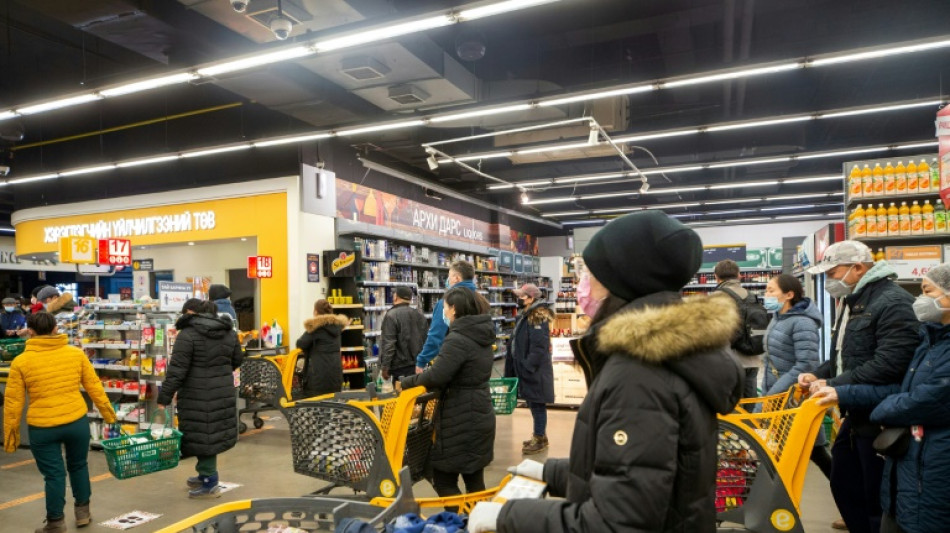
Inflation hits home for Mongolians struggling for basic goods / Photo: BYAMBASUREN BYAMBA-OCHIR - AFP

 Samsung logs record quarterly profits despite investor AI jitters

 Shares in Google owner Alphabet plummet on profit miss, ad slowdown

 US Fed holds interest rates steady despite 'too high' inflation

 Airbus aims for record deliveries despite disappointing quarter

 Real Madrid, La Liga apology over Mbappe shows power of Chinese market

 'Cruise for life' strands passengers in Cambodia as operator goes bust

 Canada hikes rates to contain oil price surge caused by Iran war

 Nintendo producer 'all nervous' as Zelda classic remake hits shelves

 Three killed by storm in southern India

 Two hundred 'Cruise for life' passengers stranded in Cambodia

 Billionaire Ambani's Jio jumps 21% in market debut after record India IPO
At Ulaanbaatar's Naiman Sharga money exchange market, elderly women stand in the street waving wads of money at passers-by, encouraging them to change foreign currency to Mongolian tugriks.
Each transaction nets them a small profit -- but when the value of the tugrik fluctuates it makes that more difficult, and lately the currency has taken a dive.
This year the currency has fallen almost 15 percent against the US dollar -- most of that since the start of Russia's invasion of Ukraine.
Angara Banerji, the International Monetary Fund's mission chief, listed a raft of factors behind the country's inflation, including a rise in domestic meat prices, China's border restrictions, surging oil and food prices, and an increase in transportation and logistical costs for imports.
The declining currency has pushed up the cost of everyday goods for a country struggling to navigate global economic headwinds caused by transportation bottlenecks and inflationary pressures, war and economic uncertainty.
"The rate is going down dramatically because of the war in Ukraine and the coronavirus," said Ts. Maisaikhan, a currency trader who operates inside the market.
"We don't produce much ourselves, most things are imported, so when the dollar goes up the price of everything goes up too."
Like elsewhere in the world, Mongolia's inflation has soared this year and reached 14.4 percent in August, compared with 9.5 percent during the same month in 2021, according to the country's National Statistical Office.
Prices for food and beverages increased by about a fifth on-year in August -- the same rate as medicine and health care -- while the cost of clothing, utilities and housing also went up.
"Inflation has surged sharply since mid-2021 and has exceeded the Bank of Mongolia's target band," said Banerji.
Last summer there were a few weeks when potato prices temporarily tripled after China closed the border over Covid-19.
Next to the money exchange offices lies Urt Tsagaan (Long White), a pedestrian mall filled with jewellery makers, seamstresses, hairdressers, boot repair stalls, cobblers, and tattoo studios.
In a sewing shop near the money exchange, Sukhbaatar Tuya said she buys some meat and vegetables each day but when prices spike suddenly it just means buying less produce.
"We're just going day by day," she said. "We don't have any plans beyond the next three days or a week."
"We have to live like this," she said. "There is no other way."
M.Davis--CPN