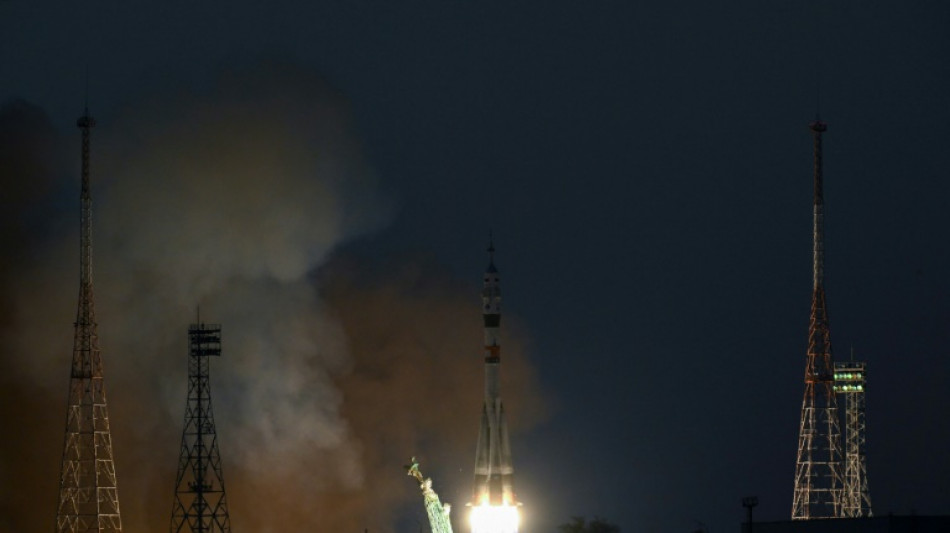
American, Russians blast off for ISS as war rages in Ukraine / Photo: NATALIA KOLESNIKOVA - AFP

 Samsung logs record quarterly profits despite investor AI jitters

 Shares in Google owner Alphabet plummet on profit miss, ad slowdown

 US Fed holds interest rates steady despite 'too high' inflation

 Airbus aims for record deliveries despite disappointing quarter

 Real Madrid, La Liga apology over Mbappe shows power of Chinese market

 'Cruise for life' strands passengers in Cambodia as operator goes bust

 Canada hikes rates to contain oil price surge caused by Iran war

 Nintendo producer 'all nervous' as Zelda classic remake hits shelves

 Three killed by storm in southern India

 Two hundred 'Cruise for life' passengers stranded in Cambodia

 Billionaire Ambani's Jio jumps 21% in market debut after record India IPO
A US astronaut and two Russian cosmonauts blasted off to the International Space Station (ISS) Wednesday on a Russian-operated flight, in a rare instance of cooperation between Moscow and Washington.
The Russian space agency Roscosmos and NASA both distributed live footage of the launch from Kazakhstan and commentators speaking over the feed said it was stable and that "the crew is feeling well".
NASA's Frank Rubio and Russia's Sergey Prokopyev and Dmitry Petelin make up the crew that launched from the Russia-leased Baikonur cosmodrome at 1354 GMT.
Rubio is the first US astronaut to travel to the ISS on a Russian Soyuz rocket since President Vladimir Putin sent troops into pro-Western Ukraine on February 24.
In response, Western capitals including Washington have hit Moscow with unprecedented sanctions and bilateral ties have sunk to new lows.
Space remained an outlier of cooperation between the two countries.
Russia's only active female cosmonaut Anna Kikina is expected to travel to the orbital station in early October aboard a SpaceX Crew Dragon.
She will become only the fifth professional woman cosmonaut from Russia or the Soviet Union to fly to space, and the first Russian to fly aboard a spacecraft of SpaceX, the company of billionaire Elon Musk.
Russian cosmonauts and Western astronauts have sought to steer clear of the conflict that is raging back on Earth, especially when in orbit together.
A collaboration among the United States, Canada, Japan, the European Space Agency and Russia, the ISS is split into two sections: the US Orbital Segment, and the Russian Orbital Segment.
- Russia leaving ISS -
At present, the ISS depends on a Russian propulsion system to maintain its orbit, about 250 miles (400 kilometres) above sea level, with the US segment responsible for electricity and life support systems.
Tensions in the space field have grown after Washington announced sanctions on Moscow's aerospace industry -- triggering warnings from Russia's former space chief Dmitry Rogozin, an ardent supporter of the Ukraine war.
Rogozin's recently appointed successor Yuri Borisov later confirmed Russia's long-mooted move to leave the ISS after 2024 in favour of creating its own orbital station.
US space agency NASA called the decision an "unfortunate development" that would hinder scientific work on the ISS.
Space analysts say that the construction of a new orbital station could take more than a decade and Russia's space industry -- a point of national pride -- would not be able to flourish under heavy sanctions.
The ISS was launched in 1998 at a time of hope for US-Russia cooperation following their Space Race competition during the Cold War.
During that era, the Soviet space programme flourished. It boasted a number of accomplishments that included sending the first man into space in 1961 and launching the first satellite four years earlier.
Experts say Roscosmos is now a shadow of its former self and has in recent years suffered a series of setbacks, including corruption scandals and the loss of a number of satellites and other spacecraft.
Russia years-long monopoly on manned flights to the ISS is also gone, to SpaceX, along with millions of dollars in revenue.
Y.Ibrahim--CPN