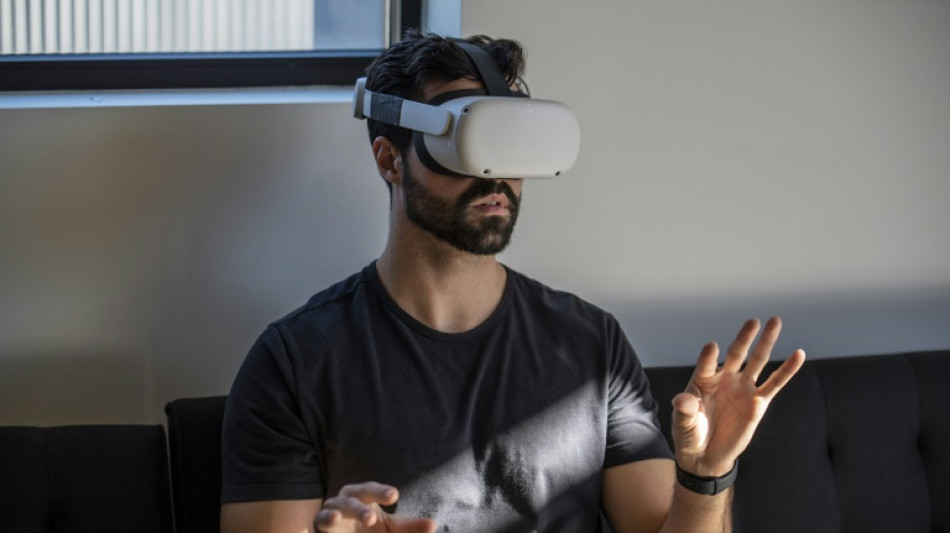
Telework in metaverse precursors already a reality

 ستاندرد آند بورز تثبت تصنيف السعودية عند A+

 Lights out in Laos as electricity exports surge

 Steven Strogatz weighs AI mathematics advances and their consequences for researchers

 Anthropic boss calls for AI slowdown, Altman and Musk agree

 French IT giant Capgemini sells subsidiary after row over ICE links

 Quebec Brokerage Qubit Insurance Announces New Data on Coverage Shortfalls as Rebuilding Costs Rise

 Lady Gaga welcomes first child with fiance: US media

 Bhutan business bets on hazelnuts for farming future

 'Widow's Bay' and 'The Pitt' are favorites for Emmys night

 Coastal erosion forces cancellation of California music festival

 Argentina's Dirty War rears its head in Venice film

 UK lawmakers throw out bill to legalise assisted dying

 US inflation steady in August, fueling Fed rate hike expectations

 New York marks 25th anniversary of 9/11 attacks

 Nepal flood reconstruction bill to be $4.78 bn: foreign ministry

 JUMO and Standard Bank launch Social Finance Framework to scale inclusive finance in Africa

 Doomsday tech: could AI really kill us all?

 French comedy show 'Call my agent' makes film comeback

 It's all coming back: Celine Dion fans gear up for Paris return

 Researchers eye AI revolution in natural disaster forecasts

 US braces for inflation report that may push Fed to hike rates

 Musk threatens legal action over documentary

 Latin America fact-check group asks Meta not to replace verification practice

 AI Risks to Enter 60–80% of Liability and Cyber Insurance Underwriting by 2028, ScienceSoft Predicts

 Tribal Launches Campfire, Letting Business and Technical Teams Build on Salesforce Together

Depending on his mood, Jeff Weiser settles down to work in a Parisian cafe, a mysterious cave or high above the Earth, thanks to the budding metaverse.
Weiser lives in the midwestern US state of Ohio but his workplace is in a faux realm accessed using virtual reality head gear.
While still the stuff of science fiction for most people, forerunners of the metaverse vision for the internet's future are already de rigueur for handfuls of people beyond the gamer and techno-hipster crowds.
Weiser, founder of a translation start-up, spends 25 to 35 hours each week working with Oculus VR gear on his head in his home in the city of Cincinnati.
A VR application called "Immersed" lets him synch screens such as his computer and smartphone to his virtual world, shutting out distractions around him at home.
Along with "increased focus," the ergonomics are "perfect," Weiser said. Display screens hover where they are easily seen and can be changed to any size.
Weiser taps on his keyboard without seeing it, and appears from the outside to be speaking to himself.
But in his virtual world, he interacts with avatars of colleagues as far away as Argentina and Ireland.
The pandemic boosted use of telework technologies that make it possible for colleagues to collaborate as teams despite being in different locations.
The Holy Grail is to replicate the kind of personal contact possible in offices.
- Persistence -
Florent Crivello co-founded Teamflow, a startup that tailors software for workers to collaborate virtually from their computers.
"We are building the metaverse for work," Crivello said, who added VR headsets aren't quite ready for "prime time".
"All of our collaboration tools are still on desktop; we want to meet people where they are."
Teamflow virtual offices look like on-screen game boards with meeting rooms, sofas and more.
Workers are represented by round icons that feature their picture, or live video of their face, and can initiate chats with colleagues by moving their "pawn" close to that of a co-worker.
If the person virtually approached has a microphone hooked up, they can automatically hear each other like they would be able to in real life.
Key to the experience is "persistence," the fact that the virtual environment exists whether a particular worker is in it or not, said Crivello.
"That's a defining characteristic," he noted.
For example, Teamflow users who "write" on a virtual white board in a faux meeting room will find it there when they return the next day.
About 1,000 people use the Teamflow app every workday.
VR app "Immersed", for its part, said it has won tens of thousands of users after a difficult period at the end of 2019, when the company almost disappeared.
"The adoption curve was in the disillusioned phase, it was the bottom of the valley and we ran out of money," said Immersed co-founder Renji Bijoy.
"When I told my team that they could go look for jobs, all seven of them said unanimously, 'We're not going anywhere.'"
- Too unreal? -
The pandemic fueled a trend to remote work, reviving investor interest in startups innovating in the sector.
At the same time, VR itself gained momentum, thanks to investments by Facebook-parent Meta in its Oculus unit and the metaverse overall.
"We are trying to build a world where anyone could live anywhere and put on a pair of glasses and feel like they're actually teleporting to their virtual office," Bijoy said.
Missing links, for Bijoy, include lifelike avatars instead of cartoonish animated characters, and body tracking that lets movements or gestures be replicated in virtual worlds.
"It's not that far away," Bijoy said of such technology, expecting to see it "much sooner than five years".
Some users fear that working in VR will be misinterpreted or misunderstood and would rather stay anonymous, like one graphic designer from New York, who used to spend six hours a day working from immersed during the pandemic.
He customized his Oculus headset for comfort, and built his own room in "Immersed", a virtual reproduction of his favorite library complete with rustling pages and soft footsteps.
The New York resident told of his productivity soaring but his health suffering.
He forgot to take breaks, losing track of place and time.
"I would take the headset off and it was kind of jarring, it was just a bit of like a slap in the face, being back in reality," this man said.
A blood test showed he was low on Vitamin D, and he suspected part of the cause was spending so much time out of the sun and in virtual reality.
"I just stopped using it," the designer said. "I don't think that it's healthy to replace reality with virtual reality."
St.Ch.Baker--CPN