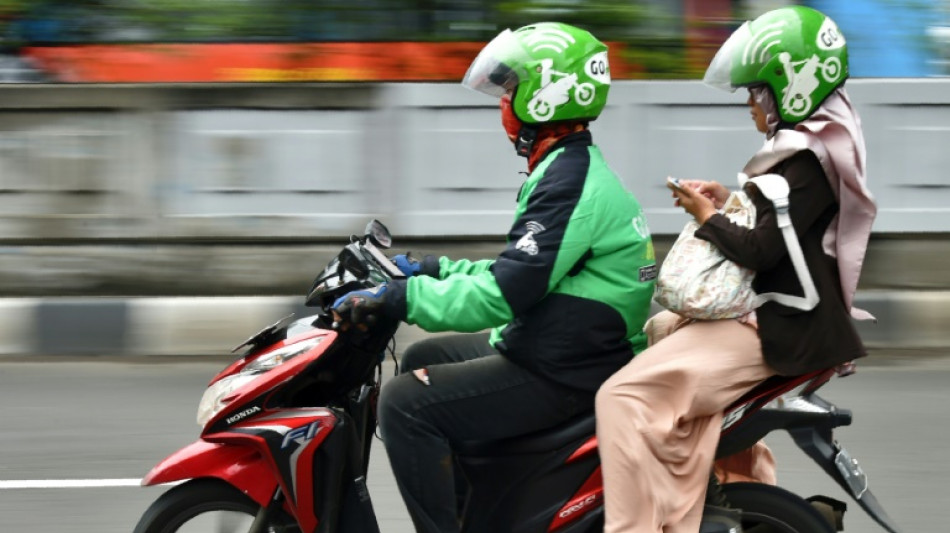
Indonesian gig drivers fear hardship after fuel price hike / Photo: Bay ISMOYO - AFP

 Samsung logs record quarterly profits despite investor AI jitters

 Shares in Google owner Alphabet plummet on profit miss, ad slowdown

 US Fed holds interest rates steady despite 'too high' inflation

 Airbus aims for record deliveries despite disappointing quarter

 Real Madrid, La Liga apology over Mbappe shows power of Chinese market

 'Cruise for life' strands passengers in Cambodia as operator goes bust

 Canada hikes rates to contain oil price surge caused by Iran war

 Nintendo producer 'all nervous' as Zelda classic remake hits shelves

 Three killed by storm in southern India

 Two hundred 'Cruise for life' passengers stranded in Cambodia

 Billionaire Ambani's Jio jumps 21% in market debut after record India IPO
Sitting on the side of a Jakarta road anxiously waiting for his phone to ping, driver Muhammad Ridwan says it is now barely worth hurtling through thick smog every day to ferry passengers.
A 30 percent hike in fuel prices spurred hundreds of drivers of the most popular ride-hailing apps to hold protests across Indonesia as they struggle to make ends meet.
"I sometimes don't eat a proper meal the whole day to allocate my cash for fuel. If I don't have fuel, how can I work?," asked Ridwan, a contractor for Gojek -- which alongside Singapore's Grab is among Asia's most valuable start-ups.
The drivers operate in an unregulated market and critics say the firms exploit them as "partners" or contractors, taking large cuts of their daily income.
To cut Indonesia's deficit during rising global inflation and soaring energy prices due to the war in Ukraine, President Joko Widodo slashed fuel subsidies.
It pushed the price of Petralite -- Indonesia's cheapest fuel choice -- from about 7,650 rupiah (50 cents) to 10,000 (67 cents) per litre.
- 'Cannot accept' cost -
On-demand drivers say the two ride-hailing giants have only hiked fares slightly -- to the tune of 800 rupiah (5 cents) per kilometre -- to cover the additional costs.
Both Gojek and Grab told AFP they imposed a rate change in line with government regulation.
Gojek, which earlier this year merged with e-commerce platform Tokopedia in a multibillion-dollar deal, said the objective of the rate change was to "support driver partners".
Grab said it was "designed to protect and maintain our driver-partners' welfare".
They both declined to disclose the rate increase but union leaders said it fell short of drivers' expectations.
"Drivers across Indonesia cannot accept the fare adjustment," said Igun Wicaksono, who heads a union of more than 100,000 drivers.
On a good day, drivers can earn up to 150,000 rupiah ($10). But where a re-fuelling stop once cost 20,000 rupiah ($1.35), it can now cost up to 35,000 rupiah ($2.35).
Drivers sometimes have to refuel twice in a shift, leaving them with a threadbare profit.
- 'Don't just throw promises' -
More competition from cheaper delivery apps is adding further pressure on Gojek and Grab drivers, leading to fears they won't be able to provide for their families.
"It significantly burdens me whenever I buy fuel these days," said 38-year-old Grab driver Iwan Nur Akbar, who had waited an hour for an order to ping on his phone.
"Thankfully I can still afford food for my family as we regularly get rice from government schemes," he said.
The gig economy, with its complex rewards-based system, has been in the spotlight globally in recent years with workers in several countries holding protests against their tech employers.
Anger was already bubbling in Indonesia before the fuel price hike with claims of unfair practices and poor working conditions.
In July, one driver sewed his lips shut to signal how drivers' concerns on go unheard.
Gig drivers warn that the lack of action could result in mass protests across the country. So far, protests have been limited to a few hundred, and met with a huge deployment of around 8,000 police officers in Jakarta.
With Grab and Gojek accounting for more than four million drivers, that is a daunting prospect for the government.
"Don't just throw promises," said Gojek driver Saiful Ridwan, 38, referring to government assurances of help as he waited outside Jakarta's Pasar Senen wholesale market.
"Don't let poor people become poorer."
Ch.Lefebvre--CPN