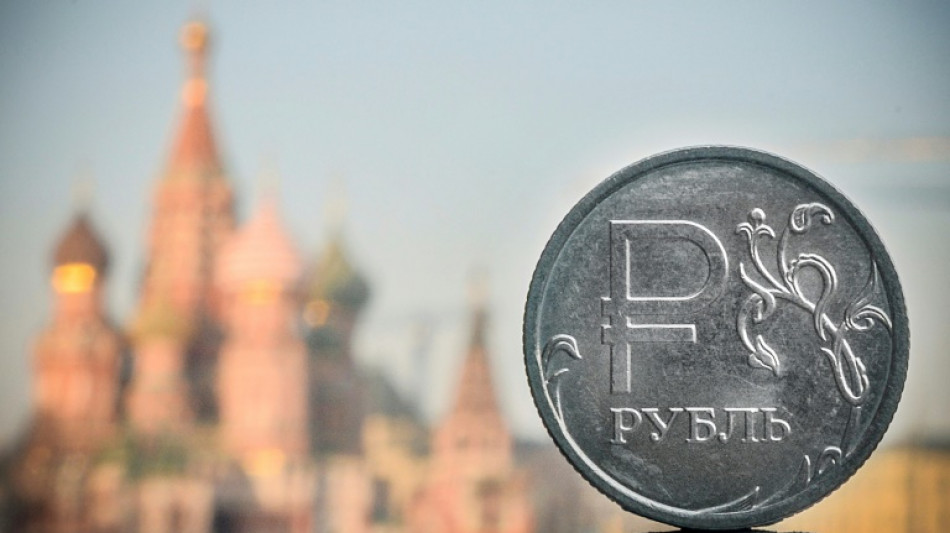
Auction to be held on Russia debt default insurance / Photo: Alexander NEMENOV - AFP/File

 Samsung logs record quarterly profits despite investor AI jitters

 Shares in Google owner Alphabet plummet on profit miss, ad slowdown

 US Fed holds interest rates steady despite 'too high' inflation

 Airbus aims for record deliveries despite disappointing quarter

 Real Madrid, La Liga apology over Mbappe shows power of Chinese market

 'Cruise for life' strands passengers in Cambodia as operator goes bust

 Canada hikes rates to contain oil price surge caused by Iran war

 Nintendo producer 'all nervous' as Zelda classic remake hits shelves

 Three killed by storm in southern India

 Two hundred 'Cruise for life' passengers stranded in Cambodia

 Billionaire Ambani's Jio jumps 21% in market debut after record India IPO
An auction to pay out insurance on Russia's unpaid debt was due to take place on Monday, an event formally marking the sanctions-hit country's first foreign default in more than a century.
Moscow was unable to transfer funds to creditors in June due to Western sanctions over its invasion of Ukraine.
The failure to pay its debt kicked off a complicated process to compensate investors who bought credit default swaps (CDS), a sort of insurance that bondholders purchase to protect against default by borrowers.
But the auction was repeatedly delayed as organisers had to ensure that the sanctions would not block the CDS payouts.
The country last defaulted on its foreign debt in 1918, when Bolshevik revolution leader Vladimir Lenin refused to recognise the massive debts of the deposed tsar's regime.
Russia defaulted on domestic debt in 1998 when, due to a drop in commodity prices, it faced a financial squeeze that prevented it from propping up the ruble and paying off debts that accumulated during the first war in Chechnya.
The latest default follows a series of unprecedented Western sanctions that have isolated Russia from the global financial system, including a freeze on Moscow's $300 billion in foreign currency reserves held abroad.
Russia lost the last avenue to service its foreign-currency loans after the United States removed an exemption in May that had allowed US investors to receive Moscow's payments.
Russian authorities have insisted throughout that they have the funds to honour the country's debt, calling the predicament a "farce" and accusing the West of pushing an "artificial" default.
Moscow's foreign currency debt is relatively low, at around $40 billion.
But the sanctions prevented it from paying bond holders in June.
- 'Credit event' -
International ratings agencies, the institutions that decide whether are country is in default, were unable to officially declare whether Russia was in default due to sanctions prohibiting them from covering Moscow's debt.
But Moody's ratings agency released a less formal "issuer comment" saying missed payments on interest totalling $100 million amounted to a default.
The official ruling was therefore left in the hands of a little-known panel of investors, the Credit Derivatives Determinations Committee (CDDC), which organises CDS auctions.
In late June, the London-based CDDC -- made up of 15 leading banks and financial firms -- declared that Russia's missed payment constituted a "credit event".
CDS auctions are usually held around 30 days after the committee declares a credit event, but doubts over whether the sanctions allowed the process to take place caused the three-month delay.
Foreign investors are no longer able to trade Russian bonds, and the auctions are essentially transactions involving such assets.
But the US Treasury Department issued a waiver in July to allow the auction on eight Russian bonds to take place this month.
JPMorgan, the investment firm, says the CDS against Russian default are worth almost $2.4 billion.
The auction takes place in two stages. The first stage will set an initial price on the eight bonds, which will serve as a base to fix the final price for compensation in a second stage open more widely to investors.
The CDDC said the settlement dates for the auction could be slightly delayed due to a bank holiday for the funeral of Queen Elizabeth II on September 19.
P.Kolisnyk--CPN