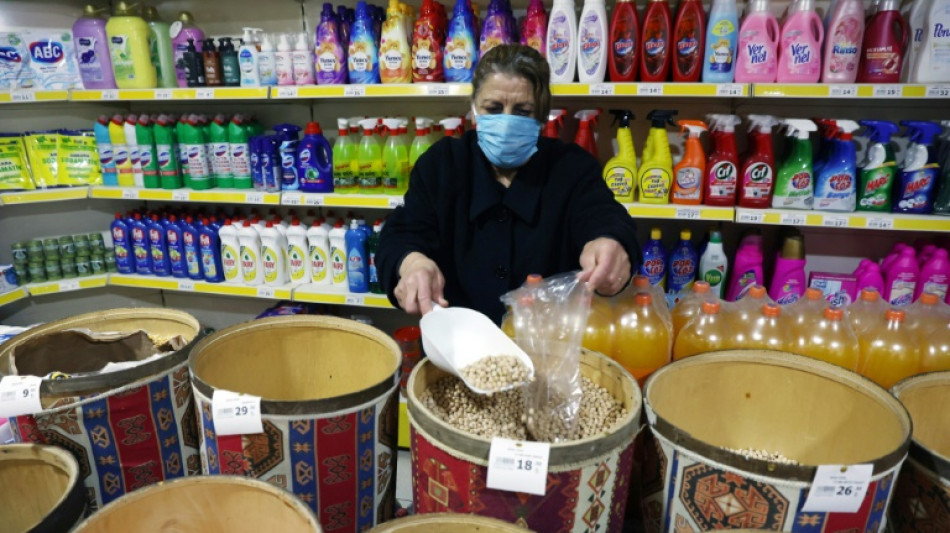
High energy prices put more pressure on Turks

 ستاندرد آند بورز تثبت تصنيف السعودية عند A+

 Lights out in Laos as electricity exports surge

 Steven Strogatz weighs AI mathematics advances and their consequences for researchers

 Anthropic boss calls for AI slowdown, Altman and Musk agree

 French IT giant Capgemini sells subsidiary after row over ICE links

 Quebec Brokerage Qubit Insurance Announces New Data on Coverage Shortfalls as Rebuilding Costs Rise

 Lady Gaga welcomes first child with fiance: US media

 Bhutan business bets on hazelnuts for farming future

 'Widow's Bay' and 'The Pitt' are favorites for Emmys night

 Coastal erosion forces cancellation of California music festival

 Argentina's Dirty War rears its head in Venice film

 UK lawmakers throw out bill to legalise assisted dying

 US inflation steady in August, fueling Fed rate hike expectations

 New York marks 25th anniversary of 9/11 attacks

 Nepal flood reconstruction bill to be $4.78 bn: foreign ministry

 JUMO and Standard Bank launch Social Finance Framework to scale inclusive finance in Africa

 Doomsday tech: could AI really kill us all?

 French comedy show 'Call my agent' makes film comeback

 It's all coming back: Celine Dion fans gear up for Paris return

 Researchers eye AI revolution in natural disaster forecasts

 US braces for inflation report that may push Fed to hike rates

 Musk threatens legal action over documentary

 Latin America fact-check group asks Meta not to replace verification practice

 AI Risks to Enter 60–80% of Liability and Cyber Insurance Underwriting by 2028, ScienceSoft Predicts

 Tribal Launches Campfire, Letting Business and Technical Teams Build on Salesforce Together

When temperatures plunged well below freezing in Ankara and energy prices soared, Dondu Isler had to make a tough choice to both stay warm and keep her soaring utility bills down.
She turned off the heating in two bedrooms of her apartment.
"Only the living room and the kitchen were heated, but at a minimum. We try to keep warm with blankets," the 61-year-old woman said.
Energy prices in Turkey and other countries have soared in the past year due to recovering demand and geopolitical tensions.
But Turks have also seen their overall purchasing power dwindle dramatically amid a currency crisis and two-decade high inflation that reached almost 50 percent last month.
Isler and her husband do not know how they will pay their bills, rent and food in the future.
Their only income is the meagre retirement benefits -- worth 2,400 Turkish liras ($177) a month -- earned by her husband, who worked as a construction site guard.
They paid 380 liras for electricity and gas in December. Their January bills more than doubled to 960 liras.
Other Turks face the same problem as electricity bills soared between 52 percent and 127 percent in January, depending on consumption.
Adding gas, many Turks have found themselves with bills that have doubled or tripled.
Some bars now even add an extra charge of four liras (29 cents) to customers who drink on heated terraces.
The currency crisis came last year after President Recep Tayyip Erdogan put pressure on the central bank to cut the main interest rate despite rampant inflation -- the opposite of conventional economic thinking to fight off rising prices.
The lira lost 44 percent of its value against the dollar last year as Turks rushed to buy gold and foreign currency.
Many Turks have fallen below the poverty line, which stands at $4.3 per day.
- Breakfast is a 'luxury'-
Inflation has become a sensitive subject in Turkey, less than 18 months before a general election during which the rising cost of living will likely dominate.
The opposition accused the state statistics agency of underestimating the rate of inflation and independent Turkish economists said consumer prices reached over 110 percent in January.
Hacer Foggo, founder of the Deep Poverty Network NGO, said record inflation was impoverishing every segment of society.
"Several families have been forced to drastically cut the amount they spend on food. Breakfast foods like eggs, cheese and olives have become luxuries," she said.
Once relatively resistant to crises, the middle class is now also under pressure.
"They've seen their rent double or triple, and they're forced to look for small homes or in areas further away from the city centre," Foggo told AFP.
But the consequences for the poorest are more dramatic since they can no longer count on financial assistance from their friends or family.
"We believe 160,000 children and young people have dropped out of school in 2021. I personally know several of the families helped by our NGO," she said.
"Some feel obliged to contribute to the family income and leave school to work. Others leave school because they cannot pay for transport or other expenses."
With sharp increases in food including basic goods and baby formula, which has risen by 55.6 percent, malnutrition is now a serious risk for children, Foggo warned.
Some mothers are forced to "give their babies dehydrated soups" instead of formula, she added.
Ali Golpinar, a village chief in a less affluent district in Ankara, has raised funds for the poorest in his neighbourhood for years.
"But we are struggling to raise money because no one has the means to participate," he said.
- Energy bill triples -
Even the association he created where local women can take part in sewing, cooking or jewellery design workshops for free has been affected by higher energy prices.
"Our electricity bill was 93 liras in December. After the price increase, it rose to 348 liras with the same amount consumed," Golpinar said.
Electricity companies cut power off from many residents' homes after they could not pay their bills, he added.
From Mugla in southwestern Turkey to Dogubeyazit in the east, the tripling of energy bills has provoked anger across the country where protests have sprung. More are planned next weekend in Istanbul.
But Erdogan senses the danger. His spokesman, Ibrahim Kalin, on Monday promised to take measures: "We won't let our citizens be crushed by inflation."
Y.Ponomarenko--CPN