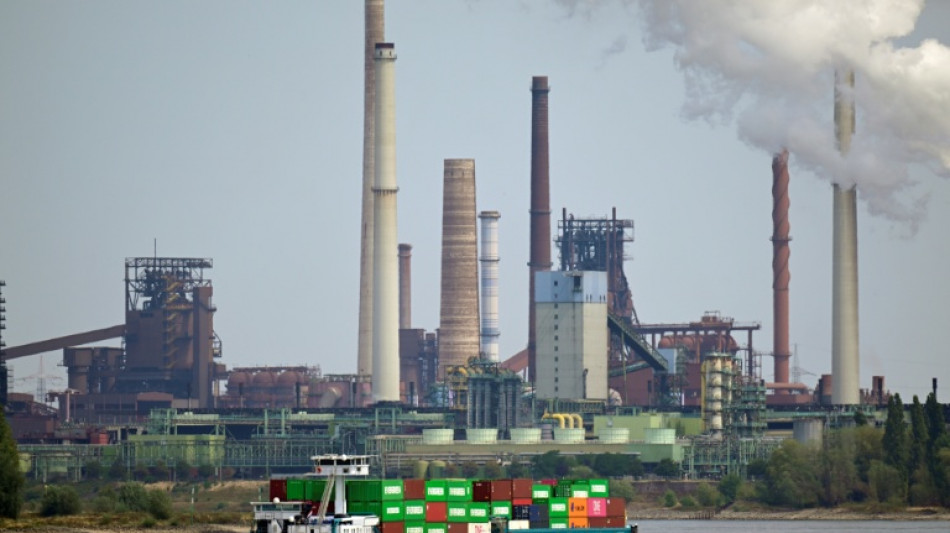
German growth prospects brighten as economy defies Mideast turmoil / Photo: Ina FASSBENDER - AFP/File

 Three killed by storm in southern India

 Two hundred 'Cruise for life' passengers stranded in Cambodia

 Billionaire Ambani's Jio jumps 21% in market debut after record India IPO

 Sri Lanka's Tamil farmers fight to reclaim land after civil war

 'They don't care about us': Trump food aid cuts leave Americans struggling and angry

 Palestinian activist Khalil returns to Columbia after US detention

 Youths testify about 'despair' in unprecedented Canadian climate trial

 Storied Paris department store seeks bankruptcy protection

 Boeing shares tumble after it releases cautious growth forecast

 Boeing reports smaller loss as it aims for stable output growth

 Dangote, Nigeria's oil tycoon rewriting Africa's story

 Kane says Ballon d'Or win 'feels like a dream' as tributes pour in

 Mercedes-Benz cuts 2026 profit outlook on tough China market
German growth this year is set to come in stronger than previously estimated, leading research institutes said Thursday, as Europe's biggest economy withstands the fallout from the Middle East war.
The surge in energy costs unleashed by the conflict had been expected to deal a hefty blow to Germany, putting the brakes on an economic rebound driven by higher public spending.
But the turmoil has had less of an impact than feared, with Germany's energy supplies more diversified than in the past and its companies weathering the shock better than rivals, particularly in Asia.
The Ifo institute now expects growth of 1.4 percent for 2026, up 0.6 percentage points from its forecast in June.
The Kiel Institute and RWI-Leibniz Institute for Economic Research have both raised their full-year forecasts to 1.3 percent, up 0.5 percentage points.
"Significant impetus from abroad and increased spending on infrastructure, climate and defence in Germany are preventing a more severe economic slowdown due to the energy price shock and low water levels in rivers," said Timo Wollmershaeuser, head of forecasts at Ifo.
"There are rays of hope, especially for the crisis-stricken industry sector," he said.
Historically low water levels on major rivers in Germany this summer have also weighed on industries, such as chemicals and steel-making, that transport goods by boat.
Growth rates in the first half of the year have come in better than expected while a string of recent indicators, from factory output to exports and business confidence, have been ticking up.
After several years of stagnation, hopes had been high the eurozone's traditional growth engine would rebound this year thanks to a spending blitz unleashed by Chancellor Friedrich Merz.
This fiscal stimulus, along with healthy demand for exports, were helping to boost economic expectations while the "dampening effects" of the energy shock were weaker than expected, the Ifo institute said.
Still, the Kiel Institute cautioned that "the recovery remains fragile".
"The war in Iran continues to pose downside risks, while the additional fiscal stimulus will fade in the years ahead," it said.
Economists also warn that deep-rooted problems such as an ageing population and complex bureaucracy will continue to hold the economy back.
Ch.Lefebvre--CPN
