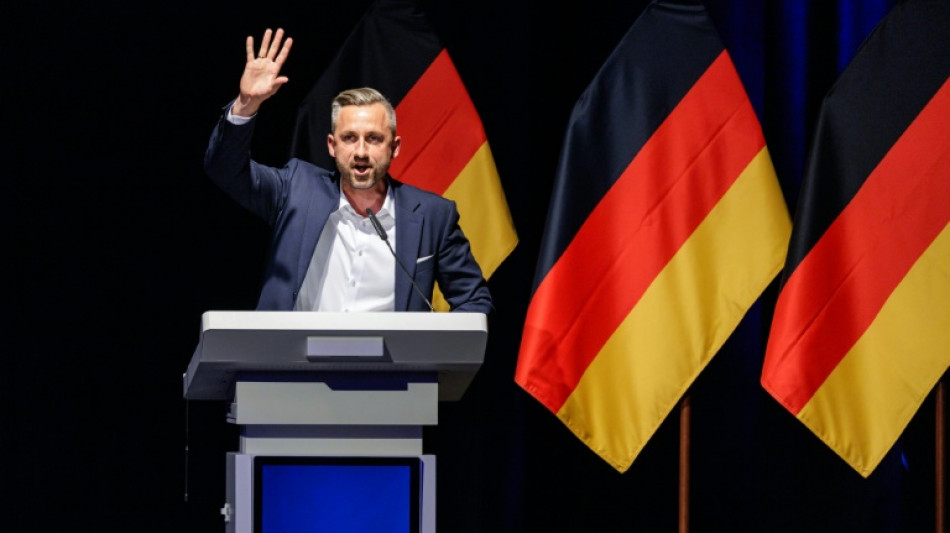
Germany's far-right AfD promises 'boom' but economists fear worst / Photo: Jens SCHLÜTER - AFP

 Three killed by storm in southern India

 Two hundred 'Cruise for life' passengers stranded in Cambodia

 Billionaire Ambani's Jio jumps 21% in market debut after record India IPO

 Sri Lanka's Tamil farmers fight to reclaim land after civil war

 'They don't care about us': Trump food aid cuts leave Americans struggling and angry

 Palestinian activist Khalil returns to Columbia after US detention

 Youths testify about 'despair' in unprecedented Canadian climate trial

 Storied Paris department store seeks bankruptcy protection
 Boeing shares tumble after it releases cautious growth forecast
 Boeing reports smaller loss as it aims for stable output growth

 Dangote, Nigeria's oil tycoon rewriting Africa's story

 Kane says Ballon d'Or win 'feels like a dream' as tributes pour in

 Mercedes-Benz cuts 2026 profit outlook on tough China market
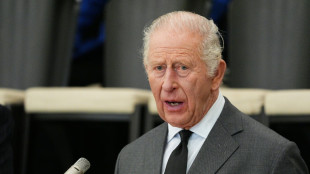
Germany's far-right AfD has promised an "economic boom" if it wins Sunday's regional elections and ends up ruling the eastern state of Saxony-Anhalt, but economists warn their policies would spell disaster.
The Alternative for Germany wants to make the ex-communist region a test case for its key ideas -- including deporting irregular migrants and reversing a rapid buildup of renewable energy.
Economists warn that deterring foreign workers through xenophobic rhetoric would only accelerate a skilled labour shortage in the state whose population is already greying and shrinking.
Ahead of Sunday's vote, the AfD has polled at over 40 percent, harnessing widespread discontent and anger at Berlin -- enough to easily win, and to possibly allow it to rule alone.
Chancellor Friedrich Merz has warned that the small state of 2.1 million people would be "considerably damaged" by a far-right government.
"I can't imagine that international investors will want to come to break ground at a new factory alongside an AfD state premier," said Merz, adding that "this is a decision that the voters have to take".
The AfD's top state candidate Ulrich Siegmund fired back on Welt TV, accusing Merz of presiding over the "deindustrialisation" of the top EU economy.
"We will see an economic boom here in Saxony-Anhalt under an AfD-led government," Siegmund promised. "New jobs will be created, and value creation will be driven forward."
The largely rural state has been a chemical industry centre since East German times, but many highly polluting and outdated factories were dismantled in the years after the 1989 fall of the Berlin Wall.
This initially sparked mass unemployment and population flight. The jobless rate surged above 20 percent and only started to come down from 2005 onward to around eight percent now.
The state now accounts for 1.8 percent of Germany's economic output. Last year, its nominal GDP per capita was 38,452 euros ($44,580), the lowest of all German states.
Siegmund argued an AfD government would actually attract big companies by offering them "long-term planning certainty free from climate mandates or quota requirements".
This would help swish money into public coffers through tax revenues, he said, "allowing us to provide tax relief on the one hand while finally making sensible investments on the other".
- Shrinking population -
The AfD in Saxony-Anhalt is promising extensive new social benefits -- including baby bonuses to encourage German couples to have children -- while promising no new taxes and no new debt.
The Leibniz Institute for Economic Research in Halle compared the costs and funding sources in the AfD manifesto and calculated a "massive funding gap" of at least 2.2 billion euros per year.
Therefore the plans are "irrelevant in terms of economic policy", the institute's president Reint Gropp told AFP, predicting that they "will not be implemented".
Gropp said the "truly critical point" however was the AfD's "misguided ethno-nationalist idea that they don't want any foreigners in Saxony-Anhalt and that everything will then improve."
"Nursing staff, doctors, construction workers -- many would consider working elsewhere instead," he said.
The state's population -- which fell sharply after German reunification in 1990 -- is projected to shrink by another 15 percent by 2040 compared to 2022.
The climate-sceptic AfD also wants to halt the expansion of wind power and restrict new solar installations -- which together now produce more than 60 percent of the state's electricity.
Reversing course on clean renewables, and boosting coal again would be "completely counterproductive" according to Gropp.
The German Institute for Economic Research has meanwhile estimated the nationwide consequences if the AfD were to implement its promises, including a German withdrawal from the EU and the euro.
Its president Marcel Fratzscher predicted a "shock" that would batter growth and paradoxically hit the hardest in regions with the strongest AfD support.
People in Saxony-Anhalt would "lose around 1,600 euros in annual per capita income on average," he wrote.
"In addition, around 10,000 jobs could be lost."
X.Wong--CPN
