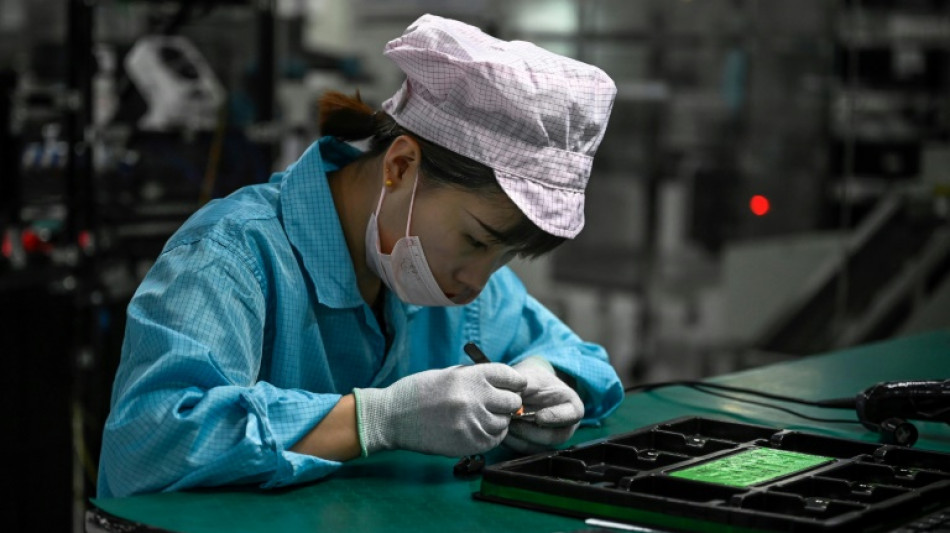
China state support for economy this year exceeds 2020, premier says / Photo: Jade GAO - AFP/File

 Samsung logs record quarterly profits despite investor AI jitters

 Shares in Google owner Alphabet plummet on profit miss, ad slowdown

 US Fed holds interest rates steady despite 'too high' inflation

 Airbus aims for record deliveries despite disappointing quarter

 Real Madrid, La Liga apology over Mbappe shows power of Chinese market

 'Cruise for life' strands passengers in Cambodia as operator goes bust

 Canada hikes rates to contain oil price surge caused by Iran war

 Nintendo producer 'all nervous' as Zelda classic remake hits shelves

 Three killed by storm in southern India

 Two hundred 'Cruise for life' passengers stranded in Cambodia

 Billionaire Ambani's Jio jumps 21% in market debut after record India IPO
State support for China's economy this year is now greater than it was in 2020, Beijing's premier has said, surpassing help given at the height of the coronavirus pandemic as the country grapples with the impacts of its zero-Covid policy and a property sector crisis.
Economists have widely predicted that China will fail to meet its 5.5 percent GDP growth target, blaming record youth unemployment, ballooning developer debt and manufacturing disruptions from frequent Covid lockdowns.
"In response to new challenges, (we have) decisively launched a package of policies to stabilise the economy. Their strength surpasses those of 2020," Premier Li Keqiang said during a Monday State Council conference.
China's economy has also been battered by the two-month lockdown of Shanghai, a nationwide mortgage boycott, and a severe drought and heatwave which shut down manufacturing hubs and severely impacted the agricultural sector.
The grim economic outlook underscores the difficulty of balancing economic growth with the country's strict zero-Covid policy, with targeted lockdowns, travel restrictions and mass testing depleting fiscal revenues and causing disruption to everyday life.
Li hinted at this fact earlier in August, telling officials "the number of people in difficulty has seen an increase" due to the virus and recent natural disasters.
Real estate sales, a major economic driver, fell 22 percent in August, year on year, while new home prices have fallen for 11 months straight, according to data released earlier this month.
China's economic growth came in at just 0.4 percent on-year in the second quarter -- its slowest rate since the pandemic began in 2020.
Beijing has taken a number of steps to help revive its economy, including a ramping-up of infrastructure investment, tax credits and loan facilities for SMEs.
China's banks last week lowered their benchmark lending rates, including on mortgage loans, for the second time this year.
Beijing also announced last week that it would allow local governments to issue more bonds.
But Ting Lu, an analyst at Nomura, wrote these measures would likely not be "game changers" due to the continued zero-Covid policy and the persistent distress affecting the property sector.
Y.Ponomarenko--CPN