Once a top export, prized Kashmir carpet fades / Photo: Tauseef MUSTAFA - AFP

 Once a top export, prized Kashmir carpet fades

 Search for missing after Nepal-Tibet floods kill 165

 'Be more honest': Markets crave clarity from cryptic Fed chair

 Meta, US states agree $18 bn settlement in landmark teen safety case

 How we might hear new Dolly Parton music in the future

 Canada renews push to boycott US products

 Stocks mixed as oil drops, US inflation stays high

 How narwhal 'scientists' track Arctic warming

 Rent TRON Energy and Reduce USDT Fees : TronBid Expands Marketplace

 Prince Harry and family arrive back in Britain: UK media

 Flags lowered across US for country music legend Dolly Parton
 With ropes and chants, thousands move Japanese castle
 Fire haze threatens health of millions in Indonesia, ministry warns

 'Our patron saint': Tennesseans mourn local hero Dolly Parton

 Drought-hit Danube gives way to fossil hunt in Bulgaria

 Julia Curlee, CIA officer fired by White House for being transgender

 Meta knew teen safety tools were ineffective, witnesses testify

 Dolly Parton: Country music's dolled up but deserving queen

 Volkswagen workers boo boss during speech on job cuts

 Volkswagen boss braces German workers for more job cuts

 The summer climate change became scorching reality for Europe

 Blockchain Infrastructure Firm tZERO Integrates with Sui for Institutional-Grade Digital Asset Securities
 Curling attracts curious Romans under Colosseum's shadow

 MEXC Kicks Off MOVE Carnival With 0-Fee Trading and 1M USDT in Rewards

 Son of Luxottica founder quits after succession row
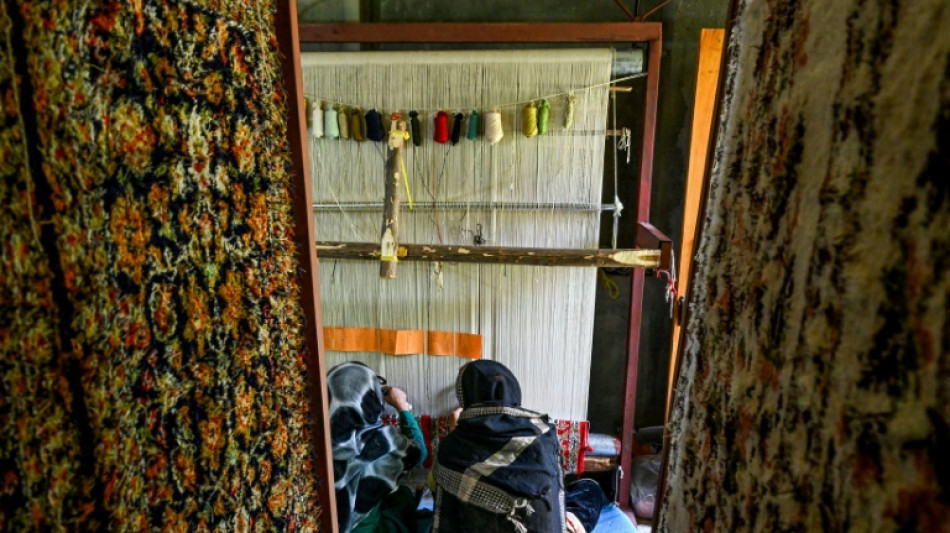
It has survived wars and upheavals, but the famed handwoven Kashmir carpet industry is now battling a steady decline as younger generations abandon the painstaking craft.
Masterpieces woven from mulberry silk or pure sheep wool by artisans have adorned imperial courts, museums and luxury homes across the world over the centuries.
The hand-spun yarn dyed in natural colours is woven on handlooms, packing in between 300 and several thousand knots per square inch, depending on the intricacy of the design.
Until the 1980s, carpets were Kashmir's top export, but volumes have since steadily declined, with wars in Ukraine and the Middle East the latest blows to the trade.
"It hurts me to see this," weaver Bashir Ahmad, 78, told AFP.
"If more young people had taken up this craft, they could have made a living from it."
But the long hours, low wages and changing aspirations have made the profession less attractive to younger Kashmiris.
A master weaver today earns only around 500 rupees ($5) a day, less than many unskilled labourers.
"There are no government jobs for everyone, and my child, or anyone else's child, could have taken up this work and tried to make a career out of it," said Ahmad.
"But things are no longer the same."
- Modern looms -
As they craft, artisans chant aloud the design code handwritten on a strip of paper known as talim -- shorthand of ancient symbols for numbers and colours -- knotting the threads string by string.
Depending upon the size and design of the carpet, a piece can take a group of artisans up to a year to weave. They can fetch $20,000 in the international market.
The art of fine carpet weaving was introduced in the Himalayan valley of Kashmir in the 15th century by Persian travellers, and received patronage during the reign of its last local king Zain-ul-Abidin Budshah.
The handicraft flourished in Srinagar and later spread to other towns and villages across Indian-administered Kashmir.
Despite the decline in volume of work, some weavers are determined to carry on with the beloved tradition.
"As long as I have the strength and the days ahead of me, I will continue doing this work," said Mushtaq Ahmad, 75, who has been weaving carpets for 50 years.
Industry estimates suggest the sector employs around 30,000 people, down sharply from hundreds of thousands three decades ago.
Officials say efforts are underway to modernise the sector and attract new workers.
"As part of those efforts, we are providing modern carpet looms free of cost," said Zubair Ahmad, director of the Indian Institute of Carpet Technology in Srinagar.
The government has also introduced "geographical indication" tags that help distinguish genuine Kashmiri carpets from cheap imitations.
"The idea is to ensure their authenticity because there was a trust deficit between buyers and sellers," director Ahmad said.
Ng.A.Adebayo--CPN