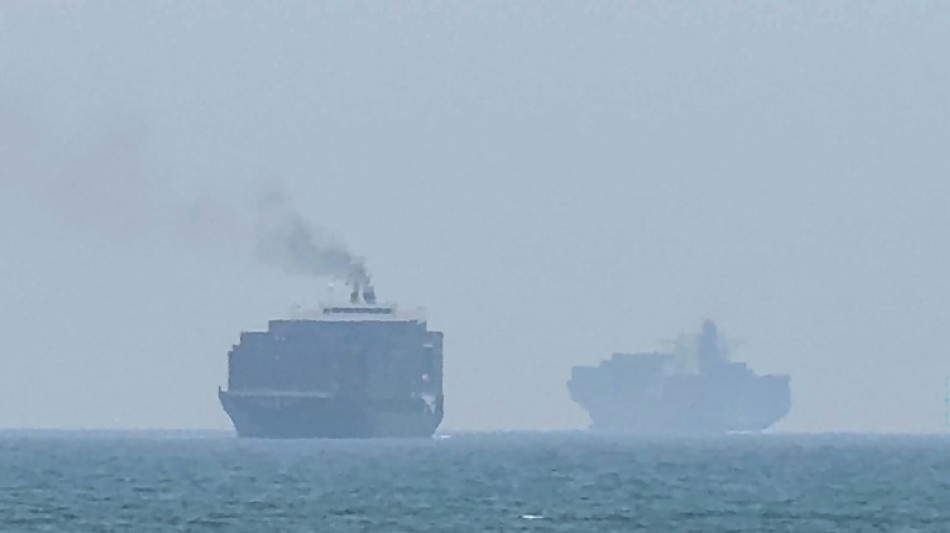
Six months into Iran war, Hormuz traffic way down, sailors stranded / Photo: - - AFP/File

 Six months into Iran war, Hormuz traffic way down, sailors stranded

 Cool Japan: Human fridge chills workers in extreme heat

 Tornado tears through French village, dozens injured

 French tourist dies after getting stuck in scorching Death Valley

 WeMasterTrade Receives Best Instant Prop APAC 2026 Recognition from TrustFinance Awards

 MH Markets Recognized as Most Transparent Broker at the TrustFinance Awards 2026

 Stocks, oil slip ahead of US threat of economic war against Iran

 Oil falls ahead of US plan for economic war on Iran

 IUX Launches New Education Webinar Series to Support Traders’ Financial Literacy

 'His feet are his pillars': Nepal para swimmer gives all for Asian glory

 India police used excessive force during protests: Amnesty
 Norwegian King Harald's health has 'deteriorated': palace

 Thousands expected at Sweden climate demo as election looms

 Prince Harry: royal misfit making unlikely UK return

 Blowing in the wind, humble balloon gets green makeover

 South Korea sends first container ship through Arctic route

 US, Canada fail to reach trade pact to avert Trump tariffs

 Odyssey effect: stars sell Greece to a new wave of US tourists
 Canadian negotiator says 'more work to do' on US trade deal

 One dead, three wounded after sword attack at Swedish high school

 Bolivia's Paz forced to fire economy minister in mid-crisis

 US, Canada work to wrap up trade deal ahead of looming deadline

 'Duck run' pest control catching on in S.Africa's winelands

 Trump announces temporary tariff relief on ground beef imports

 UK forecasts 'biggest' El Nino will smash records, spark hottest year

Six months since the start of the Middle East war, the strategic Strait of Hormuz remains largely paralysed, with thousands of sailors still stranded in the Gulf and commodity carrier traffic way below its normal level.
- Only a few transits per day -
Before Iran blocked the strait in response to joint US-Israeli strikes in February, around one fifth of the world's oil and liquefied natural gas exports passed through the waterway.
Iran's Guards have also warned of a "danger zone" covering 1,400 square kilometres where mines may be present.
After Iran closed the strait on March 1, commodity carrier traffic plummeted to an average of 10 transits per day, compared with a daily average of 95 in February, according to an AFP analysis of data from maritime tracker Kpler.
An agreement signed by the United States and Iran in June led to a temporary rebound to 36 transits per day, before they dropped back to an average of 15 between the resumption of hostilities on July 8 and August 22.
- New routes, 'dark' transits -
Before the war, vessels crossed the strait freely via a route through the centre of the waterway adopted by the International Maritime Organization (IMO).
There are now two distinct routes: one to the north, near the Iranian coast -- the only one approved by Tehran -- and another to the south, between the Omani coast and potentially mined areas.
During the relatively calm period between June 17 and July 7, an average of nine ships per day used the Iranian route and eight the Omani one. The rest transited via unidentified routes or the traditional IMO corridor.
Ever since the ceasefire collapsed on July 8, two-thirds of transits have become "dark", or unknown, compared with less than one percent before the war, according to Kpler.
These transits involve vessels whose exact route cannot be confirmed due to insufficient data stemming from disabled transponders, jammed signals or missing satellite imagery.
- Thousands of sailors stranded -
Some 6,000 sailors and 500 ships have remained stuck in the Gulf since the beginning of the conflict, the IMO told AFP.
The organisation said there were "ongoing discussions" to ensure a secure maritime route, adding that their outcome "depends on de-escalation in the region".
The IMO had begun an initiative in June to evacuate more than 11,000 seafarers stuck in the Gulf, but the effort was soon suspended following an attack on a vessel.
Over the past six months, at least 20 sailors and dockworkers have been killed in incidents or attacks in the region, according to the IMO.
H.Meyer--CPN