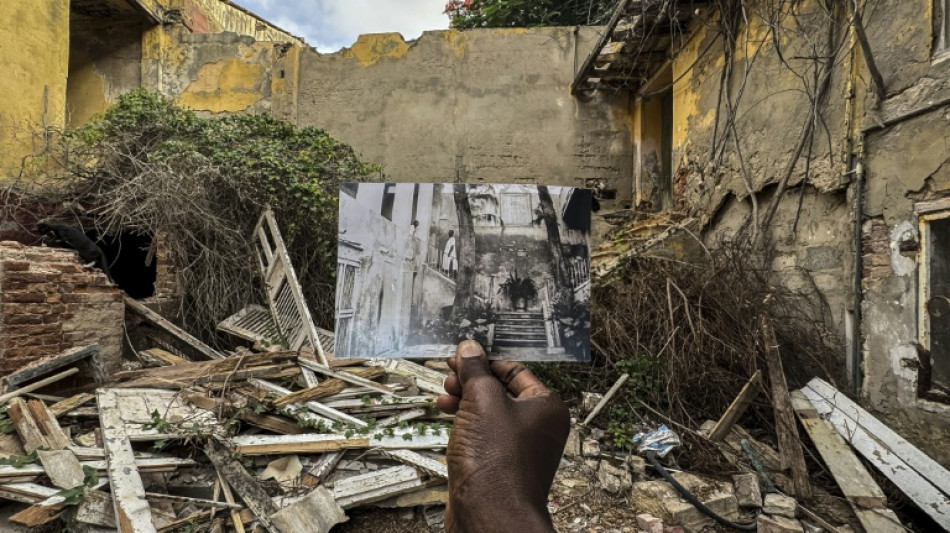
In Senegal's Saint-Louis, traces of slave-trading past fade away / Photo: PATRICK MEINHARDT - AFP

 PrimeXBT Expands Swap-Free Trading to PXTrader 2.0

 'It is tough': Indonesia battles wildfires, bracing for worse to come

 What property giant Evergrande's sentence means for China's economy
 US national debt exceeds $40 trillion for first time

 NASA satellite rescue mission fails

 PSG Ligue 1 opener moved over state of Parc des Princes pitch

 Lake Zurich sees water level hit record low amid drought

 Oldest human brain cells grown in lab 'recorded passage of time'

 Robots sort packages and serve fast food at Beijing showcase

 Europe can't afford to miss AI revolution: ECB chief

 Humanoid-maker Unitree surges more than 600% on Shanghai debut

 Southern African mothers plead for sons lured to Russia's war

 Freedom Holding Marks New Türkiye Milestone as Freedom Yatırım Secures Brokerage License

 Humanoid resources: China's robots search for workforce breakthrough

 China's robots open to opportunities in search of commercial breakthrough

 New Zealand blocks lawsuits against firms over climate harm

 NASA images reveal crater left by SpaceX rocket's Moon crash

 French producer Nicolas Altmayer, Dior PR chief Favier die in car crash

 How only a few tree species drive Amazon forest recovery

 Tribal Partners with ServiceNow to Empower Enterprise Teams to Build and Deploy Apps & Agents

 Fusion Markets Extends Negative Balance Protection to Clients Globally

 Beleaguered FIFA chief Infantino rids himself of critic Lamour

 Crude extends gains, most stocks drop as Mideast hopes dim

 A Viking longship in 'The Odyssey'? It's a case of history meets Hollywood

 Whales spark joy in New York but face threats from boat traffic

A dilapidated two-century-old building in Saint-Louis, Senegal bears testament to the island's little-known past as part of the transatlantic slave trade, the traces of which are quickly and quietly disappearing from view.
Located in the country's north, between the Atlantic Ocean and the Senegal River, the island is rarely mentioned in the history of the slave trade, even though it was a hub through which tens of thousands of Africans passed, according to historians interviewed by AFP.
Saint-Louis was France's first trading post in sub-Saharan Africa, established in 1659, and served as the former capital of the French colonial empire in west Africa.
It was also a holding point for captives, before shipment onward.
However, its role has been more muted compared to Senegal's famous Goree Island off Dakar, which has become a major symbol of the slave trade thanks to its House of Slaves historical site and museum.
One of the only explicit reminders of Saint-Louis's historical ties with slavery is a plaque on a building that housed a depot for enslaved people, facing the river.
"On the ground floor lie the remains of the only slave depot preserved in Saint-Louis," reads an inscription on the three-storey building.
- 'Dilapidated' -
"This dilapidated building is a slave depot that has survived," historian and teacher Mamadou Diallo told AFP, explaining that it had belonged to a Bordeaux-based trading company, Maurel and Prom, and was built between 1822 and 1825.
At least 10,000 enslaved people passed through Saint-Louis every year during the 18th century, he said.
Peak trade in Saint-Louis occurred during "high-water season, from May to November", drawing victims from the pre-colonial kingdom of Galam located between Senegal and Mali, historian Ibrahima Seck, director of research at the Whitney Plantation Slavery Museum in the US state of Louisiana, told AFP.
"Gold and captives were the primary commodities," alongside gum and ambergris, he said.
Maurel and Prom's holding areas contain five cells, Diallo said.
The building is overgrown with weeds and the interior is littered with debris, but it still has its original wooden ceiling. Today it is owned by a Senegalese family.
"There were many slave-holding facilities in Saint-Louis, especially in the northern part of the island, but they are no longer to be found," Diallo said, indicating that many have been converted and changed beyond recognition.
The governor's palace in the city also once housed slave depots, according to historians.
Colonial mansions line the island's grid-pattern streets -- buildings with balconies and cracked or crumbling walls, often with holes in the roofs.
Ancient trading houses along the river quays also served as depots although "the local population, unknowing, did not preserve them", writer and local expert Louis Camara said.
Those driving the trade were trading companies and their local intermediaries, most notably wealthy African or biracial women known as signares, who formed alliances or temporary marriages with European merchants and officers.
Saint-Louis was even the site of a 1779 slave revolt, in which captives who had been waiting 11 months to be transported to the Americas killed a French guard. Many of them were subsequently massacred, Diallo said.
Seck, from the Whitney Plantation Slavery Museum, said that according to "Atlas of the Transatlantic Slave Trade", a definitive reference on slavery deportations, some 145,000 captives were officially transported from Saint-Louis.
It is a place where "every old house was potentially a slave-holding facility", Seck said.
- 'Taboo subject' -
Joseph Ndiaye, the renowned curator of Goree Island's House of Slaves, championed the memory of the enslaved while playing a major role in preserving the island.
Saint-Louis, however, has lacked such a promoter.
Following the abolition of the slave trade in France's colonies and possessions in April 1848, "former captives, including those escaped from the interior, were resettled in 'freedom villages'" around the island, Seck said.
The history of the slave trade "is completely unknown to the majority of Saint-Louis residents who prefer to sweep it under the rug", Camara said.
Ghana, considered a hub of the transatlantic slave trade, hosted a first global conference in mid-June aimed at turning a recent UN resolution that recognised the transatlantic trade as "the gravest crime against humanity" into concrete commitments.
Yet, in Saint-Louis, the descendants of those involved in the trade and those who were enslaved mostly do not talk about it.
The topic remains "a taboo subject", Diallo said.
L.Peeters--CPN