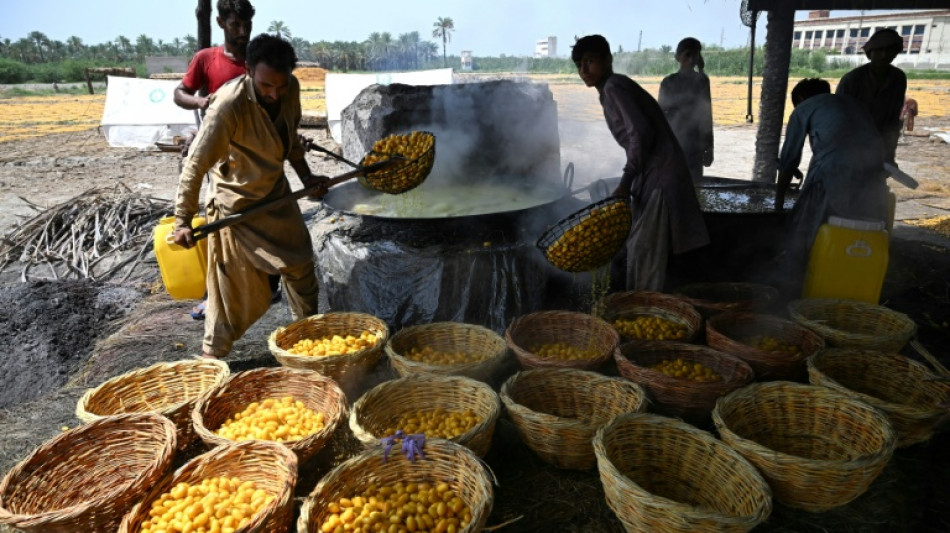
Pakistan's date workers toil through rising heat / Photo: Aamir QURESHI - AFP

 Billionaire Ambani's Jio soars in market debut after India's biggest IPO

 AI chip giant SK hynix posts seven-fold surge in quarterly operating profit

 S.African activists push back on data centre rush

 Billionaire Ambani's Jio to debut after record India IPO

 UK set for cautious budget as borrowing costs climb

 US Fed expected to hold rates steady ahead of key midterm elections

 AI chip giant SK hynix says quarterly operating profit soars 630%

 Charles tackles thorny legacy of slavery on Caribbean trip

 UN nuclear watchdog chief urges Iran to grant access

 Boeing releases cautious growth plan as shares fall sharply

 Tech firms gain on Anthropic IPO optimism; HSBC slumps in London

In blazing temperatures, Muhammad Idrees ladles boiled dates from a vat simmering over an open flame, work that labourers lament is getting hotter each year in Pakistan's southern Sindh province.
Date season arrives in July, when temperatures in Sindh regularly hit the mid-40 degrees Celsius.
Workers start before sunrise, and split the day into short shifts, but the heat soon catches up with them.
Their gruelling routine involves harvesting and boiling fruit picked from palms that line Khairpur district, which produces more than half the country's dates and supports thousands of farmers and seasonal labourers.
Idrees, who has worked the date harvest for more than a decade, said the heat has now become "unbearable."
Date labourers are one of many professions in agriculturally-dependent Pakistan that are becoming more difficult and dangerous as temperatures rise.
"It used to be less intense," Idrees told AFP as temperatures hit 42C.
Now "the heat is much harsher and the days are extremely hot. We fall ill because of it."
Multiple workers told AFP they often suffer heatstroke, fainting and fever.
"When the heat makes us sick, we go to the doctor for treatment and then return to work," Idrees added.
Pakistan is among the countries globally most vulnerable to climate change despite contributing less than one percent of global greenhouse gas emissions.
The country has experienced increasingly frequent heatwaves, erratic monsoon rains and devastating floods, including catastrophic 2022 floods that inundated around one-third of the country and displaced millions, hitting Sindh province particularly hard.
- Heat and harvest -
Workers descend on date farms to begin work around 2:00 am to avoid the worst of the daytime heat and take a break before continuing until the late evening.
Idrees said the physically demanding work earns him around 1,200 Pakistani rupees ($4) a day.
"We harvest the dates, load them onto trolleys and bring them here," he said.
"They are boiled over the fire and then spread outside in the sun to dry."
Pakistan, the world's fifth-largest date producer, normally earns more than $120 million a year in exports, according to industry estimates.
Date farmer Shahnawaz Phulpoto, who owns more than 1,500 palm trees, said that heavy monsoon rains from shifting weather patterns have hampered date crops and caused financial losses.
But for now the main challenge is the heat, he added, as the sun blazed overhead.
"The temperature rises every year," he told AFP.
"We are seeing the effects of climate change every year."
Y.Ponomarenko--CPN
