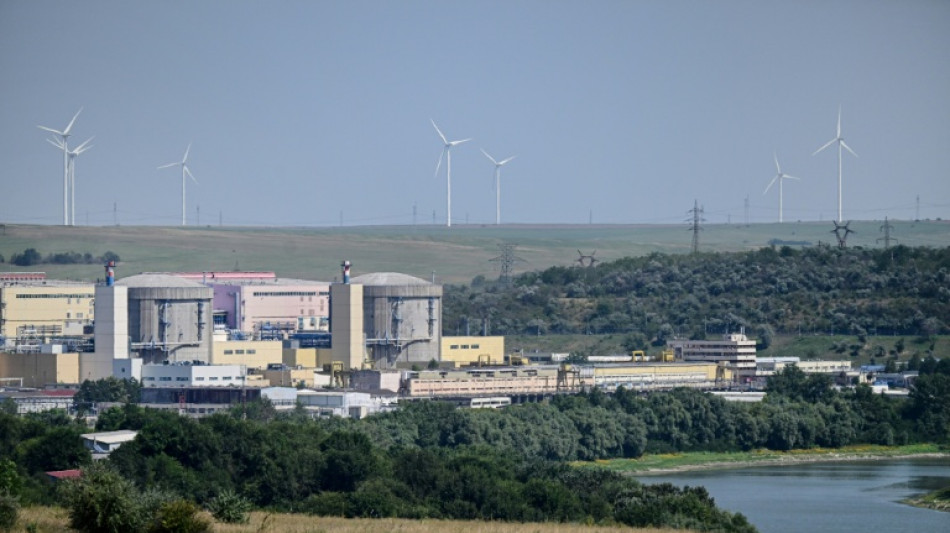
Romania shuts down nuclear plant as Danube drops / Photo: Daniel MIHAILESCU - AFP

 Kenya's economy faces climate change risks: World Bank

 SBCFX to Showcase Trading Innovation, Regional Growth Strategy, and Future Vision at iFX EXPO Asia 2026

 Maghreb sees demographic shift with fertility at historic low
 From Chinese AI to Global ETFs: STARTRADER Launches 45 New 24/7 Stock and ETF CFDs

 Seoul tech leads Asian stock gains as traders cheer US inflation

 Outflanked by AI, stars fade for South Korea's blind fortune-tellers

 Travis Kelce says wedding to Taylor Swift was 'best night of my life'

 As millions gazed in awe, a swathe of Spain plunged into darkness

 Skies darken as solar eclipse heads south from Arctic to Spain

 Russian economy rebounds in second quarter despite Ukrainian strikes

 Knot and Venmo Team Up to Make Venmo the Effortless Way to Pay

 In Moscow, Russians worry about new fuel shortages

 Grieving Argentine icon Messi unsure about playing on 'much longer'

 US consumer inflation slows slightly in July despite elevated fuel prices

 WallStreetPR Releases Report on China’s Gold Purchases and African Mining Investment

 Skywatchers gather in Europe to see total solar eclipse

 Eclipse chasers flock to Spain for 'breathtaking' experience

 Mideast war impact on travel bookings fading, TUI says

 Toyota ex-chief Okuda, pioneer of the Prius, dead at 93

 Parched and desperate for rain, Kazakhstan turns to cloud-seeding

 Total solar eclipse to spellbind Europe

 Caught between great powers: the cautionary tale of Manus

 US company stokes Greenland tensions by unloading drilling gear

 UK 'on course' to record warmest summer for second year in a row

 Oil prices lower, stocks higher as Hormuz doubts drag on

Romania halted operations of its only nuclear plant on Thursday, a rare shutdown due to a drought scorching Europe that has caused the Danube river, whose waters cool the plant, to fall to record lows.
Much of Europe is facing another heatwave this summer following amid droughts that have driven rivers to historic lows.
The Cernavoda plant, which usually generates a fifth of Romania's electricity, has been shut down just once before, in 2003, due to drought.
The national nuclear energy company Nuclearelectrica had already shut down one of the plant's two reactors last month, and announced Thursday that it needed to shut the second as well "due to the significant and ongoing drop in the water level of the River Danube".
"We do not foresee a restart within the next ten days," the plant's director, Romeo Urjan, told AFP.
- Efforts to divert Danube flow -
Romania had been trying to avert a complete shutdown of the plant's two 700MW reactors.
It had budgeted more than two million euros ($2.3 million) to try to divert the Danube's flow in order to maintain cooling of the reactors, including blowing up a rock and sinking four barges filled with rocks into the river.
Alternative power sources, including from wind power as well as electricity imports, are expected to ensure adequate supplies, the energy ministry said Wednesday.
But it also reiterated an appeal for "responsible consumption".
It has warned that as a last resort, large industrial consumers would have to face restrictions on consumption in the evening hours to save electricity.
In early August, the government said the carmakers Dacia and Ford would pause production in the country until August 19 to help with the power deficit.
- Record-low flows -
Nearly two-thirds of the Danube has seen flow rates that are the lowest on record for a month of July in 34 years, according to an analysis published Monday by the European climate change observatory Copernicus.
The current drought has been exacerbated by human-induced climate change, according to a report by the World Weather Attribution group of scientists, who warn that the problem is set to worsen.
Neighbouring Hungary has so far been able to avoid a complete shutdown of its only nuclear plant, Paks, whose four reactors are also cooled by the Danube.
But with the Danube expected to drop even more, Hungarian Prime Minister Peter Magyar said Wednesday that the government had ordered the construction of a submerged wall, or weir, to try to control flows nears the plant.
Two 80-metre barges are also being stationed at Paks that could be sunk to raise the water level.
Paks, whose output usually covers around a third of Hungary's electricity needs, has been partially shut down since late last month.
The low levels of the Danube, Europe's second-longest river, have also severely impacted shipping along its 2,850-kilometre (1,770-mile) route stretching from western Germany to its mouth on the Black Sea.
P.Schmidt--CPN