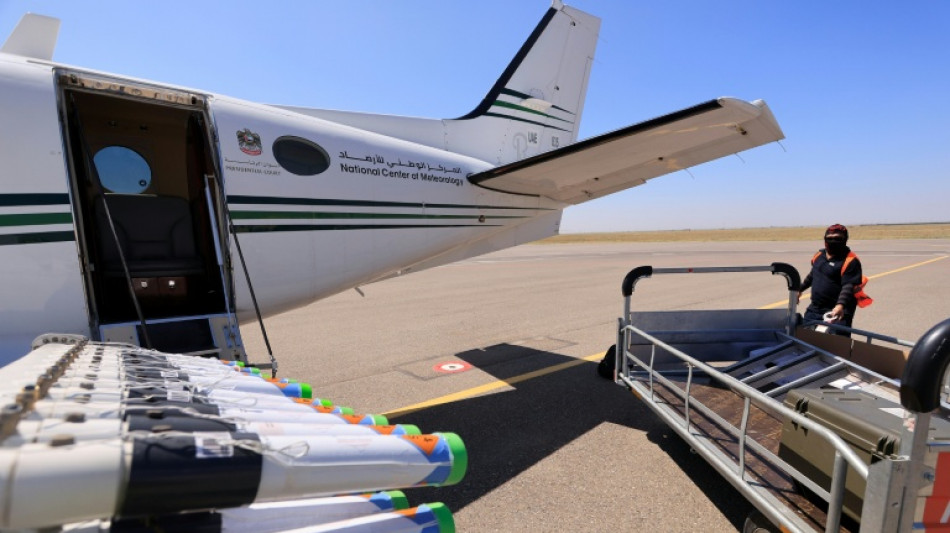
Parched and desperate for rain, Kazakhstan turns to cloud-seeding / Photo: Ruslan PRYANIKOV - AFP

 Kenya's economy faces climate change risks: World Bank

 Eclipse chasers flock to Spain for 'breathtaking' experience

 Mideast war impact on travel bookings fading, TUI says

 Toyota ex-chief Okuda, pioneer of the Prius, dead at 93

 Parched and desperate for rain, Kazakhstan turns to cloud-seeding

 Total solar eclipse to spellbind Europe

 Caught between great powers: the cautionary tale of Manus

 US company stokes Greenland tensions by unloading drilling gear

 UK 'on course' to record warmest summer for second year in a row

 Oil prices lower, stocks higher as Hormuz doubts drag on

 MEXC Report: 74.2% of Traditional Finance Users Have Shifted Their Trading Activity to Crypto Exchanges

 MEXC Lists DAPPOS (DOS) With $60,000 Worth of DOS and 10,000 USDT in Airdrop+ Rewards
 Ebola death toll in DR Congo outbreak rises to more than 2,000

 Hong Kong's tech index plans expansion with AI and robotics themes

 Singapore says AI-related demand lifting economy

 Schools closed as Indonesia battles wildfires

 Ceuta leader wants migrant detention centre after influx
 Meta pushes global AI vision amid race with OpenAI, Anthropic and China

 US had hottest month on record in July

 Bookmap Announces Partnership with Plus500 to Expand Futures Trading Access

 Drought forces water restrictions across nearly 70 percent of France

 Europe wary as gas stocks languish at lows while winter looms

 Freedom Holding Corp. Reports 40% Increase in Quarterly Revenue to $732.5 Million

 Massive shake-up of Hungary media after Orban's exit
 MEXC Sponsors Yohani's Colombo Concert, Bridging Sri Lankan Culture and Global Digital Finance

There were only arid steppes in sight when a small plane took off from an airport in southern Kazakhstan, embarking on a delicate mission: bringing rain for the scorched earth below.
To tackle the severe droughts and water shortages that plague the country, Kazakhstan has resorted to cloud seeding, a weather modification method previously unseen in Central Asia.
"The aircraft is specifically equipped with a cloud-seeding flare system," Ahmed Aljaberi, a pilot with the United Arab Emirates' meteorological centre, which conducts cloud seeding at home and is collaborating with Kazakhstan on the project, explained to AFP.
Cartridges fixed on the aircraft's wings contain a substance that, when dispersed, sticks to cloud droplets, making them heavy enough to fall as rain.
Kazakh authorities are betting on cloud seeding to reduce the impact of drought and water shortages in its southern Turkestan region, the country's leading cotton-growing region.
Areas in the region with some 9,110 square kilometres of arable land are being targeted, with estimated economic benefits of around $75 million a year through better harvests.
- 'Local and short-lived' -
Delivering droplets onto the parched crops requires meticulous preparation to identify suitable clouds.
The plane must "get as close as possible, detect the updrafts, and begin seeding," Aljaberi told AFP on board the flight.
At best, the technique can increase precipitation by 15 to 20 percent, according to various scientific studies.
But those involved also highlight the significant risk of failure due to numerous factors, not least because not just any cloud can be seeded.
"Salt particles -- specifically sodium chloride and potassium chloride -- are most often used" as cloud-seeding agents, said Adnan Yarmohammed, one of the Emirati officials in charge of sharing his country's experience.
The techniques vary: either seeding rockets are burned to release a plume of particles, or the saline solution is sprayed directly into the cloud for greater precision.
This "weighs down the droplets," which "grow from a few micrometres to several millimetres: up to two or three. They fall, and it rains," explained Yarmohammed.
He added that the technique "does not create new clouds".
Kazakhstan's cloud-seeding trials raised alarm in neighbouring Kyrgyzstan where fears were flagged of "cloud theft" -- alleging that rain clouds could be diverted to Kazakhstan, aggravating its own drought.
The Kazakh meteorological service said the impact of the project is "local and short-lived," and that it "does not affect climate processes or alter the movement of air masses".
No clouds were detected during the flight an AFP team took part in -- bringing no respite to a part of the country that last year set a new record-high temperature of 44.9C.
- Cloud seeding shortfalls -
The effects of boosting rainfall through cloud seeding remain uncertain, its consequences difficult to measure, and its large-scale application costly.
The World Meteorological Organization has called for more scientific research, pointing to a "rise in demand for these activities ... due to the frequency of droughts".
The UN organisation also ruled out any danger to human health or the environment and acknowledged potential economic benefits if the technique proved successful.
The method, already used in around 50 countries to combat drought, hail and air pollution, is new for Central Asia -- a region warming twice as fast as the global average.
In Kazakhstan, Central Asia's largest economy, the average annual temperature could rise by more than six degrees by the end of the century, the World Bank has warned.
Neighbouring Uzbekistan has also expressed interest in the method and is looking at trialing its own cloud seeding project.
In 2025, Kazakhstan's Turkestan region experienced eight months without rain and very low humidity levels, regional agricultural official Kazbek Bedebayev told AFP.
"The water deficit problem must be addressed comprehensively (and) a set of complementary measures is needed," Bedebayev said.
Cloud seeding "will not meet all needs," he said and less advanced measures still have a role to play -- like "drip irrigation and repairing the irrigation system and canals," which suffer from frequent leaks due to the ageing Soviet infrastructure.
A.Agostinelli--CPN