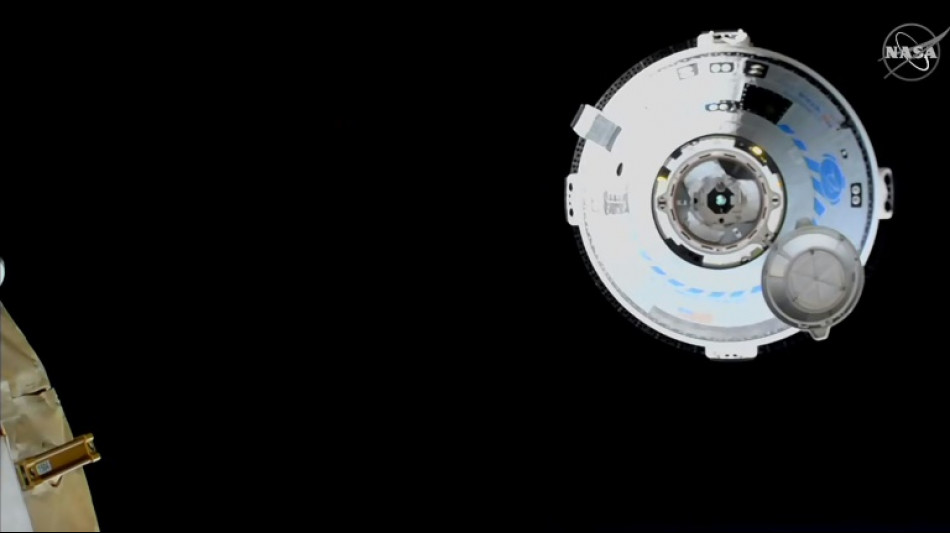
Boeing eyes February for space capsule's first crewed flight / Photo: - - NASA TV/AFP/File

 Samsung logs record quarterly profits despite investor AI jitters

 Shares in Google owner Alphabet plummet on profit miss, ad slowdown

 US Fed holds interest rates steady despite 'too high' inflation

 Airbus aims for record deliveries despite disappointing quarter

 Real Madrid, La Liga apology over Mbappe shows power of Chinese market

 'Cruise for life' strands passengers in Cambodia as operator goes bust

 Canada hikes rates to contain oil price surge caused by Iran war

 Nintendo producer 'all nervous' as Zelda classic remake hits shelves

 Three killed by storm in southern India

 Two hundred 'Cruise for life' passengers stranded in Cambodia

 Billionaire Ambani's Jio jumps 21% in market debut after record India IPO
The first crewed flight of Boeing's space capsule Starliner is scheduled for February 2023, the company and NASA announced Thursday, as the United States seeks to secure a second way for its astronauts to reach the International Space Station.
Since 2020, American astronauts have traveled to the ISS aboard SpaceX's vessels but the US space agency wants to widen its options.
After a series of hiccups in its space program that led to serious delays, including a 2019 flight that did not reach the ISS, Boeing finally managed to send the gumdrop-shaped capsule to the station in May -- without a crew.
This time, the aerospace giant will send the Starliner up with humans aboard, to earn NASA's green light to begin regular missions -- at an expected pace of one per year.
"Currently, we're targeting a launch date as early as February of 2023," Steve Stich, the manager of NASA's Commercial Crew Program, told reporters.
"We're in good shape to execute these plans to be ready for that flight in February," added Mark Nappi, the Starliner program manager at Boeing.
The test flight -- aptly named CFT, or Crew flight test -- will carry US astronauts Barry Wilmore and Sunita Williams.
They are expected to be docked for eight days at the ISS, where they will conduct a series of experiments, said ISS program manager Joel Montalbano.
"Our agency goal is to get two US commercial providers up and running as soon as we can."
Boeing had hoped to conduct this test flight before the end of the year, but a few glitches experienced in the uncrewed May flight led to necessary adjustments to the vessel.
An issue was detected in the propulsion system: two thrusters responsible for placing Starliner in a stable orbit failed, though officials insisted there was plenty of redundancy built into the system to overcome the problem.
Boeing's teams later determined that "debris-related conditions" were to blame, Nappi said, adding that the origin of said debris was still unknown.
Some filters were removed to fix a pressure problem, and flight software was updated to avoid a data overload.
Boeing and SpaceX were awarded contracts in 2014, shortly after the end of the space shuttle program, during a time when the United States was left reliant on Russian Soyuz rockets for rides to the ISS.
Elon Musk's SpaceX filled the void first, providing space "taxi" service since a successful test mission for its Dragon capsule in 2020.
S.F.Lacroix--CPN