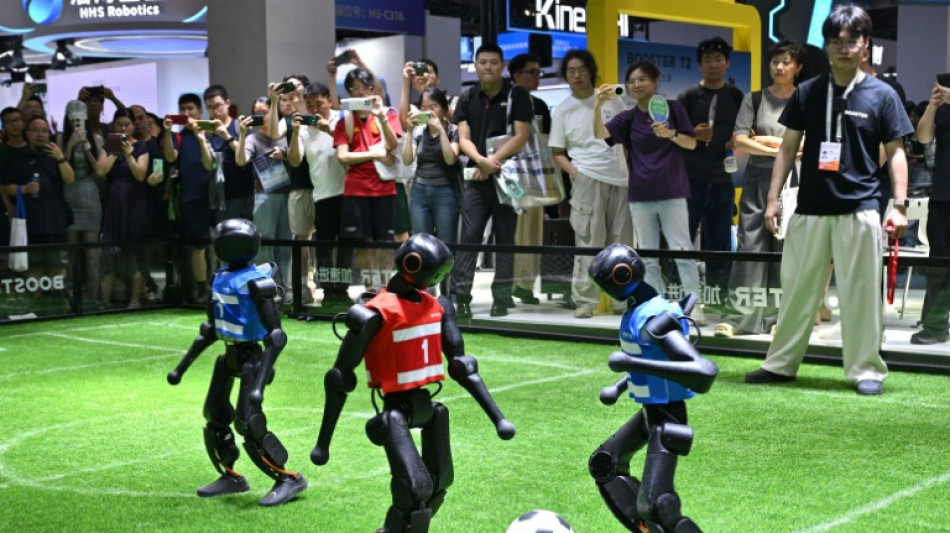
US government bans humanoid robots manufactured abroad / Photo: Hector RETAMAL - AFP

 Dozens arrested in major anti-LGBTQ raids in Turkey
 Poland, Ukraine slam Russian strikes near border as 'escalation'

 iPhone 18預購後出現可疑扣款 四間銀行調查未授權交易

 Galaxy Tab S12系列效果圖曝光 Ultra擬配雙鏡頭及瀏海螢幕

 Altman tells Fortune OpenAI will not go public in 2026

 الأرصاد السعودية تتوقع سيولاً وأمطاراً رعدية في خمس مناطق
 Steven Strogatz weighs AI mathematics advances and their consequences for researchers
 Venezuelans outside Caracas say capital not sharing blackout burden
 Anthropic boss calls for slowing pace of AI development

 BRICS nations urge 'maximum restraint' in Middle East war

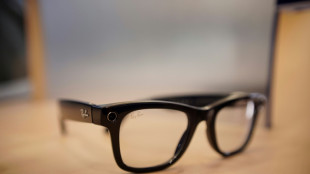 Europe eyes battle over 'pervert' AI glasses

 Children in flood-hit Nepal grapple with loss, cling to hope

 Venice Film Festival: A look back on the highlights

 DR Congo school fire stampede death toll rises to 26: UNICEF

 Dance Fitness Tempe Announces Expansion of Accessible Digital Movement Programs

 Europe saw record summer air traffic despite Mideast war: Eurocontrol

 Relatives of 9/11 victims hit out at Saudi Arabia -- and US leaders

 Relative of 9/11 victim unleashes searing attack on Saudi Arabia

 Czech antitrust office lets Turkey's Pegasus Airlines buy Smartwings

 Investors on edge as energy costs, surging bond yields roil markets

 UK lawmakers to vote again on failed assisted dying bill

 Yemen's Houthis complete takeover of Bab al-Mandab area: govt official to AFP

 Fast-pace dance takes I.Coast's working-class streets by storm

 Fans celebrate Celine Dion's Paris return with giant karaoke

 Appreciation, anger await as Trump heads to Irish golf resort

US President Donald Trump's administration on Tuesday added humanoid and quadruped robots to a list of products and companies that are banned from being imported into the United States on national security grounds.
Most humanoid robots sold in the US are manufactured abroad, particularly in China.
"Advanced robotic devices" were added to the list, the Federal Communications Commission (FCC) announced Tuesday.
Certain types of drones, as well as Chinese companies Huawei and China Telecom, are already on the list, which now includes what the FCC called "mobile robots" -- or robots that mimic how humans and animals walk by standing on two or four legs.
The decision was based on findings from a task force convened by the White House, which concluded that the foreign-built robots could create "a cybersecurity risk that threatens the security of critical infrastructure" and "the safety and security" of US residents.
However, the Pentagon and Department of Homeland Security can grant exemptions.
Most humanoid robots are currently used for industrial applications in confined spaces, such as automobile factories or storage warehouses.
Among the examples cited by the task force was the case of French programmer Sammy Azdoufal, who reportedly accessed data from thousands of robotic vacuum cleaners made by Chinese manufacturer DJI.
The decision only applies to new models and not to those already sold or authorized in the United States, and it comes against the backdrop of the Trump administration's efforts to boost domestic manufacturing.
The FCC also added foreign-made inverters to the list -- devices that, among other functions, convert direct current from batteries or solar panels into standard alternating current, which can be used by the electrical grid.
Several robotics companies already manufacture some humanoid robots in the United States, including Boston Dynamics, Tesla, Figure AI and Agility Robotics.
South Korean automotive giant Hyundai -- which announced this month that it acquired Boston Dynamics -- has plans to build a robotics factory in the US that will eventually have the capacity to produce 30,000 units per year.
Tesla aims to begin industrial production of its own humanoid robot Optimus soon at two US factories.
The company claims it will eventually produce 1 million robots annually at the factory in Fremont, California and 10 million annually in Austin, Texas.
However, Tesla's efforts will involve assembly rather than full-scale production.
Buzzy startup Figure AI already assembles robots at its plant in San Jose, California, and Agility has a factory in Salem, Oregon, where it can produce up to 10,000 robots annually.
A Trump administration official specified that the ban covers robots that are fully assembled, as well as those assembled on US soil with more than 35 percent of their components manufactured abroad.
A.Levy--CPN