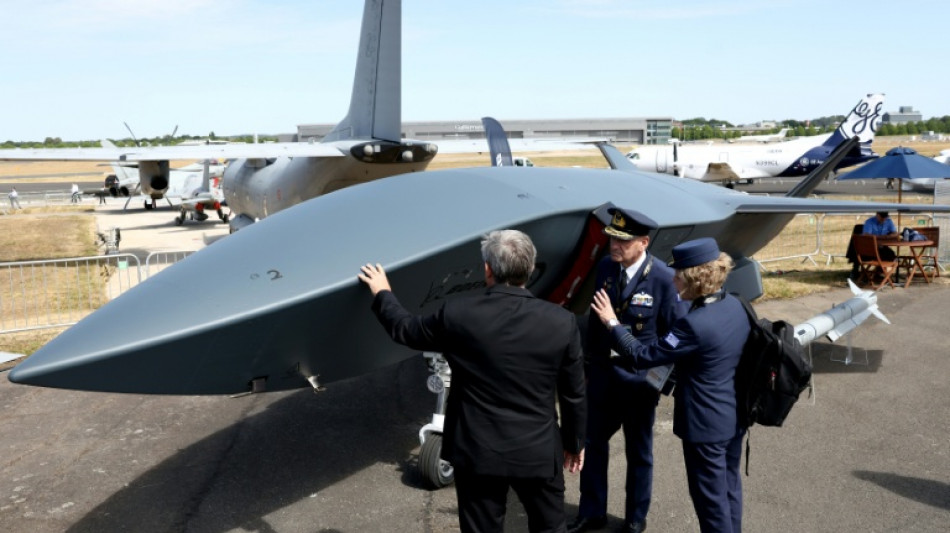
Autonomous fighter jets target Europe market at Farnborough airshow / Photo: Toby Shepheard - AFP

 Dozens arrested in major anti-LGBTQ raids in Turkey

 Poland, Ukraine slam Russian strikes near border as 'escalation'
 iPhone 18預購後出現可疑扣款 四間銀行調查未授權交易

 Galaxy Tab S12系列效果圖曝光 Ultra擬配雙鏡頭及瀏海螢幕

 Altman tells Fortune OpenAI will not go public in 2026

 الأرصاد السعودية تتوقع سيولاً وأمطاراً رعدية في خمس مناطق

 Steven Strogatz weighs AI mathematics advances and their consequences for researchers

 Venezuelans outside Caracas say capital not sharing blackout burden

 Anthropic boss calls for slowing pace of AI development

 BRICS nations urge 'maximum restraint' in Middle East war

 Europe eyes battle over 'pervert' AI glasses

 Children in flood-hit Nepal grapple with loss, cling to hope

 Venice Film Festival: A look back on the highlights

 DR Congo school fire stampede death toll rises to 26: UNICEF

 Dance Fitness Tempe Announces Expansion of Accessible Digital Movement Programs

 Europe saw record summer air traffic despite Mideast war: Eurocontrol

 Relatives of 9/11 victims hit out at Saudi Arabia -- and US leaders

 Relative of 9/11 victim unleashes searing attack on Saudi Arabia

 Czech antitrust office lets Turkey's Pegasus Airlines buy Smartwings

 Investors on edge as energy costs, surging bond yields roil markets

 UK lawmakers to vote again on failed assisted dying bill

 Yemen's Houthis complete takeover of Bab al-Mandab area: govt official to AFP

 Fast-pace dance takes I.Coast's working-class streets by storm

 Fans celebrate Celine Dion's Paris return with giant karaoke

 Appreciation, anger await as Trump heads to Irish golf resort

As Europe ramps up its rearmament drive, US aerospace giant Boeing is seeking a foothold in the emerging market for autonomous fighter aircraft, showcasing its capabilities at the Farnborough airshow this week.
Boeing's MQ-28 Ghost Bat is an uncrewed aircraft, developed with the Royal Australian Air Force, to fly alongside crewed fighter jets carrying out electronic warfare and surveillance and to help multiply forces.
It belongs to a category of AI-enabled Collaborative Combat Aircraft (CCA) which have risen to prominence as a new type of drone, as unmanned systems dominate the battlefield in Ukraine.
Boeing hopes to win over the European market by partnering with local defence companies.
In Germany, defence group Rheinmetall has teamed up with Boeing to integrate the MQ-28 into the German Air Force, with the capability expected to be available by 2029.
Such partnerships, however, have revived questions about the limits of Europe's push for greater defence sovereignty.
"The key objective is to deliver capabilities quickly," Pascal Fabre, a partner at advisory firm AlixPartners, told AFP.
"If you want to field new capabilities rapidly, you either develop the system yourself -- which takes time -- or you partner with someone who already has a mature platform, even if that company is not European," he added.
The trade-off lies at the heart of Europe's rearmament push, driven by growing security concerns and unease over relying on an increasingly unpredictable ally in US President Donald Trump.
"The defence industry is global, and European industry remains embedded in global networks with allies," said Emil Archambault, an associate fellow at the German Council on Foreign Relations.
"European-built CCAs will still require integration with these American systems and therefore do not offer a fully European solution," he told AFP.
- 'Take risks' -
"The thing we have going for us that no one else does, that no one can ever match, is we started nine years ago," Glen Ferguson, director of the MQ-28 Global Program, told AFP on the sidelines of Farnborough.
For Ferguson, the big advantage of CCAs is to "achieve missions that would be too high risk with normal human life at the stake".
The aircraft has a range of 3,700 kilometres, can fly at altitudes of up to 12,000 metres and reach a top speed of Mach 0.9 -- comparable to the speed of the world's fastest private jets.
It meanwhile has the possibility of being paired with the next-generation fighter being developed by Britain, Italy and Japan's GCAP program.
Ferguson said Boeing's model of building with regional partners was intended to give countries greater control over the capability rather than simply importing a US system.
"We would work with local industry because we're all about providing a sovereign capability to that country," he added.
- Multi-billion-dollar industry -
Boeing is not alone in the race.
BAE Systems unveiled Britain's first sovereign CCA at Farnborough, though London has yet to commit to a procurement decision, leaving the field open to competitors.
The UK government has pledged to spend £300 million ($400 million) on its autonomous jet programme over the next four years.
"Globally, the CCA sector is projected to be valued at more than £125 billion to 2050," said new UK defence minister Wes Streeting.
European aviation giant Airbus has partnered with US firm Kratos to use an existing American platform while integrating its own mission systems.
US rivals General Atomics and Anduril also showcased at Farnborough models of their autonomous aircraft at the airshow.
"From a Western world perspective, we need everyone who's creating a CCA to be successful," Ferguson said.
"The demand for CCAs in the rest of the world is going to be so immense that not one company, two companies, three companies can actually keep up," he added.
C.Smith--CPN