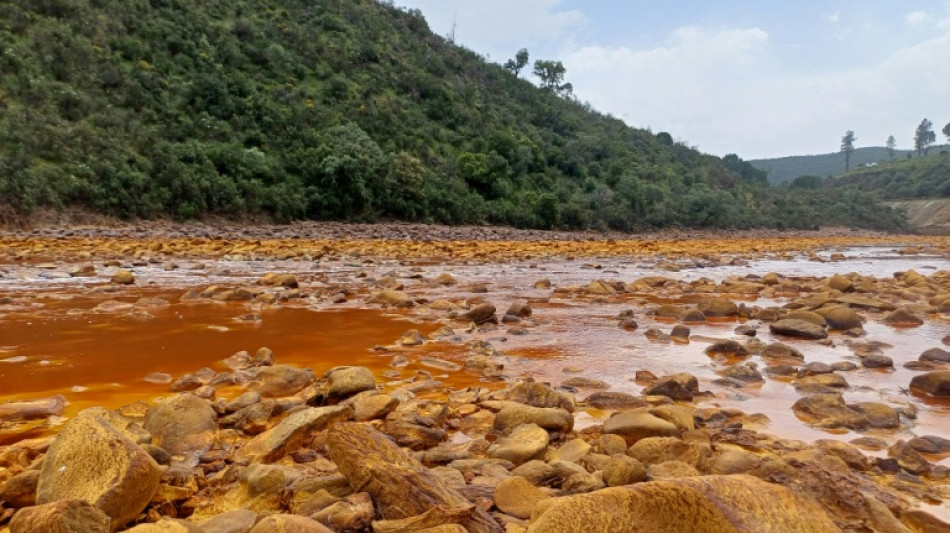
Metal mining's carbon footprint far larger than thought: study / Photo: Luke Bridgestock - University of St Andrews/AFP

 Dozens arrested in major anti-LGBTQ raids in Turkey

 Poland, Ukraine slam Russian strikes near border as 'escalation'

 iPhone 18預購後出現可疑扣款 四間銀行調查未授權交易

 Galaxy Tab S12系列效果圖曝光 Ultra擬配雙鏡頭及瀏海螢幕

 Altman tells Fortune OpenAI will not go public in 2026

 الأرصاد السعودية تتوقع سيولاً وأمطاراً رعدية في خمس مناطق

 Steven Strogatz weighs AI mathematics advances and their consequences for researchers

 Venezuelans outside Caracas say capital not sharing blackout burden

 Anthropic boss calls for slowing pace of AI development

 BRICS nations urge 'maximum restraint' in Middle East war

 Europe eyes battle over 'pervert' AI glasses

 Children in flood-hit Nepal grapple with loss, cling to hope

 Venice Film Festival: A look back on the highlights

 DR Congo school fire stampede death toll rises to 26: UNICEF

 Dance Fitness Tempe Announces Expansion of Accessible Digital Movement Programs

 Europe saw record summer air traffic despite Mideast war: Eurocontrol

 Relatives of 9/11 victims hit out at Saudi Arabia -- and US leaders

 Relative of 9/11 victim unleashes searing attack on Saudi Arabia

 Czech antitrust office lets Turkey's Pegasus Airlines buy Smartwings

 Investors on edge as energy costs, surging bond yields roil markets

 UK lawmakers to vote again on failed assisted dying bill

 Yemen's Houthis complete takeover of Bab al-Mandab area: govt official to AFP

 Fast-pace dance takes I.Coast's working-class streets by storm

 Fans celebrate Celine Dion's Paris return with giant karaoke

 Appreciation, anger await as Trump heads to Irish golf resort

From building wind turbines to reinforcing power grids for rising demand from electric cars, transitioning from fossil fuels to greener economies will require a massive increase in metal extraction.
But new research published in Environmental Science and Technology on Wednesday shows the carbon footprint linked to metal mining could be 10 times greater than previously thought, with major implications for the world's climate goals.
"We found an emission source that's not well considered in the mining industry for CO2, that is potentially very large in at least certain settings -- much larger than the well-accounted-for emission sources," senior author Luke Bridgestock of the University of St Andrews told AFP.
"We need to decarbonize the mining industry, and the only way to do that is if we know where the emissions are coming from and have tailored strategies of dealing with each of those emission sources," he added.
Metal mining is energy-intensive, and conventional estimates for its carbon footprint attribute most of its emissions to heavy equipment on-site, as well as diesel transport required to haul ore away.
- Hiding in plain sight -
Bridgestock and colleagues instead looked at acid mine drainage, a common side effect of mining that, despite being well understood, had never been formally quantified before this study.
Metal ores dug up during mining often contain sulfide minerals. When these sulfide minerals interact with oxygen-rich surface waters, they turn it acidic.
As that acidic water reacts with certain rocks -- limestone, for instance -- it releases carbon dioxide into the atmosphere.
Alternatively, the acidic water can flow out to the ocean where its reaction with seawater likewise releases carbon dioxide.
The team focused on the Iberian Pyrite Belt in southwest Spain, a copper-mining region with 82 active or historic mines that generate more acid mine drainage than anywhere else in the world.
By measuring the chemistry of rivers draining the mines, they quantified the extent of acid mine drainage and how much of the water was neutralized through mineral reactions that produce carbon dioxide. They also tracked changes to river water as it mixed with seawater.
Altogether, their results showed that acid mine drainage since industrial-scale mining began in the area in the 19th century had produced a similar amount of carbon dioxide as already known emissions -- meaning the true footprint to date is about double what was previously thought.
- Centuries of emissions -
But that is only part of the story.
Because metal sulfide minerals dug up during mining can take hundreds to thousands of years to fully react with surface water, they will keep generating emissions long after a mine's reserves are depleted.
By the researcher's calculations, that figure is seven to 165 tons of carbon dioxide per ton of copper produced, depending on the sulfide content of the metal ore and local geologic conditions.
The midpoint of that range is roughly ten times greater than conventional carbon footprint estimates.
The team is now testing whether a fast-dissolving mineral called olivine could be used to neutralize the acidic runoff without releasing carbon, potentially cutting emissions drastically.
Bridgestock said the next step is identifying which mining regions are most at risk, so mitigation efforts can be targeted where they matter most.
"Otherwise, we can't get to net zero," he said, "because you'll always have a bunch of emissions from metal mining from this process."
A.Zimmermann--CPN