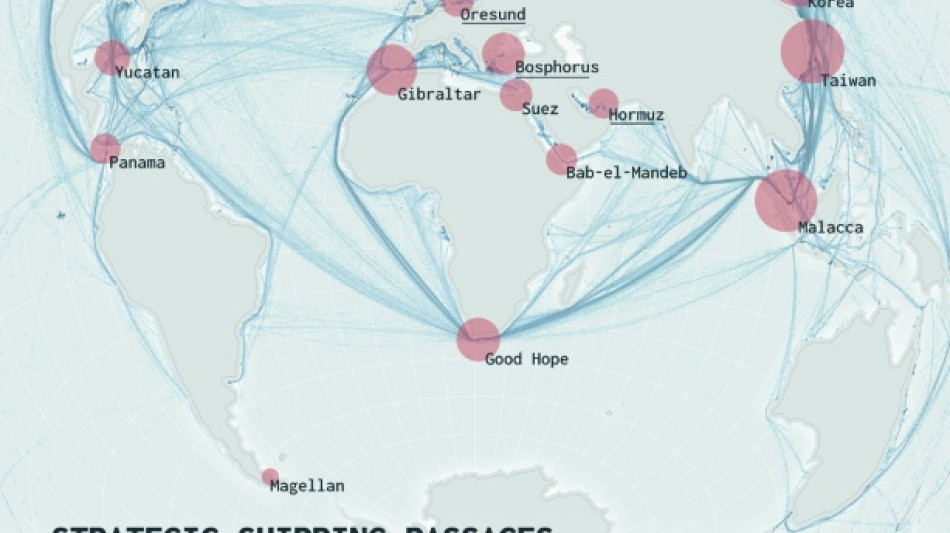
Hormuz, Malacca and other key straits spawn tensions throughout history / Photo: Sherine ELSAYARY, Luca MATTEUCCI - AFP

 Dozens arrested in major anti-LGBTQ raids in Turkey

 Poland, Ukraine slam Russian strikes near border as 'escalation'

 iPhone 18預購後出現可疑扣款 四間銀行調查未授權交易

 Galaxy Tab S12系列效果圖曝光 Ultra擬配雙鏡頭及瀏海螢幕

 Altman tells Fortune OpenAI will not go public in 2026

 الأرصاد السعودية تتوقع سيولاً وأمطاراً رعدية في خمس مناطق

 Steven Strogatz weighs AI mathematics advances and their consequences for researchers

 Venezuelans outside Caracas say capital not sharing blackout burden

 Anthropic boss calls for slowing pace of AI development

 BRICS nations urge 'maximum restraint' in Middle East war

 Europe eyes battle over 'pervert' AI glasses

 Children in flood-hit Nepal grapple with loss, cling to hope

 Venice Film Festival: A look back on the highlights

 DR Congo school fire stampede death toll rises to 26: UNICEF

 Dance Fitness Tempe Announces Expansion of Accessible Digital Movement Programs

 Europe saw record summer air traffic despite Mideast war: Eurocontrol

 Relatives of 9/11 victims hit out at Saudi Arabia -- and US leaders

 Relative of 9/11 victim unleashes searing attack on Saudi Arabia

 Czech antitrust office lets Turkey's Pegasus Airlines buy Smartwings

 Investors on edge as energy costs, surging bond yields roil markets

 UK lawmakers to vote again on failed assisted dying bill

 Yemen's Houthis complete takeover of Bab al-Mandab area: govt official to AFP

 Fast-pace dance takes I.Coast's working-class streets by storm

 Fans celebrate Celine Dion's Paris return with giant karaoke

 Appreciation, anger await as Trump heads to Irish golf resort

Hormuz and a handful of maritime straits around the world have served as the linchpin of global trade since the 16th century and have fuelled geopolitical rivalries throughout history.
As Iran tightens its grip on the Strait of Hormuz, its Yemeni allies, the Houthi rebels, want to disrupt shipping in the Red Sea to and from Saudi ports and could possibly disturb traffic in another strait, Bab el-Mandeb, which ships must cross to reach the Suez Canal, experts say.
These two passages, which lock access to the Gulf and to the Red Sea, are among the dozen or so straits considered vital to international trade.
Oil and gas tankers, bulk carriers and container ships loaded with raw materials and goods pass through these narrow natural corridors.
The United Nations Convention on the Law of the Sea signed in Montego Bay on December 10, 1982 -- a kind of constitution for the oceans -- "formalises the fact that a strait is a natural feature that must not be subject to tolls" and where "the principle of free navigation" is guaranteed, Sylvain Domergue, a lecturer at Sciences Po Bordeaux and author of Geopolitics of Maritime Spaces told AFP.
By contrast, canals such as Panama or Suez, which are man‑made waterways, may be subject to tolls levied by the states that control them.
In Hormuz, Iran, which "has not ratified the Montego Bay Convention, had until now respected it under customary law," Domergue said.
Portugal, whose navigators were the first to open the sea route to the Indies, tried as early as 1507 to establish control over Hormuz to secure a monopoly on access to spices and the riches of the Orient, he said.
- 'The sea belongs to none' -
But after a famous controversy, the Mare Liberum thesis of Dutch jurist and philosopher Hugo Grotius prevailed in the early 17th century: straits were then seen as essential to long‑distance international trade because "the sea belongs to no one".
"To guarantee freedom of navigation, one had to start by guaranteeing freedom of passage through the straits," Domergue said.
The Netherlands adopted this doctrine and defended freedom of the seas, followed by Britain and later by the United States which to this day respects "almost all of the Montego Bay Convention," despite not having ratified it either, he said.
Yet the principle of free navigation "did not prevent the British from guiding their colonisation in part according to the geography of straits", Domergue said.
Britain's key military footholds were established along strategic waterways. Its great colonial naval base in Asia would be in Singapore, allowing control of Malacca, through which the largest share of global maritime traffic from China now passes.
London would also establish bases on the island of Socotra, near Bab el‑Mandeb and the entrance to the Red Sea.
In Europe, the Danish straits (the Oresund, the Kattegat), which close off the Baltic, "were of great importance in the 19th century because they enabled the Danes, for a very long time, to collect a toll," and are strategic because they "block access to the Atlantic for the Baltic powers, particularly the Russians," the geographer said.
- Turkish exceptions -
The only major straits where a toll is still collected are the "Turkish Straits" of the Bosphorus and the Dardanelles, which are governed by earlier agreements, signed in Montreux in 1936.
"In the long run, other issues concerning straits will arise," Domergue said, citing the Taiwan Strait, given China's declared territorial ambitions in Southeast Asia, or the Strait of Malacca, shared by Singapore, Malaysia, and Indonesia.
"There is already a 'war of sand' going on in the Taiwan Strait: Chinese vessels come to collect marine sand for the construction sector in China, in waters claimed by Taiwan—provocative actions," he said.
On the evening Iran announced plans to introduce a toll in Hormuz, "the Malaysian prime minister spoke out to say it was a very good idea that he might emulate for Malacca, before backtracking," Domergue noted.
"If there were a toll in Malacca, Singapore would lose some of its splendour and its status as a hub of East Asia," he added.
A.Zimmermann--CPN