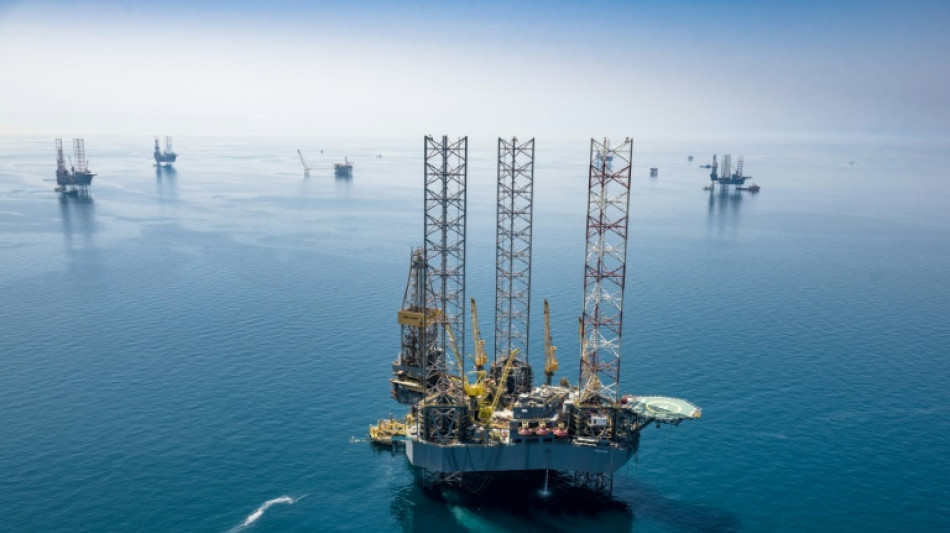
Oil prices fall but inflation stays high / Photo: Mohamed ALEBN ALSHAIKH - Saudi Aramco/AFP/File

 Microsoft beats expectations fueled by Azure cloud business

 Shares in Google owner Alphabet sink on profit miss, ad slowdown

 Pioneering US labor leader Dolores Huerta dies at 96

 US Fed holds interest rates steady despite surging inflation

 US labor leader Dolores Huerta dead: family

 French firm Safran helps build aircraft wings of the future in UK factory

 World Bank warns of worsening food insecurity as commodity prices soar

 Billionaire Ambani's Jio soars in market debut after India's biggest IPO

 AI chip giant SK hynix posts seven-fold surge in quarterly operating profit

 S.African activists push back on data centre rush

 Billionaire Ambani's Jio to debut after record India IPO

 UK set for cautious budget as borrowing costs climb

 US Fed expected to hold rates steady ahead of key midterm elections

Oil prices have dropped by a quarter since June and could fall further if a nuclear deal is reached with Iran as it would bring more crude to the market, yet inflation remains stubbornly high.
Crude prices soared to $140 per barrel in early March after Moscow invaded Ukraine, raising fears that Western sanctions would drastically cut supplies from Russia, a major producer and exporter.
But traders are now concerned about demand due to various factors, including fears of recession, a strong dollar and weak Chinese oil imports during the country's Covid lockdowns, said Giovanni Staunovo, commodities analyst at UBS bank.
Oil prices are set in dollars, so any rise in the currency makes barrels more expensive for importers using other currencies.
In China, "oil demand has taken a hit as processing of crude imports were weak in July" although stockpiles still rose, said Geordie Wilkes, analyst at Sucden.
The price of Brent, the international benchmark, has dropped to $95 while WTI, the main US contract, is at around $90 -- and fuel prices at the pump have fallen in the United States.
But UBS expects Brent prices to climb back to around $125 by the end of the year as Russia exports fall, Chinese imports rise and Western countries stop tapping their strategic reserves, Staunovo said.
- Iran wildcard -
The market, however, could fall again if Tehran reaches a nuclear deal that would allow the country to raise its exports, which are currently restricted by sanctions.
This could add around one million barrels per day to the market.
"Iran was able to bring capacity back online fast last time and this shocked the market," Wilkes said.
The European Union and United States said Tuesday they were studying Iran's response to a "final" draft agreement on reviving the 2015 nuclear accord with major powers.
"Our view continues to be that a deal is still unlikely in the short term," said experts at investment firm Goldman Sachs in a note, adding that Tehran can live with a reduced volume of exports as long as prices remain high.
"An announcement by Iran indicating willingness to entertain nuclear talks is likely intended to draw out further ongoing discussion in our view, before more disruptive counter-measures are potentially taken by the US and its allies," the Goldman Sachs experts said.
"The US is similarly incentivized to draw out negotiations given stricter sanctions enforcement would exacerbate the oil shortage."
Iran's return to the market would lower prices by $5 to $10 per barrel in 2023, according to the experts.
- 'The world has changed' -
While lower crude prices have eased the pain at the pump, analysts say it may not be enough to tame inflation that has reached decades high in many countries and raised fears of recession.
Natural gas prices have surged as Russia has slashed supplies to Europe.
Inflation in Britain accelerated to 10.1 percent in July, pushed up by rising food prices. They rose by 8.9 percent in the eurozone in July.
While consumer prices have eased in the United States -- slowing to 8.5 percent in July from 9.1 percent in June -- they remain at an elevated level.
"The world has changed," Andrew Kenningham, Europe analyst at research firm Capital Economics, told AFP.
"We used to have a very simple way to look at the price of energy and electricity in Europe based on the price of oil. Now we have a much more complex equation with different trends for oil, gas and electricity," he said.
In Europe, the recent drop in crude prices should take 0.5 percentage points off inflation, said Holger Schmieding, chief economist at Berenberg.
Small drops "mattered" when inflation was under two percent "but not when inflation is at nine percent", Kenningham said.
A.Leibowitz--CPN