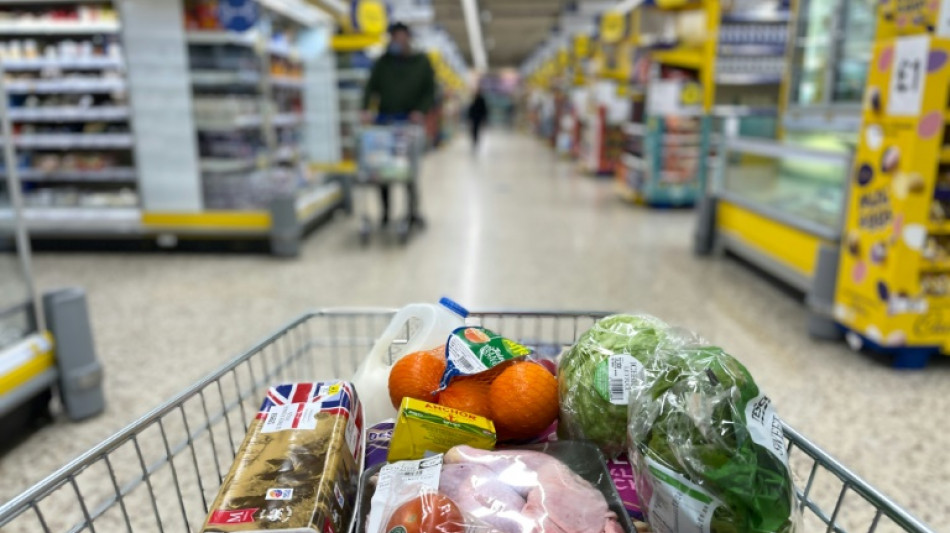
UK inflation hits new 40-year high as food prices rocket / Photo: Daniel LEAL - AFP/File

 Microsoft beats expectations fueled by Azure cloud business

 Shares in Google owner Alphabet sink on profit miss, ad slowdown

 Pioneering US labor leader Dolores Huerta dies at 96

 US Fed holds interest rates steady despite surging inflation

 US labor leader Dolores Huerta dead: family

 French firm Safran helps build aircraft wings of the future in UK factory

 World Bank warns of worsening food insecurity as commodity prices soar

 Billionaire Ambani's Jio soars in market debut after India's biggest IPO

 AI chip giant SK hynix posts seven-fold surge in quarterly operating profit

 S.African activists push back on data centre rush

 Billionaire Ambani's Jio to debut after record India IPO

 UK set for cautious budget as borrowing costs climb

 US Fed expected to hold rates steady ahead of key midterm elections

British inflation surged to a new 40-year high in July on soaring food prices, official data showed Wednesday, adding to a cost-of-living crisis as the country faces the prospect of recession.
The Consumer Prices Index (CPI) accelerated to 10.1 percent last month from 9.4 percent in June -- itself a four-decade high -- the Office for National Statistics said.
The Bank of England warned earlier this month that UK inflation would climb to just above 13 percent this year, which would be the highest level since 1980.
It also projected that the country would enter a recession near the end of the year that the BoE expects to last until late 2023.
Official data last week showed Britain's economy shrank in the second quarter.
"I understand that times are tough, and people are worried about increases in prices that countries around the world are facing," finance minister Nadhim Zahawi said following the latest data.
"Getting inflation under control is my top priority," he said, as Britons face also rocketing energy bills.
While the government of outgoing Prime Minister Boris Johnson has pledged to help reduce fuel costs for millions of Britons this coming winter, consumer groups are demanding far more state support.
It comes as Britain endures a cost-of-living crisis, with wage values falling at a record pace.
The deteriorating economy will be inherited by Johnson's successor after he leaves office next month, with Foreign Secretary Liz Truss and former finance minister Rishi Sunak vying to take the reins of the Conservatives.
- Rate hikes -
In a bid to bring down inflation, the Bank of England has hiked its key interest rate several times since the end of last year.
The most recent increase was by 0.5 percentage points, the biggest hike since 1995 and which leaves borrowing costs at 1.75 percent -- driving up mortgage repayments for households but boosting savers.
"Today's data leaves the Bank of England stuck in a bit of a quandary, with multi-decade high inflation accompanied by an economy expected to enter into a deep recession in 2023," noted Matthew Ryan, head of market strategy at global financial services firm Ebury.
He added that "another 50 basis-point interest rate hike is effectively guaranteed at the bank's next meeting in September".
The BoE's recent moves mirror aggressive monetary policy from the US Federal Reserve and the European Central Bank, as the world races to cool red-hot inflation that has been fuelled by Russia's invasion of Ukraine.
- Bread, cereal, toilet paper -
The UK statistics office said the "largest movements" in July's CPI came from food.
Bread and cereals were the largest contributors to the jump in food prices, followed by milk, cheese and eggs.
The increases were reflected in higher prices for takeaway food, said ONS chief economist Grant Fitzner.
"Price rises in other staple items, such as pet food, toilet rolls, toothbrushes and deodorants also pushed up inflation in July," he added.
Package holiday costs and air fares also increased on higher demand, Fitzner said, while the cost of raw materials and good leaving factories continued to rise.
"The eye-watering increase in the price of food in July will be dismal reading for many families already struggling to pay for their supermarket shop," said Laura Suter, head of personal finance at AJ Bell.
"Food inflation reached 12.7 percent in July, having seen the highest monthly growth in more than 20 years."
Y.Ponomarenko--CPN