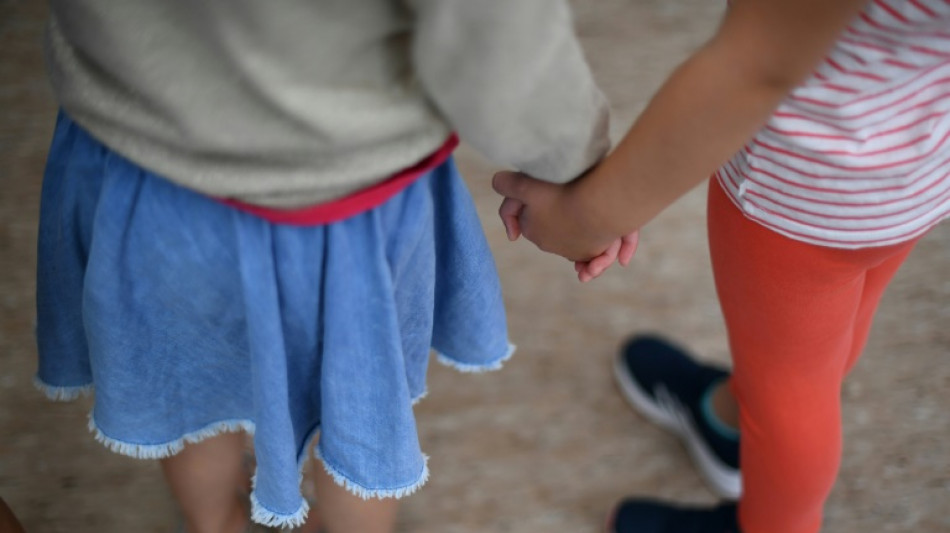
Richer childhood friends boost future income, Facebook data shows / Photo: Fred TANNEAU - AFP/File

 Shares in Google owner Alphabet plummet on profit miss, ad slowdown

 US Fed holds interest rates steady despite 'too high' inflation
 Airbus aims for record deliveries despite disappointing quarter

 Real Madrid, La Liga apology over Mbappe shows power of Chinese market

 'Cruise for life' strands passengers in Cambodia as operator goes bust

 Canada hikes rates to contain oil price surge caused by Iran war

 Nintendo producer 'all nervous' as Zelda classic remake hits shelves

 Three killed by storm in southern India

 Two hundred 'Cruise for life' passengers stranded in Cambodia

 Billionaire Ambani's Jio jumps 21% in market debut after record India IPO

 Sri Lanka's Tamil farmers fight to reclaim land after civil war

 'They don't care about us': Trump food aid cuts leave Americans struggling and angry

 Palestinian activist Khalil returns to Columbia after US detention

 Youths testify about 'despair' in unprecedented Canadian climate trial

 Charles tackles thorny legacy of slavery on Caribbean trip
An analysis of 21 billion Facebook friendships shows that children from poorer homes are likely to earn more later in life if they grow up in areas where they can become friends with wealthier kids.
It has long been believed that having rich friends can help children rise up out of poverty, but previous research has had small sample sizes or limited data, according to two studies published in the journal Nature on Monday.
So a team of US-based researchers turned to Facebook, the world's largest social database, with its nearly three billion users offering unprecedented scale and precision to examine the issue.
They analysed the privacy-protected data of 72 million US Facebook users aged between 25 and 44 years. The Facebook friendships were used to represent real-world friendships.
The researchers used an algorithm to rank users by socio-economic status, age and region, among other factors.
They then measured how much richer and poorer people interacted with each other and created the term "economic connectedness" to represent the share of a person's friends who were above or below the average socio-economic level.
They then compared this measure with previous research into children's ability to escape poverty in every US zip code.
The results were "strikingly similar", said Raj Chetty, an economist at Harvard University and the lead author of the two studies.
The first paper showed that economic connectedness "is one of the strongest predictors of economic mobility that anyone has identified to date," Chetty said.
The second paper sought to find out why children from richer or poorer backgrounds are more likely to make friends in some areas than others.
- Let's be friends -
The researchers found two major factors. One was how much the two groups are exposed to each other -- for example whether they attend different high schools or live in separate neighbourhoods.
Even if wealthy and non-wealthy students did go to the same school, however, they still might not hang out with each other -- a factor the researchers called friending bias.
Around half of social disconnection between the rich and poor was due to lack of exposure to each other, the study found.
"But the remaining half is explained by friending bias," Chetty said.
The findings showed that US policies aimed at reducing economic segregation between schools and regions were important but "not enough," he added.
Where richer and poorer children meet has a major influence on whether they become friends -- meaning that institutions play a major role, the study found.
For example, friendships in religious institutions like churches were "much more likely to cut across class lines," Chetty said.
The data on exposure and friending bias was published on socialcapital.org on Monday, with researchers hoping it will prompt authorities across the United States to act.
Chetty predicted that similar results would likely be found in other countries, urging researchers and governments worldwide to access their own Facebook data.
Noam Angrist of Oxford University and Bruce Sacerdote of Dartmouth College in New Hampshire said the research represented "an important contribution that will enable a deeper understanding of social capital".
"A sensible next step is to extend Chetty and colleagues' monumental data creation and analysis to countries beyond the United States," they wrote in a linked comment in Nature.
A.Mykhailo--CPN