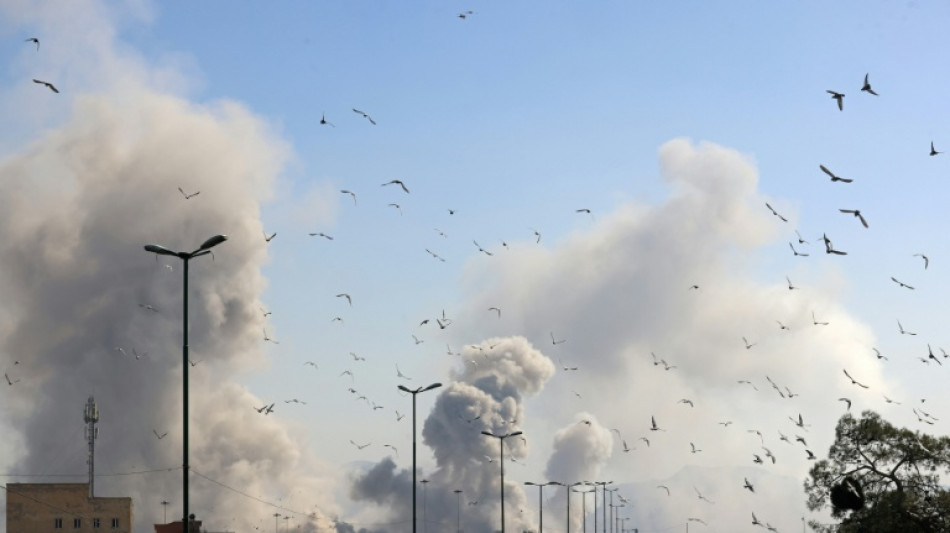
Equities mostly drop as Mideast crisis rages, though oil dips / Photo: ATTA KENARE - AFP

 UK actor Naomi Watts honoured at Spain film festival

 Trump signs bill authorizing sweeping Russia sanctions

 Anthropic picks Accenture for in-house AI safety evaluation

 Hushing and hedging: US companies retreat on climate

 Crisis-wracked Volkswagen warns of 10-bn-euro hit to profits

 Shakira to cap off world tour with Madrid 12-gig run

 Isolated Syrian-Druze city shortages

 UNESCO can be 'moderator' in AI debate: chief to AFP

 Russia seizes assets of Nestle, French firms

 Anthropic says AI systems moving towards building themselves

 Asian stocks boosted by falling oil, yen weakens after BoJ rate hike

 Afghan medical students in Pakistan hope court stops college expulsions

 Australia to detain tourists who overstay visa, minister says

 Asian stocks track Wall St rally as oil prices drop

 Prized Mexican relic returns on loan, two centuries on

 'In our lane': Fed's Warsh defies Trump but still fighting for credibility

 Trump admin makes major cut to endangered species protections

 GM delivers first components for US interceptor missiles

 Travis Scott and Keith Richards feature on GTA VI soundtrack

 King Charles warns tech bosses of 'existential dangers' of AI

 French fishermen block ports over petrol prices

 Micron's Taiwan workers say 68 months' bonus not enough

 Canada's Carney pushes 'new alliance' with EU despite Trump threats

 Beyond Investment Returns: Families Are Measuring Wealth by Freedom, Continuity, and Legacy, According to Nour Private Wealth

 King Charles disputes claims in book by Princess Diana's brother

Most stocks in Asia fell Friday as the war in the Middle East showed no sign of ending, though there was some reprieve from the surge in oil prices after the United States looked to ease supply concerns.
After a torrid week on trading floors, investors were limping into the weekend wondering when the US-Israel war on Iran, and Tehran's attacks across the Gulf region, will come to an end.
Equities across the world have been battered by the crisis, which has sent crude prices soaring by about a fifth since Friday last week -- the day before the attacks started -- and fanned fears of a fresh spike in inflation that could hit the global economy.
While there was a midweek bounce, analysts warned that the longer the conflict goes on, the worse it will be for markets to absorb.
"It is too soon to suggest that stocks have bottomed," wrote IG chief market analyst Chris Beauchamp.
"Unless the war ends soon -- and if anything a more intense conflict seems more likely -- markets will struggle. Volatility remains elevated, which means we should expect plenty of two-way price action, but a continued decline for the moment seems likely, even with short-term bounces along the way."
And the battle looks set to be drawn out, with Iranian Foreign Minister Abbas Araghchi warning Thursday that the Islamic republic was neither asking for a ceasefire nor negotiations with the US.
After a fresh retreat on Wall Street, where all three main indexes staged late rallies but ended down, Asia largely followed suit.
Seoul was again at the forefront of the action. The Kospi, which was pummelled almost 19 percent on Tuesday and Wednesday before bouncing more than nine percent Thursday, shed 1.5 percent.
Sydney, Singapore, Wellington, Manila and Jakarta were also down.
But Tokyo, Hong Kong, Shanghai and Taipei rose.
The selling has also been stoked by fears that the spike in crude prices will push inflation back up and force central banks to re-evaluate plans to cut interest rates, with some analysts warning that they could even contemplate hikes.
While Iran has not officially shut off the Strait of Hormuz, shipping through the waterway has all but dried up.
Still, there was some reprieve on the oil front as both main contracts dropped around two percent after US Interior Secretary Doug Burgum said officials were looking at plans to temper the price gains.
He told Bloomberg that "everything is being considered", with options including tapping the country's reserves, possibly in tandem with other nations.
With that in mind, the White House on Thursday temporarily eased sanctions against Russia to allow its oil currently stranded at sea to be sold to India until April 3.
Treasury Secretary Scott Bessent said the waiver was issued "to enable oil to keep flowing into the global market."
Earlier this week US President Donald Trump pledged to protect ships through the Strait of Hormuz, through which a fifth of the world's crude supplies and a substantial amount of gas run.
Other countries have also moved to address the issue, with China, fearing shortages, asking its largest oil refiners to suspend exports of diesel and gasoline, according to Bloomberg News.
However, prices remain elevated. By the end of trade Thursday, Brent had risen around 19 percent since Friday, while WTI had spiked more than 22 percent, having topped $80 a barrel for the first time since January last year.
Meanwhile, traders will also be keeping an eye on the release of US jobs data due later in the day hoping for some insight into the state of the world's top economy.
- Key figures at around 0230 GMT -
West Texas Intermediate: UP 2.0 percent at $79.38 per barrel
Brent North Sea Crude: UP 1.5 percent at $84.10 per barrel
Seoul - Kospi: DOWN 1.6 percent at 5,497.51
Tokyo - Nikkei 225: UP 0.4 percent at 55,490.04 (break)
Hong Kong - Hang Seng Index: UP 0.9 percent at 25,557.59
Shanghai - Composite: UP 0.1 percent at 4,111.86
Euro/dollar: UP at $1.1617 from $1.1604 on Thursday
Pound/dollar: UP at $1.3367 from $1.3357
Dollar/yen: DOWN at 157.51 yen from 157.55 yen
Euro/pound: UP at 86.91 pence from 86.87 pence
New York - DOW: DOWN 1.6 percent at 47,954.74 (close)
London - FTSE 100: DOWN 1.5 percent at 10,413.94 (close)
D.Goldberg--CPN