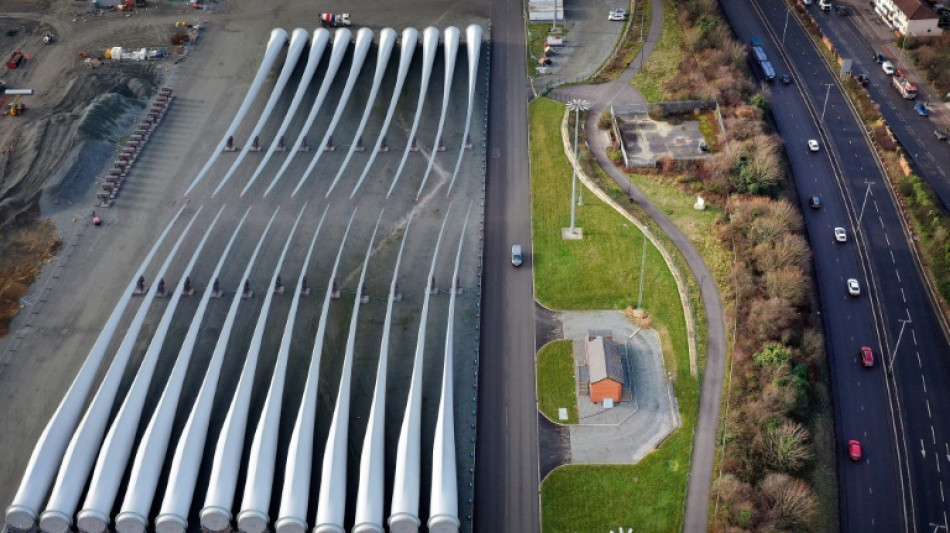
Wind powers change in England's industrial heartland

 Lights out in Laos as electricity exports surge

 Steven Strogatz weighs AI mathematics advances and their consequences for researchers

 Anthropic boss calls for AI slowdown, Altman and Musk agree

 French IT giant Capgemini sells subsidiary after row over ICE links

 Quebec Brokerage Qubit Insurance Announces New Data on Coverage Shortfalls as Rebuilding Costs Rise

 Lady Gaga welcomes first child with fiance: US media

 Bhutan business bets on hazelnuts for farming future

 'Widow's Bay' and 'The Pitt' are favorites for Emmys night

 Coastal erosion forces cancellation of California music festival

 Argentina's Dirty War rears its head in Venice film

 UK lawmakers throw out bill to legalise assisted dying

 US inflation steady in August, fueling Fed rate hike expectations

 New York marks 25th anniversary of 9/11 attacks

 Nepal flood reconstruction bill to be $4.78 bn: foreign ministry

 JUMO and Standard Bank launch Social Finance Framework to scale inclusive finance in Africa

 Doomsday tech: could AI really kill us all?

 French comedy show 'Call my agent' makes film comeback

 It's all coming back: Celine Dion fans gear up for Paris return

 Researchers eye AI revolution in natural disaster forecasts

 US braces for inflation report that may push Fed to hike rates

 Musk threatens legal action over documentary

 Latin America fact-check group asks Meta not to replace verification practice

 AI Risks to Enter 60–80% of Liability and Cyber Insurance Underwriting by 2028, ScienceSoft Predicts

 Tribal Launches Campfire, Letting Business and Technical Teams Build on Salesforce Together

 Stocks fall as fresh oil surge fans inflation fears

On the banks of the River Humber in northern England, the winds of change are blowing through Hull, where factory workers busily craft turbine blades in a green revolution.
Hull, known for a once-thriving fishing industry, the poet Philip Larkin, rugby league, and the city's eponymous football club recently bought by Turkish TV personality Acun Ilicali, is home to Britain's biggest wind turbine blade plant.
That has placed Hull at the centre of the UK government's long-term plan to slash carbon emissions, tackle climate change and cut rocketing household energy bills.
German-Spanish giant Siemens Gamesa is rapidly expanding its facility to meet booming demand and keep the country's much-trumpeted 2050 net-zero target on track.
The need for cheaper sources of energy became increasingly urgent this week, as the government scrambled to head off a cost of living crisis, faced with runaway electricity and gas costs that are fuelling decades-high inflation.
Britain unveiled financial support for households after the UK energy regulator lifted prices to reflect the spiking natural gas market.
- 'Cheaper and cleaner' -
"We are doing our bit to tidy the world up and get cheaper and cleaner energy for everybody," blade painter Carl Jackson, 56, told AFP from the factory floor.
"I think wind power is a big part of the future. It's been a massive boost to jobs and the economy in Hull," added Jackson, who joined when Siemens Gamesa opened six years ago.
The hub has since manufactured 1,500 hand-made turbine blades and now employs more than 1,000 people.
Prime Minister Boris Johnson, host of last November's UN climate change summit in Glasgow, has vowed to "level up" economic opportunity in places like Hull, which voted overwhelmingly for Brexit.
Siemens Gamesa built the £310-million plant jointly with Associated British Ports in 2016, and it is now undergoing a major extension to build bigger blades.
The Hull factory manufactures about 300 turbine blades per year, with each measuring 81 metres in length -- about the same as the wingspan of an Airbus A380 aircraft.
A wind turbine, comprising three such blades, can power an average house for 24 hours with one single rotation.
New, even longer 100-metre blades will provide enough power for up to two days.
- 'Driving down energy costs' -
In the cavernous Hull factory, staff assemble balsa wood, fibreglass and resin into vast blade moulds to start a journey that will eventually harness the ferocious winds of the North Sea.
That enables Britain to cut carbon emissions while curbing its dependency on imported energy and lowering prices in the long term, said plant director Andy Sykes.
"Over the course of last year, 25 percent of the UK's (electricity) was delivered from wind power," said Sykes.
"That will only continue to grow and help drive down the cost of energy by reducing the need for the import of energy."
The group will open another factory in Le Havre, northern France, this year in a push for cleaner energy across Europe, where wind generated an average 16 percent of electricity according to 2020 industry data.
Scotland recently awarded a string of vast offshore wind projects after Johnson vowed to make Britain the "Saudi Arabia of wind".
Hull is also expanding into the broader renewable sector, with plans for biofuels, green hydrogen, and carbon capture, as well as solar and tidal power generation under the city's "Green Port" initiative.
The local authority is eager to slash carbon output from the Humber estuary region, which accounts for 40 percent of Britain's industrial emissions -- particularly from the cement, gas, oil, petrochemicals and steel sectors.
"You really have to decarbonise the Humber area for the UK to be really able to address significant parts of its net zero challenge," Hull City Council climate officer Martin Budd told AFP.
"And this Siemens offshore wind plant provides a key activator to achieve that."
The Humber estuary's high seabed makes it ideal for offshore turbines.
At the same time, the estuary expels an estimated 12.3 million tonnes of carbon per year.
- Ensuring survival -
Budd said tackling climate change was vital to saving low-lying Hull from flooding.
"We are the second most vulnerable UK city after London to flooding. So the survival of the city depends on tackling climate change," he added.
"It's integral that we tackle climate change and that as a city we take those steps by supporting manufacturing in industries that are going to tackle climate change."
The UK wants offshore wind farms to provide one-third of the country's electricity by 2030.
Climate change specialist Nick Cowern, an emeritus professor at Newcastle University, cautioned that Britain also needed to develop chemical storage capability.
"It's realistic to put wind power at the centre of the UK's low carbon electricity generation approach, which is a major part of the effort towards net zero," he told AFP.
He added that while wind and solar were safe long-term bets, gas still had a significant role to play.
"Until we have the ability to store electricity as hydrogen -- or alternatives like ammonia -- and be better grid-connected to our neighbours in continental Europe and the Nordic countries, gas will still be needed during periods of low wind speeds and low solar generation."
H.Meyer--CPN