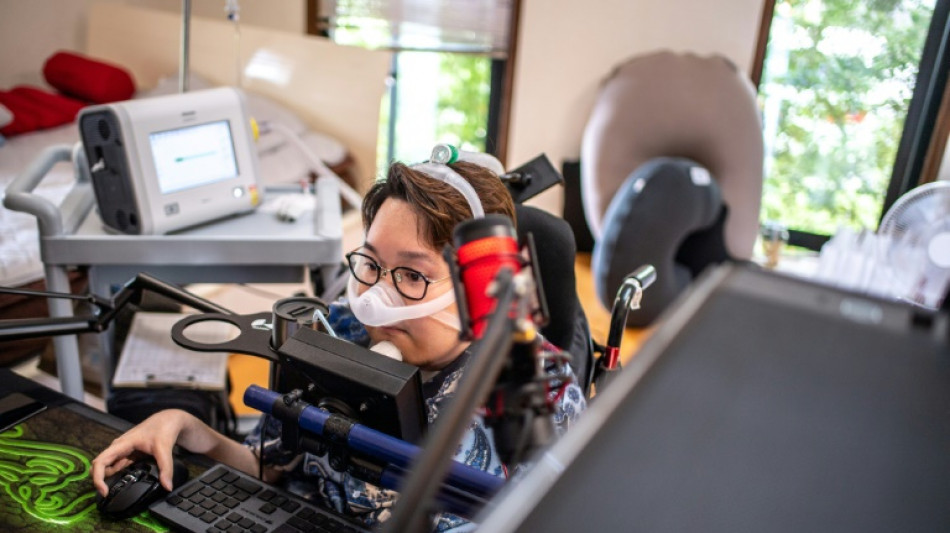
Japan eSports players with disabilities shoot down stereotypes / Photo: Philip FONG - AFP

 US Fed holds interest rates steady despite 'too high' inflation

 Airbus aims for record deliveries despite disappointing quarter

 Real Madrid, La Liga apology over Mbappe shows power of Chinese market

 'Cruise for life' strands passengers in Cambodia as operator goes bust

 Canada hikes rates to contain oil price surge caused by Iran war

 Nintendo producer 'all nervous' as Zelda classic remake hits shelves

 Three killed by storm in southern India

 Two hundred 'Cruise for life' passengers stranded in Cambodia

 Billionaire Ambani's Jio jumps 21% in market debut after record India IPO

 Sri Lanka's Tamil farmers fight to reclaim land after civil war

 'They don't care about us': Trump food aid cuts leave Americans struggling and angry

 Palestinian activist Khalil returns to Columbia after US detention

 Youths testify about 'despair' in unprecedented Canadian climate trial

 Charles tackles thorny legacy of slavery on Caribbean trip
Street Fighter player Shunya Hatakeyama has muscular dystrophy, so he uses his chin to launch devastating combos. He is not the only Japanese gamer proving that disability is no barrier in eSports.
Naoya Kitamura, who is blind and relies on sound to play beat 'em up game Tekken 7, also hopes that his skills in a billion-dollar industry will help make society more open-minded.
"I'll block a move and the sound it makes will tell me what kind of move it was," Kitamura said.
"Then I'll react and make my move," he told AFP, demonstrating a dizzying attack with Tekken character Lucky Chloe.
Competitive gaming is booming worldwide, with global eSports revenues estimated at more than $1 billion, and many think it could one day be at the Olympics.
The sector is not as big in Japan as in eSports-crazy China and South Korea, but it is gradually starting to take root.
Keen to offer Japanese gamers with disabilities a chance to be part of the action, social welfare worker Daiki Kato founded a company called ePara in 2016.
Kato's firm employs players such as Hatakeyama and Kitamura, who are both 28, and gives them time to practise around their other duties, which include working on the company's website and helping organise gaming events.
Hatakeyama mostly enters Street Fighter V tournaments that are open to anyone -- disabled or non-disabled -- and says the beauty of fighting games is that "you can overcome handicaps and compete against different people".
"When I play in a tournament I don't want my disability to be an issue," he said.
"I want to move people with the way I play."
- Custom controller -
Hatakeyama was born with degenerative muscular dystrophy and has used a wheelchair since he was about six years old.
He has always loved fighting games, but over the years his muscles weakened so much that he could not hold a controller.
Depressed, he quit playing for six years until he and a friend decided last year to design and make a custom controller that he could operate with his chin.
Using his fingers to press buttons on his computer keyboard, Hatakeyama says he quickly got back into the groove.
Now he also coaches other players with disabilities, talking them through complicated combos and offering tips on different characters.
"If I had never played fighting games, I don't think I would try to find solutions whenever I encountered something difficult," he said.
Many of ePara's gamers are new to eSports and do not have much experience of competing in tournaments.
Company chief Kato believes there is a growing market for gamers with disabilities and he thinks manufacturers will start to sit up and take notice.
"If you have more people with hearing impairments or visual impairments playing games, game manufacturers will react by making more games that they can play," he said.
- 'Same rules, same competitions' -
Kato wants to use eSports to showcase the talents of people with disabilities, saying many people in Japan "don't have much chance to interact" with them.
Kitamura, who has microphthalmos and has been blind since birth, says eSports can help change the perception that people with disabilities "just need assistance".
"I'm really good with computers and I can do a lot more than some people who can see can do," he said.
"It's not just about being helped -- depending on the circumstances, we can help people out too. It's about cooperation."
Kitamura thinks the term eSports itself also helps, projecting the image of serious competition rather than "just people playing games".
The Southeast Asian Games have featured eSports medal events and they will also appear at next year's pandemic-delayed Asian Games.
Many believe that the Olympics and Paralympics will follow suit but Kato says there is "no need to distinguish between people with or without disabilities in eSports".
"That's one interesting thing about it," he said.
"Whether you're in a wheelchair or not, it's the same rules and the same competitions."
J.Bondarev--CPN