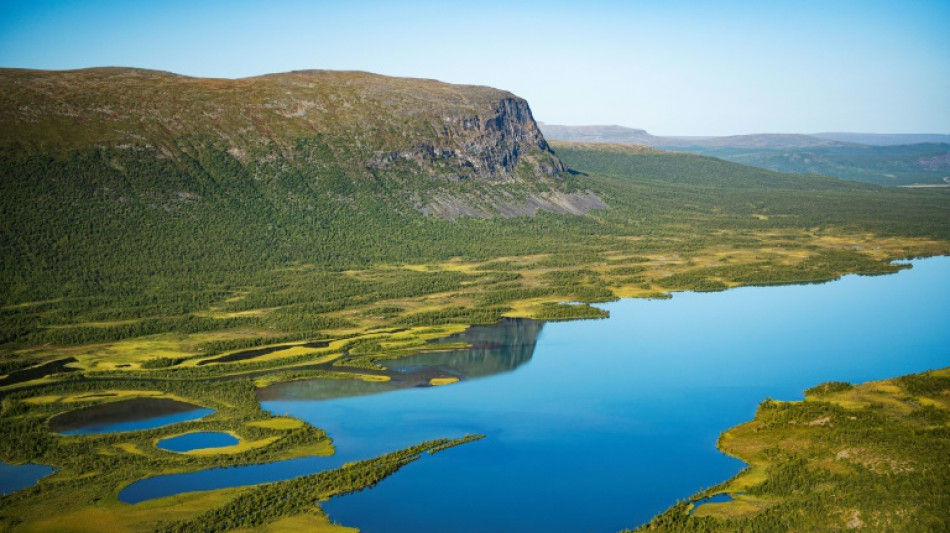
Faster growth may help bacteria remove lake plastic waste: study / Photo: Jonathan NACKSTRAND - AFP/File

 US Fed holds interest rates steady despite 'too high' inflation

 Airbus aims for record deliveries despite disappointing quarter

 Real Madrid, La Liga apology over Mbappe shows power of Chinese market

 'Cruise for life' strands passengers in Cambodia as operator goes bust

 Canada hikes rates to contain oil price surge caused by Iran war

 Nintendo producer 'all nervous' as Zelda classic remake hits shelves

 Three killed by storm in southern India

 Two hundred 'Cruise for life' passengers stranded in Cambodia

 Billionaire Ambani's Jio jumps 21% in market debut after record India IPO

 Sri Lanka's Tamil farmers fight to reclaim land after civil war

 'They don't care about us': Trump food aid cuts leave Americans struggling and angry

 Palestinian activist Khalil returns to Columbia after US detention

 Youths testify about 'despair' in unprecedented Canadian climate trial

 Charles tackles thorny legacy of slavery on Caribbean trip
Chemicals leaking from plastic waste make bacteria grow faster in European lakes, according to research published Tuesday that authors said could provide a natural way to remove plastic pollution from freshwater ecosystems.
Microplastics have been found in virtually every corner of the globe -- from the highest glaciers to the bottom of the deepest sea trench -- but the impact of plastic pollution in lakes is less well researched than in oceans.
When plastic materials such as carrier bags break down in water, they release simple carbon compounds slightly different to those produced when organic matter such as twigs and leaves disintegrate.
Researchers from the University of Cambridge wanted to see what effect these compounds had on bacteria populations in 29 lakes across Scandinavia.
They cut up plastic bags from four major British shopping chains and mixed them with water until the carbon compounds were released.
They then filled glass bottles with water from each lake, mixing a small amount of the plastic water into half of these samples.
In the water with plastic-derived compounds, the bacteria had doubled in mass within 72 hours and already absorbed around half of the carbon present in the samples.
Overall, they found that the bacteria in the plastic water samples grew nearly twice as easily (1.72 times) as the lake bacteria with no plastic water added.
Andrew Tanentzap, from the University of Cambridge's Department of Plant Sciences, said the study showed the profound impact plastic pollution is likely having on bodies of freshwater where the waste is present.
"It's almost like the plastic pollution is getting the bacteria's appetite going," he said.
"This suggests that plastic pollution is stimulating the whole food web in lakes, because more bacteria means more food for the bigger organisms like ducks and fish."
The study examined how bacteria react to plastic carbon compounds in lakes with different depths, locations, surface temperatures and organic matter content.
It showed that bacteria were better at removing plastic pollution in lakes with fewer unique natural carbon compounds because there were fewer natural food sources.
The results suggested that in some places, specific types of bacteria could be harnessed to help break down plastic waste.
"But you'd want to know more about the ecosystem balance before committing to doing that," first study author Eleanor Sheridan told AFP.
She also cautioned against assuming that bacteria alone could solve the growing ecological disaster posed by plastic waste.
Plastics are "not only damaging to ecosystems on a macro level, they also contain chemicals that leach out and last beyond when a plastic bag is fished out of the water," Sheridan said.
"I hope that this increases awareness of the multitude of different effects that just one type of pollution can have on the environment."
M.Mendoza--CPN