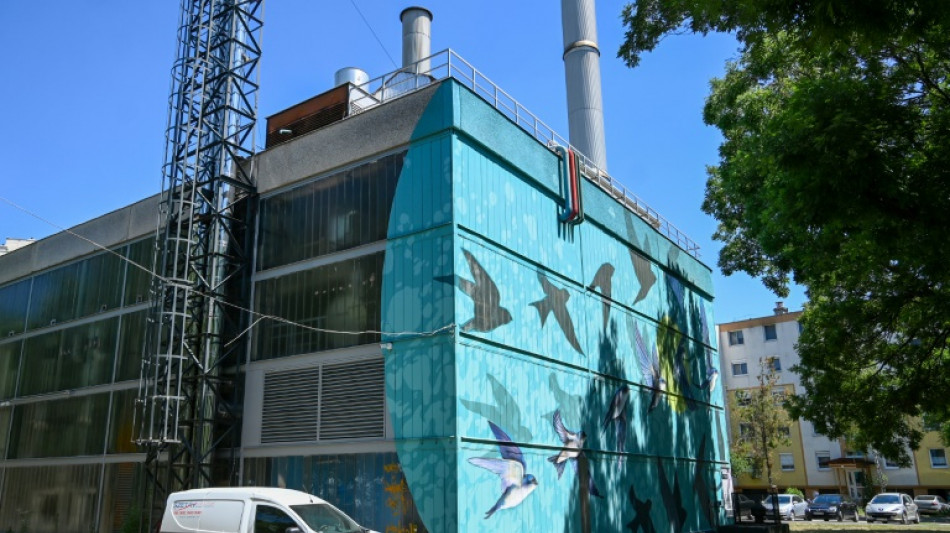
Hot water wells in Hungary fuel switch from Russian gas / Photo: ATTILA KISBENEDEK - AFP

 US Fed holds interest rates steady despite 'too high' inflation

 Airbus aims for record deliveries despite disappointing quarter

 Real Madrid, La Liga apology over Mbappe shows power of Chinese market

 'Cruise for life' strands passengers in Cambodia as operator goes bust

 Canada hikes rates to contain oil price surge caused by Iran war

 Nintendo producer 'all nervous' as Zelda classic remake hits shelves

 Three killed by storm in southern India

 Two hundred 'Cruise for life' passengers stranded in Cambodia

 Billionaire Ambani's Jio jumps 21% in market debut after record India IPO

 Sri Lanka's Tamil farmers fight to reclaim land after civil war

 'They don't care about us': Trump food aid cuts leave Americans struggling and angry

 Palestinian activist Khalil returns to Columbia after US detention

 Youths testify about 'despair' in unprecedented Canadian climate trial

 Charles tackles thorny legacy of slavery on Caribbean trip
At plants painted with birds and hedgehogs, hot water from deep underground is being channelled to produce energy and heat for thousands of households in Hungary's third largest city Szeged.
Experts say the project -- billed as Europe's biggest urban heating system overhaul -- can serve as a model for other cities across the continent as EU nations scramble to wean themselves off Russian gas after Moscow's invasion of Ukraine.
"Geothermal energy is local, accessible and renewable so why not use it," geologist Tamas Medgyes told AFP beside a recently completed well in the middle of a residential neighbourhood.
The city of 160,000 people, located some 170 kilometres (110 miles) south of Budapest, is one of 12 in the landlocked central European country with geothermal district heating.
When the system is fully built out next year, 27 wells and 16 heating plants will push geothermally heated water through 250 kilometres of pipes to heat 27,000 flats and 400 non-residential consumers.
- 'Blueprint' -
This will make it Europe's biggest geothermal urban heating system outside of Iceland.
But unlike in the Icelandic capital, Szeged's heating systems were built to run on gas.
EU member Hungary covers 65 percent of its oil needs and 80 percent of its gas needs with imports from Russia.
"This housing project was built in the 1980s. Since then we have burnt millions of cubic metres of imported Russian gas to heat cold water in these apartments," Medgyes said.
But now, "we drilled down and got the hot water beneath our feet," he said about the project, whose cost of more than 50 million euros ($51 million) is partially covered by EU funds.
He added the project can be a "blueprint" for cities in parts of France, Germany, Italy or Slovakia that are rich in geothermal deposits.
Experts says geothermal energy is an underutilised source of renewable heat in Europe.
"The geothermal urban heating development in Szeged is an easy-to-adopt example in many regions of Europe," said Ladislaus Rybach, an expert at the Institute of Geophysics in Zurich, Switzerland.
Lajos Kerekes of the Regional Centre of Energy Policy Research told AFP that more than 25 percent of the EU's population lives in areas suitable for geothermal district heating.
Long before the Ukraine war, Balazs Kobor, director at Szeged heating firm Szetav, began exploring how cities can use geothermal energy and "knocking on doors of decision-makers".
In 2015, the city municipality appointed him and Medgyes to initiate the integration of renewables into district heating.
"To heat the city annually the firm was burning 30 million cubic metres of gas and producing around 55,000 tonnes of carbon emissions every year," said Kobor.
"The city itself was its biggest carbon emitter," he added.
Replacing gas by geothermal energy will slash the city's greenhouse gas emissions by 60 percent -- around 35,000 tonnes -- annually, according to Kobor.
If similar small-to-medium-sized cities switched their district heating to geothermal it would be "a major step towards a carbon neutral, sustainable Europe," he said.
- 2,000 metres below ground -
Surrounded by the Carpathian and Alps mountain ranges, Hungary and especially the area around Szeged forms a basin where 92-93 degree Celsius (198-199 degree Fahrenheit) hot water collects as deep as 2,000 metres (6,600 feet) below ground.
In facilities adjacent to the wells, "heat exchangers" comprising hundreds of metal panels transfer the heat to water in pipeline circuits that serve different neighbourhoods.
The geothermal water itself does not enter the circuits but re-enters the earth through a "reinjection" well nearby, explained Medgyes.
In another neighbourhood, a noisy drill is gradually working its way deeper and deeper into the ground, adding sections of pipe as it goes.
The drilling period takes around three months, said Medgyes.
And while residents can see and hear the drills as they work, after the work is done, they don't notice the change of heat source in their homes.
"The radiators and tap water are as warm as before. I don't feel any difference," Gabriella Maar Pallo, a 50-year-old clerk, told AFP in her nearby apartment.
St.Ch.Baker--CPN