BoE agrees second rate hike in row as inflation soars

 Lights out in Laos as electricity exports surge

 Steven Strogatz weighs AI mathematics advances and their consequences for researchers

 Anthropic boss calls for AI slowdown, Altman and Musk agree

 French IT giant Capgemini sells subsidiary after row over ICE links

 Quebec Brokerage Qubit Insurance Announces New Data on Coverage Shortfalls as Rebuilding Costs Rise

 Lady Gaga welcomes first child with fiance: US media

 Bhutan business bets on hazelnuts for farming future

 'Widow's Bay' and 'The Pitt' are favorites for Emmys night

 Coastal erosion forces cancellation of California music festival

 Argentina's Dirty War rears its head in Venice film

 UK lawmakers throw out bill to legalise assisted dying

 US inflation steady in August, fueling Fed rate hike expectations

 New York marks 25th anniversary of 9/11 attacks

 Nepal flood reconstruction bill to be $4.78 bn: foreign ministry

 JUMO and Standard Bank launch Social Finance Framework to scale inclusive finance in Africa

 Doomsday tech: could AI really kill us all?

 French comedy show 'Call my agent' makes film comeback

 It's all coming back: Celine Dion fans gear up for Paris return

 Researchers eye AI revolution in natural disaster forecasts

 US braces for inflation report that may push Fed to hike rates

 Musk threatens legal action over documentary

 Latin America fact-check group asks Meta not to replace verification practice

 AI Risks to Enter 60–80% of Liability and Cyber Insurance Underwriting by 2028, ScienceSoft Predicts

 Tribal Launches Campfire, Letting Business and Technical Teams Build on Salesforce Together

 Stocks fall as fresh oil surge fans inflation fears

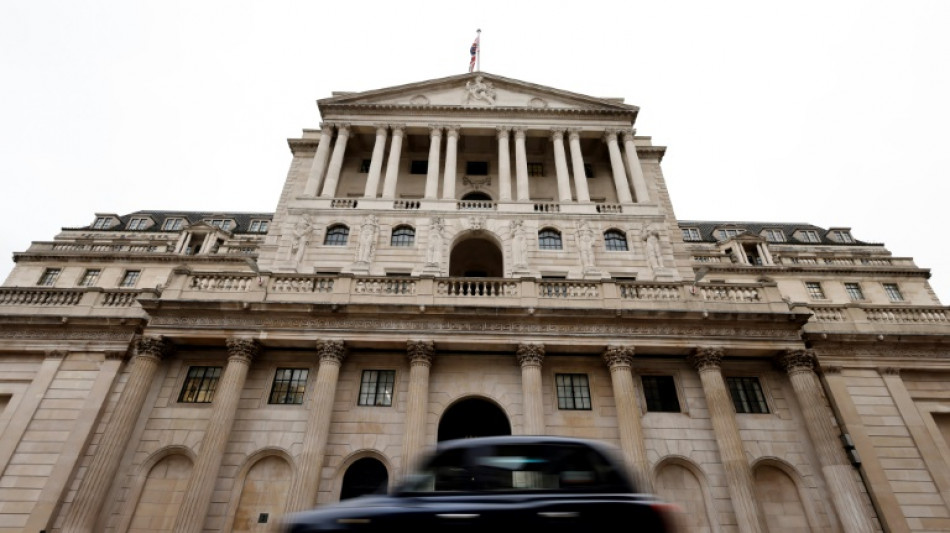
The Bank of England on Thursday lifted its main interest rate for the second time in a row in a bid to tackle decades-high inflation.
The BoE also said Britain's annual inflation rate would peak at 7.25 percent in April, compared with 5.4 percent last December which was already near a 30-year high.
The central bank slashed its interest rate dramatically in 2020 to help the economy weather the effects of the Covid pandemic.
With soaring prices now threatening the economic recovery, the BoE decided Thursday to raise borrowing costs again by a quarter point to 0.5 percent.
It had already increased interest rates from a record-low 0.1 percent to 0.25 percent in December -- the first monetary policy tightening in more than three years.
Minutes of the regular meeting said all nine policymakers judged that a further increase was warranted given a tight labour market and "continuing signs of greater persistence in domestic cost and price pressures".
Policymakers were divided however on the size of the increase.
A majority five members, including governor Andrew Bailey, voted for a rise to 0.5 percent, while the remaining four wanted a larger increase to 0.75 percent.
It is the first time that the BoE has increased its policy rate in two successive meetings since June 2004.
The European Central Bank, which is also holding its regular policy meeting on Thursday, is expected to leave its key interest rates unchanged.
ECB chief Christine Lagarde has downplayed inflation concerns, arguing that the forces pushing up prices across the eurozone are expected to ease over 2022.
Official data on Wednesday showed that eurozone inflation soared to a record high of 5.1 percent in January.
On the other side of the Atlantic, the US Federal Reserve is expected to hike borrowing costs as many as seven times before 2023, with an initial 50-basis-point move pencilled in for March.
- Rising costs -
Britain's soaring inflation has stoked fears about a cost-of-living squeeze as wages fail to keep pace.
And UK inflation is forecast to move even higher in the coming months with domestic energy prices set to surge.
The BoE's chief task is to keep inflation close to 2.0 percent.
At the same time, Britain's economy has surpassed its pre-pandemic level after recording strong growth in November.
Since then, however, retail sales suffered a record drop in December as consumers shunned bricks-and-mortar shops owing to concerns over the Omicron coronavirus variant.
While higher interest rates increase costs for borrowers, including homeowners and businesses, they improve returns on savings.
As the pandemic erupted in early 2020, the BoE slashed its key interest rate from 0.75 percent and also began pumping massive sums of new cash into the economy.
It has created £450 billion (540 billion euros, $610 billion) under its quantitative easing (QE) programme since March 2020, when Britain imposed its first coronavirus lockdown.
Prior to that, it had pumped hundreds of billions of pounds worth of QE into the UK economy over a decade following the 2008-09 global financial crisis and Brexit.
The central bank's total emergency stimulus package stands at £895 billion, an amount kept on hold Thursday.
Y.Ponomarenko--CPN