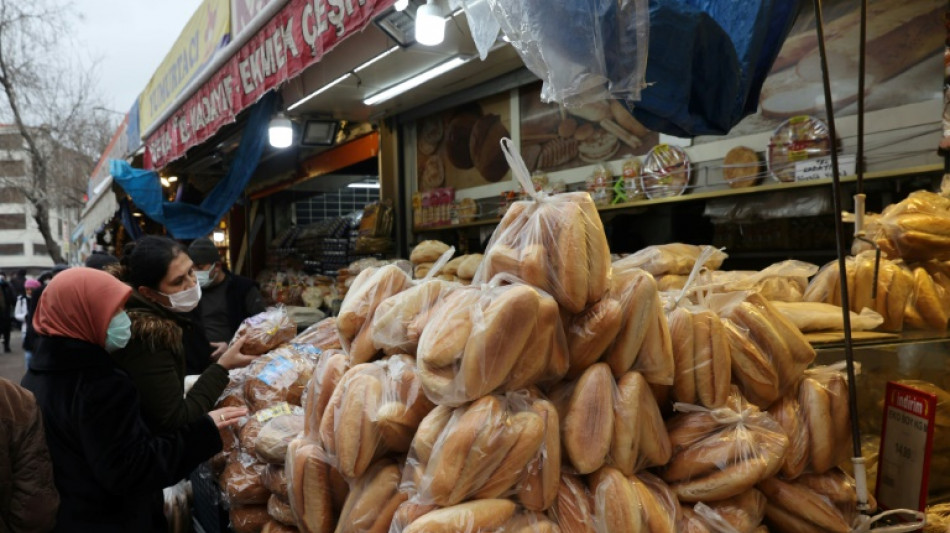
Turkey inflation surges to near 20-year high

 Lights out in Laos as electricity exports surge

 Steven Strogatz weighs AI mathematics advances and their consequences for researchers

 Anthropic boss calls for AI slowdown, Altman and Musk agree

 French IT giant Capgemini sells subsidiary after row over ICE links

 Quebec Brokerage Qubit Insurance Announces New Data on Coverage Shortfalls as Rebuilding Costs Rise

 Lady Gaga welcomes first child with fiance: US media

 Bhutan business bets on hazelnuts for farming future

 'Widow's Bay' and 'The Pitt' are favorites for Emmys night

 Coastal erosion forces cancellation of California music festival

 Argentina's Dirty War rears its head in Venice film

 UK lawmakers throw out bill to legalise assisted dying

 US inflation steady in August, fueling Fed rate hike expectations

 New York marks 25th anniversary of 9/11 attacks

 Nepal flood reconstruction bill to be $4.78 bn: foreign ministry

 JUMO and Standard Bank launch Social Finance Framework to scale inclusive finance in Africa

 Doomsday tech: could AI really kill us all?

 French comedy show 'Call my agent' makes film comeback

 It's all coming back: Celine Dion fans gear up for Paris return

 Researchers eye AI revolution in natural disaster forecasts

 US braces for inflation report that may push Fed to hike rates

 Musk threatens legal action over documentary

 Latin America fact-check group asks Meta not to replace verification practice

 AI Risks to Enter 60–80% of Liability and Cyber Insurance Underwriting by 2028, ScienceSoft Predicts

 Tribal Launches Campfire, Letting Business and Technical Teams Build on Salesforce Together

 Stocks fall as fresh oil surge fans inflation fears

Turkey's annual inflation rate in January reached its highest level since April 2002, official data showed Thursday, after a currency crisis decimated people's purchasing power.
Consumer prices surged by a stronger-than-expected 48.7 percent from the same period in January last year, up from an annual rate of 36.1 percent in December, according to the Turkish statistics agency.
The reading came out just days after President Recep Tayyip Erdogan changed the head of the state statistics agency for the fourth time since 2019.
Turkish media reported that Erdogan was unhappy with agency data showing inflation reaching the highest level since his Islamic-rooted party stormed to power two decades ago, complicating his path to re-election in 2023.
Former agency chief Erdal Dincer had only been in the job for 10 months. He was replaced by Erhan Cetinkaya, who was vice-chair of Turkey's banking regulator.
Independent data collected by Turkish economists suggested that the annual rate of inflation rose to more than 110 percent in January.
Erdogan staunchly opposes raising interest rates, which he believes cause inflation -- the exact opposition of conventional economic thinking.
He admitted on Monday that Turks would "have to carry the burden" of inflation for "some time".
"God willing we have entered a period where each month is better than the previous one," he added.
Turkey has suffered from persistently high inflation for years, experiencing two currency crises since 2018.
The second last year came after Erdogan orchestrated sharp interest rate cuts that put them far below the rate at which prices were rising, eroding Turks' purchasing power and the value of their savings.
This prompted Turks to stock up on gold and foreign currency, resulting in a currency crash that saw the lira lose 44 percent of its value against the dollar in 2021.
- 'Fight against interest rates' -
Turkish Finance Minister Nureddin Nebati told Nikkei Asia in an interview published on Thursday that inflation would peak in April before falling to the single digits by the June 2023 general election.
The central bank last month also revised up its forecast for inflation at the end of 2022 to 23.2 percent from 11.8 percent, although most economists dismiss the reading as overly optimistic.
"We expect inflation to hover at 45-50% throughout much of this year and, barring another collapse in the lira, it will only drop back in the final months of 2022," said analyst Jason Tuvey of Capital Economics.
The government hopes that inflation will fall after pressures -- including a minimum wage hike in January and rising energy bills for households and businesses -- subside and new currency support measures kick in.
The central bank paused a four-month streak of interest rate cuts in January, providing relief for lira, which has held largely steady this year.
But at the weekend, Erdogan once again refused to accept conventional thinking that says high borrowing costs help bring down consumer prices by limiting demand and slowing economic activity.
"You know my fight against interest rates," he said.
"We're going to bring down the rate and we are reducing the rate. Know that inflation will fall -- it will fall further."
Erdogan cites Islamic rules against usury while promoting an "economic war of independence" designed to break Turkey's reliance on foreign currency inflows.
But economists point out that Turkey still needs dollars to pay for energy and other imports, which become more expensive as the value of the lira drops.
Y.Tengku--CPN