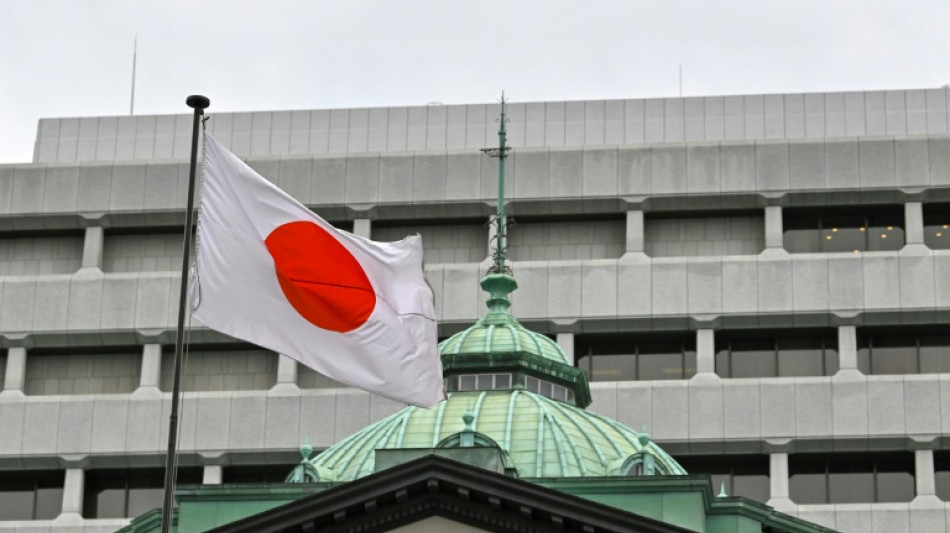
Stocks waver, oil prices fall on recession fears / Photo: Kazuhiro NOGI - AFP

 Airbus aims for record deliveries despite disappointing quarter

 Real Madrid, La Liga apology over Mbappe shows power of Chinese market

 'Cruise for life' strands passengers in Cambodia as operator goes bust

 Canada hikes rates to contain oil price surge caused by Iran war

 Nintendo producer 'all nervous' as Zelda classic remake hits shelves

 Three killed by storm in southern India

 Two hundred 'Cruise for life' passengers stranded in Cambodia

 Billionaire Ambani's Jio jumps 21% in market debut after record India IPO

 Sri Lanka's Tamil farmers fight to reclaim land after civil war

 'They don't care about us': Trump food aid cuts leave Americans struggling and angry

 Palestinian activist Khalil returns to Columbia after US detention

 Youths testify about 'despair' in unprecedented Canadian climate trial

 Charles tackles thorny legacy of slavery on Caribbean trip

Stock markets wobbled and oil prices sank on Friday over growing fears that inflation-fighting interest rate hikes by central banks could trigger recessions.
Investors were shaken this week after the US Federal Reserve unleashed its biggest hike in borrowing costs for almost 30 years to tackle runaway consumer prices.
This was followed by the fifth straight hike by the Bank of England and the first in 15 years by the Swiss central bank, underscoring the growing global concerns about inflation.
The moves caused a global selloff on Thursday. US and European markets tried to stage a rebound on Friday, but some indices were back in the red later in the day.
On Wall Street, the Dow Industrial Average was back under 30,000 points approaching midday, but the broad-based S&P 500 and the tech-heavy Nasdaq were in the green.
European markets seesawed, with London in the red while Frankfurt and Paris were up in late afternoon deals.
"Worries about weakening earnings growth prospects have precipitated some of this week's selling interest. Those worries have not gone away," said Patrick O'Hare, analyst at Briefing.com.
Sentiment turned sour again as US official data showed industrial production in May had risen by just 0.2 percent, much slower than April and weaker than expected.
Asian stock markets mostly closed lower Friday.
Recession fears also gripped the oil market as WTI, the US benchmark, fell by 5.5 percent to $111.12 per barrel. The international benchmark, Brent North Sea Crude, was down almost five percent at $114.23.
Energy prices have soared since Russia invaded Ukraine, driven inflation higher, which has prompted central banks to spring into action.
Investors worry that while the rate increases can help tame inflation, they can have the adverse side effect of crimping economic growth.
"There is unlikely to be sustained relief from the sinking feeling that has hit financial markets this week, as worries rise countries around the world will not avoid falling into the economic pit of recession," said Hargreaves Lansdown analyst Susannah Streeter.
"After the initial boost of optimism that the Federal Reserve was going to get a handle on inflation... concerns mounted that the price spiral was going to be an even harder nut to crack without fresh aggressive hikes."
The Bank of Japan, however, bucked the global trend on Friday as it stood by its decision not to raise its rate, sending the yen close to the lowest level against the dollar since 1998.
Officials in Tokyo insist that low rates are still needed to nurture a struggling economy, though the BoJ did say it "was necessary to pay due attention to developments in financial and foreign exchange markets".
Stock markets have been tumbling for months as traders contemplate the end of the era of cheap cash that had sent share prices to record or multi-year highs.
Inflation worldwide stands at levels not seen for decades owing in particular to surges in energy and food prices.
- Key figures at around 1510 GMT -
New York - Dow: DOWN 0.1 percent at 29,888.20 points
London - FTSE 100: DOWN 0.2 percent at 7,033.70
Frankfurt - DAX: UP 0.6 percent at 13,110.58
Paris - CAC 40: UP 0.1 percent at 5,893.19
EURO STOXX 50: UP 0.4 percent at 3,439.81
Tokyo - Nikkei 225: DOWN 1.8 percent at 25,963.00 (close)
Hong Kong - Hang Seng Index: UP 1.1 percent at 21,075.00 (close)
Shanghai - Composite: UP 1.0 percent at 3,316.79 (close)
Euro/dollar: DOWN at $1.0464 from $1.0549 late Thursday
Pound/dollar: DOWN at $1.2199 from $1.2353
Euro/pound: UP at 85.79 pence from 85.41 pence
Dollar/yen: UP at 135.30 yen from 132.21 yen
Brent North Sea crude: DOWN 4.7 percent at $114.23 per barrel
West Texas Intermediate: DOWN 5.5 percent at $111.12
burs-lth/jm
M.Mendoza--CPN