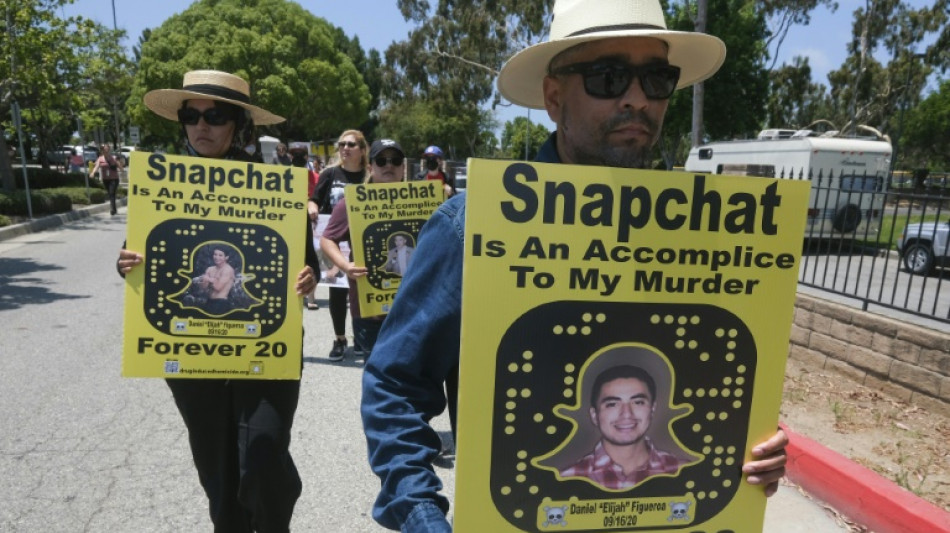
Families of overdose victims demand action from social media platforms / Photo: RINGO CHIU - AFP

 French firm Safran helps build aircraft wings of the future in UK factory

 World Bank warns of worsening food insecurity as commodity prices soar

 Billionaire Ambani's Jio soars in market debut after India's biggest IPO

 AI chip giant SK hynix posts seven-fold surge in quarterly operating profit

 S.African activists push back on data centre rush

 Billionaire Ambani's Jio to debut after record India IPO

 UK set for cautious budget as borrowing costs climb

 US Fed expected to hold rates steady ahead of key midterm elections

 AI chip giant SK hynix says quarterly operating profit soars 630%

 GA-ASI and Saab Perform Advanced AEW Flight Testing on Uncrewed MQ-9B

 Storied Paris department store seeks bankruptcy protection

 Boeing shares tumble after it releases cautious growth forecast
Families of teens who died after overdosing on drugs they bought through Snapchat and other social media platforms called Monday for tech firms to do more to address the problem.
Sam Chapman, part of a group that staged a protest Monday in front of Snapchat's Santa Monica headquarters, told AFP his son died in February 2021 after a pill he purchased through the platform was laced with the extremely powerful opioid fentanyl.
"I'm here today to warn people about the dangers of social media, delivering drugs and other criminal acts into the lives of our families, through our children," said Chapman, 57.
His son Sammy would have celebrated his 18th birthday last weekend.
Chapman described the horrific scene of finding his son dead on the floor in his bedroom, in what he said was called the "fentanyl death pose."
"He had stopped breathing and fell backwards in his chair and vomited, and he choked on his own vomit... It's a very common way of going," said Chapman.
Of the 107,000 overdose deaths recorded last year in the United States, 70 percent were caused by "fentanyl poisoning," which is now the leading cause of death for Americans aged 18 to 45, according to the groups backing Monday's protest.
Chapman said a drug dealer had contacted his son on Snapchat, and sent him a "colorful drug menu with pictures."
"At the bottom it said that he delivered. And so he connected with our son and delivered the drugs to our home after we were asleep, like it was a pizza," he added.
Like the other victims' family members, Chapman is calling on Snapchat and other social media platforms geared toward young people to take stronger action against drug sales.
"We have been working tirelessly to help combat this national crisis by eradicating illicit drug dealers from our platform," a Snapchat spokesperson told AFP.
"We use advanced technology to proactively detect and shut down drug dealers who try to abuse our platform, and block search results for dangerous drug-related content," the representative added.
But Chapman said the tools currently in place do not work because dealers use emojis and code words that aren't blocked.
The group Victims of Illicit Drugs (VOID) is demanding US law to be updated so that social networks are held liable for what happens to their users on their platforms.
"If you're walking in a grocery store, you slip and fall, you can sue them," said VOID president Jaime Puerta.
"The law was written in 1996," he added.
"The legislators had no idea of where the internet would be today."
Y.Tengku--CPN