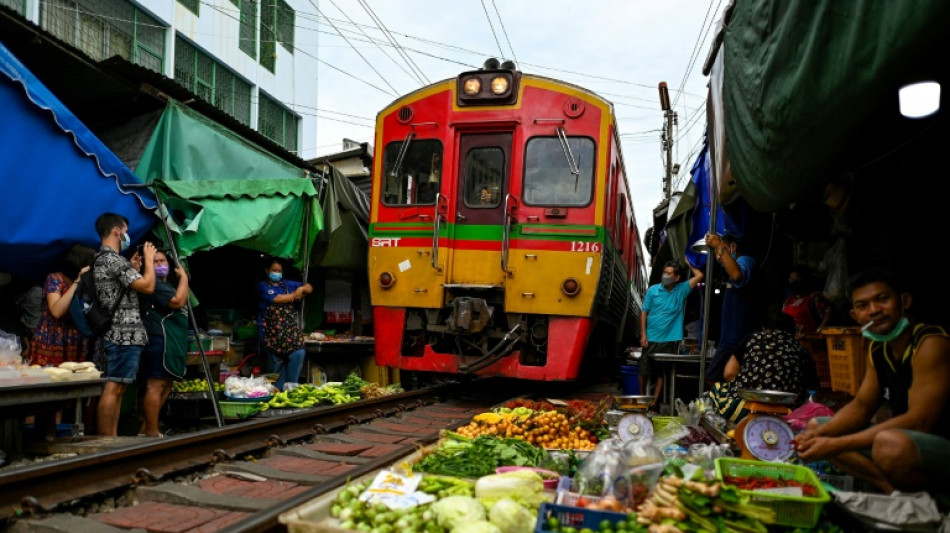
Thai railway market back on track post-pandemic / Photo: Manan VATSYAYANA - AFP

 French firm Safran helps build aircraft wings of the future in UK factory

 World Bank warns of worsening food insecurity as commodity prices soar

 Billionaire Ambani's Jio soars in market debut after India's biggest IPO

 AI chip giant SK hynix posts seven-fold surge in quarterly operating profit

 S.African activists push back on data centre rush

 Billionaire Ambani's Jio to debut after record India IPO

 UK set for cautious budget as borrowing costs climb

 US Fed expected to hold rates steady ahead of key midterm elections

 AI chip giant SK hynix says quarterly operating profit soars 630%

 GA-ASI and Saab Perform Advanced AEW Flight Testing on Uncrewed MQ-9B

 Storied Paris department store seeks bankruptcy protection

 Boeing shares tumble after it releases cautious growth forecast
A train bell rouses a Thai grandmother dozing in her fruit and flower stall, sending her rushing to fold in her awning before the locomotive slowly rumbles past, so close it almost touches her wares.
Six times a day at the Mae Klong Railway Market, local customers and foreign tourists scramble into nooks and crannies while vendors calmly move their woven baskets of goods away from the tracks and close their umbrellas to make way.
Hundreds of stallholders carve out a living along this 500-metre stretch of railway in Samut Songkhram, 80 kilometres (50 miles) west of Bangkok, selling everything from fresh produce to live turtles to clothes and souvenirs.
"Even though it looks risky and dangerous, it's not dangerous at all," said fruit and vegetable vendor Samorn Armasiri.
Her family has run a stall in the bazaar -- nicknamed in Thai "talad rom hup", or the umbrella-pull-down market -- for five decades, and she's never witnessed an accident.
"When the train enters, officers sound the horn and everybody packs their stuff -- they know the drill," she said.
- Big train, tiny space -
The sides of the train carriages pass directly over -- with just centimetres to spare -- bags of lettuce, broccoli, onions, ginger, chilli, tomatoes and carrots placed carefully on the outside of the rails.
In recent years, the spectacle had become a hub for coconut-drinking backpackers in elephant pants and Instagram selfie enthusiasts, but the pandemic hit hard.
Now, with Thailand dropping Covid-19 entry restrictions, tourism is picking up once more.
Australian Ella McDonald, on a two-day stopover on her way to Turkey, was among those marvelling at the market's organised chaos.
"It was crazy and hectic," she told AFP. "I was shocked at how big the train was in the small amount of space.
"It's a unique experience. I've never seen anything like this anywhere else in the world."
- Not just for tourists -
Before Covid-19 hit, the market was also beloved by Chinese tourists buying durian -- the pungent-smelling "king of fruit".
Strict quarantine rules presently discourage would-be visitors from China, who once made up the largest share of foreign tourists in Thailand.
But even without them, fishmonger Somporn Thathom -- a stallholder since 1988 -- said business was finally picking up after two years of hardship and financial strain.
"During Covid, I barely made enough to pay my staff. I managed to sell 10 fish per day," the 60-year-old said.
"I used up all my savings... and had to borrow money from the bank."
Station manager Charoen Charoenpun believes the market's authenticity ensures its popularity.
"It's not made up. It's not built for the tourists," he said.
"The tourists, when they come they can see the tradition and culture of the local people of Samut Songkhram."
But for eight-year-old Australian William, the pandemonium ensuing as the train passed through was captivating.
"The most exciting thing is when you get the train going past -- just seeing the (market vendors) pack up," he said.
X.Wong--CPN


