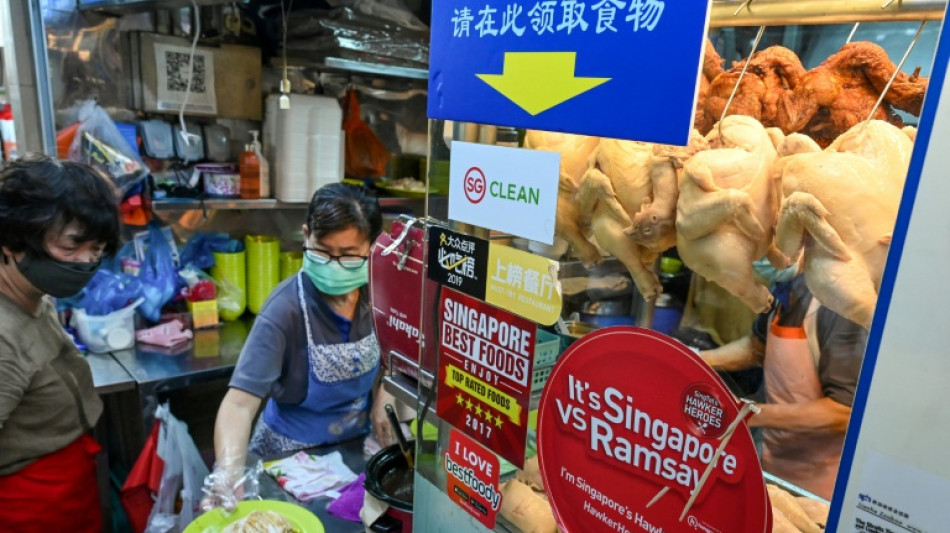
Singaporeans in a flap at Malaysian chicken export curbs / Photo: Roslan RAHMAN - AFP

 French firm Safran helps build aircraft wings of the future in UK factory

 World Bank warns of worsening food insecurity as commodity prices soar

 Billionaire Ambani's Jio soars in market debut after India's biggest IPO

 AI chip giant SK hynix posts seven-fold surge in quarterly operating profit

 S.African activists push back on data centre rush

 Billionaire Ambani's Jio to debut after record India IPO

 UK set for cautious budget as borrowing costs climb

 US Fed expected to hold rates steady ahead of key midterm elections

 AI chip giant SK hynix says quarterly operating profit soars 630%

 GA-ASI and Saab Perform Advanced AEW Flight Testing on Uncrewed MQ-9B

 Storied Paris department store seeks bankruptcy protection

 Boeing shares tumble after it releases cautious growth forecast
Long queues at stalls selling a popular chicken dish, increasing prices and warnings about supply disruptions -- Singaporeans are in a flap due to curbs on poultry exports from neighbouring Malaysia.
Malaysia's move to halt exports of 3.6 million chickens a month, which kicks in Wednesday, is the latest protectionist move in Asia aimed at tackling domestic shortages and taming surging inflation.
But the surprise step has caused consternation in Singapore, a tiny city-state that relies on its larger neighbour for a good chunk of food imports, including around a third of its chicken.
Of particular concern is the impact on chicken rice, a hugely popular dish of poached chicken, rice and chili dip, often sold at the city-state's ubiquitous open-air food courts.
Chicken prices "will definitely go up", said Foo Kui Lian, founder of Tian Tian Hainanese Chicken Rice, one of the best-known stalls selling the dish in Singapore.
"If (suppliers) raise prices by a lot we would have to raise ours a bit, or it'll be difficult for us to survive."
A day before the export curbs kicked in, a long queue formed at the stall as diners sought to get a taste of the dish before a feared surge in prices.
Office worker Meilan Lim was among those who bought the dish ahead of the restrictions.
"Even though I'm not really a chicken rice person, it's just that sometimes you do have the craving," she told AFP.
"So if (the ban is) going to be lasting for a while, it's going to be a problem for me."
Some stall holders have already hiked their prices, and officials are warning about disruptions to chicken supplies.
The city-state's food agency has advised consumers to buy only what they need, consider buying frozen instead of refrigerated chicken, or shift to different meats.
Most chickens from Malaysia are imported to Singapore alive, and then slaughtered and chilled there. Frozen chicken is often imported from other countries, including Brazil.
Like many other countries, Malaysia is battling rising inflation, particularly when it comes to food, which prompted it to impose the curbs.
But Singapore -- which has had a fractious relationship with Kuala Lumpur for decades -- is also facing rising prices, with inflation at a decade-high.
Other countries that have taken protectionist measures include India, which banned wheat exports and Indonesia, which temporarily halted palm oil shipments.
The moves come as concerns grow worldwide about food insecurity caused by supply chain snarls, climate change and Russia's invasion of Ukraine, a major grain producer.
T.Morelli--CPN


