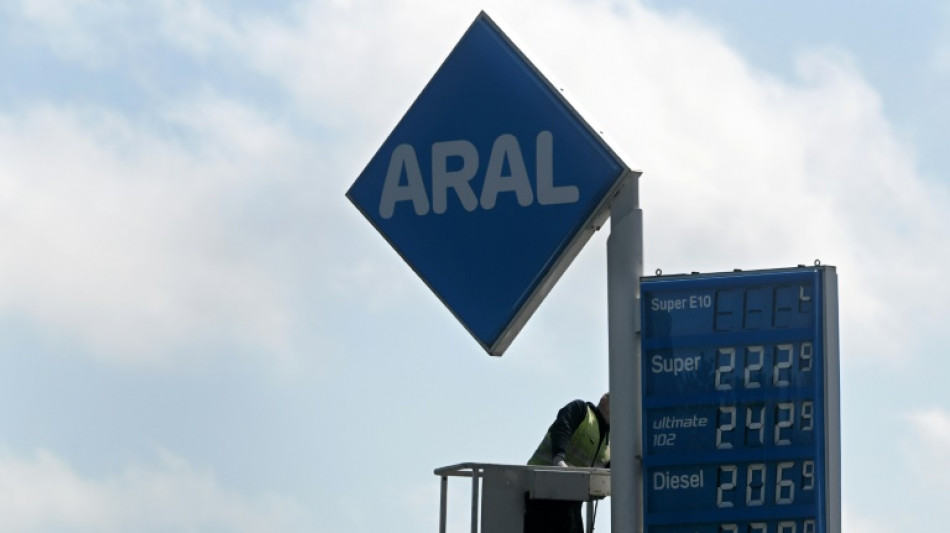
Eurozone inflation soars to new record over Ukraine war / Photo: Christof STACHE - AFP/File

 French firm Safran helps build aircraft wings of the future in UK factory

 World Bank warns of worsening food insecurity as commodity prices soar

 Billionaire Ambani's Jio soars in market debut after India's biggest IPO

 AI chip giant SK hynix posts seven-fold surge in quarterly operating profit

 S.African activists push back on data centre rush

 Billionaire Ambani's Jio to debut after record India IPO

 UK set for cautious budget as borrowing costs climb

 US Fed expected to hold rates steady ahead of key midterm elections

 AI chip giant SK hynix says quarterly operating profit soars 630%

 GA-ASI and Saab Perform Advanced AEW Flight Testing on Uncrewed MQ-9B

 Storied Paris department store seeks bankruptcy protection

 Boeing shares tumble after it releases cautious growth forecast
Eurozone inflation accelerated to another record high in May, data showed Tuesday, as the war in Ukraine stoked energy and food prices and threatened to flatline the economy.
The EU's Eurostat data agency said that the increase in consumer prices in the 19 countries that use the euro reached 8.1 percent compared to the year before, up from 7.4 percent in April.
The uninterrupted rise in prices heaped pressure on the European Central Bank to speed up interest rate rises for the first time in over a decade.
The ECB has said it plans to hike interest rates in July in order to cool the pressure on prices and is expected to officially end its bond-buying stimulus policies as early as next week.
By raising rates, the ECB would be playing catch-up with other major central banks that have already made moves to tame inflation that has spread globally.
The US Federal Reserve raised rates by an unusually large 50 basis points at the beginning of May, while the Bank of England sealed its fourth consecutive hike.
The chief economist of the European Central Bank, Philip Lane, indicated on Monday that interest rates in the eurozone will rise more cautiously, going up by 0.25 percent in July and again in September.
This would lift the ECB's bank deposit rate out of negative territory, meaning lenders would no longer pay to park their excess cash at the central bank.
The ECB had previously argued that sharp leaps in consumer prices, driven also by the waning effect of Covid-19 pandemic, were likely to let up, downplaying the inflationary threat.
Russia's war in Ukraine disrupted that view, worsening already disrupted supply chains and throwing up new shortages in essential material from wheat to metals.
This remained that case in May with energy prices spiking by a hair-raising 39.2 percent from a year earlier. Food prices went up by 7.5 percent.
- Energy crunch -
Western economies including Germany -- the eurozone's biggest -- are scrambling to wean themselves off Russian energy, which will also have its effects on inflation.
The EU on Monday agreed to ban two-thirds of its oil dependency by the end of the year -- and German and Polish pledges to voluntarily forgo pipeline deliveries could push the cut to 90 percent -- which could put still more upward pressure on prices.
The ban on Russian oil swiftly hit the market price for oil which means "that risks (to inflation) are skewed once again to the upside", said Oxford Economics in a note.
"We think headline inflation will peak in the second quarter but will slow only gradually throughout 2022," it added.
Policymakers will also be keeping an especially close eye on wages for fear pay increases to help workers meet high prices could stoke inflation further.
Despite the challenges, Lane on Monday stood by the ECB's assessment that inflation in the eurozone would find its way back to its two percent target in the medium term.
Meanwhile, fears of negative or zero growth in Europe will be fuelled by data showing the French economy contracted 0.2 percent in the first quarter from the previous three months, in a downward revision.
The European Commission this month sharply cut its eurozone growth forecast for 2022 to 2.7 percent, but warned the outlook was highly uncertain because of the war in Ukraine.
A.Zimmermann--CPN

