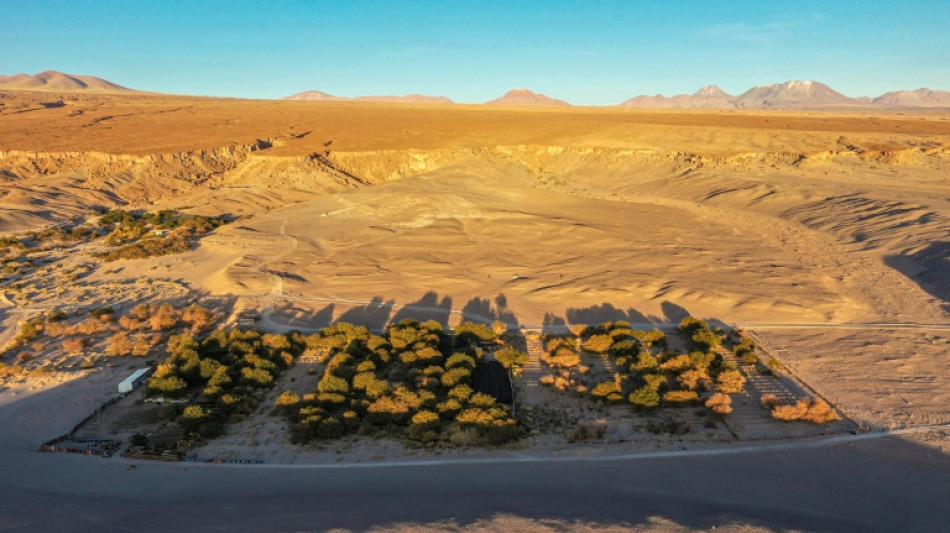
'Kind of complicated': Growing grapes in the world's driest desert / Photo: MARTIN BERNETTI - AFP/File

 French firm Safran helps build aircraft wings of the future in UK factory

 World Bank warns of worsening food insecurity as commodity prices soar

 Billionaire Ambani's Jio soars in market debut after India's biggest IPO

 AI chip giant SK hynix posts seven-fold surge in quarterly operating profit

 S.African activists push back on data centre rush

 Billionaire Ambani's Jio to debut after record India IPO

 UK set for cautious budget as borrowing costs climb

 US Fed expected to hold rates steady ahead of key midterm elections

 AI chip giant SK hynix says quarterly operating profit soars 630%

 GA-ASI and Saab Perform Advanced AEW Flight Testing on Uncrewed MQ-9B

 Storied Paris department store seeks bankruptcy protection

 Boeing shares tumble after it releases cautious growth forecast
In the middle of Chile's Atacama desert, the driest in the world, Hector Espindola has an unexpected job: he runs a vineyard.
Nearly 2,500 meters (8,000 feet) above sea level, his small Bosque Viejo farm produces muscat grapes -- and another of a unique "criollo," or local, variety -- in the shadow of quince, pear and fig trees irrigated by a stream fed by melting Andean snow.
Espindola, 71, farms in an oasis in the Toconao region in Chile's extreme north -- some 1,500 kilometers (932 miles) from the vineyards at the center of the world's longest country that have made it one of the world's top 10 wine exporters.
But growing grapes in the desert is no easy task.
Espindola contends with extreme day-night temperature fluctuations and extreme solar radiation on top of wind and frost.
"You have to be dedicated. I water here at night... at three in the morning, eleven at night," he told AFP while caressing his vines, dry and brown two months after the harvest.
"You have to be careful because here the heat, the climate is no joke," he said.
"Sometimes it is windy and production is lost, sometimes the frost comes early. It is kind of complicated."
- For her sons -
Espindola sends his crop to the Ayllu cooperative which since 2017 has received grapes from 18 small vineyards around Toconao.
In 2021, the cooperative received 16 tons of grapes for a yield of 12,000 bottles.
The harvest was better in 2022 with more than 20 tons of grapes -- enough for 15,000 bottles but still just a drop, at about one percent, of Chile's annual production.
Most contributors to the cooperative are members of indigenous communities who were previously individual, small-scale producers.
One of them, 67-year-old Cecilia Cruz, grows syrah and pinot noir grapes at an altitude of about 3,600 meters outside the village of Socaire -- Chile's highest vineyard.
"I feel special... to have this vineyard here and to produce wine at this altitude," she said amid the vines that still sport a few bunches of wrinkled, dried grapes.
But she has a bigger goal: "a future" for her three sons.
- 'Taste the Atacama' -
For Ayllu oenologist Fabian Munoz, 24, the mission is to create a unique wine that captures the characteristics of the volcanic rock in which the grapes grow.
"When the consumer tastes an Ayllu wine (they should) think: 'Wow! I'm tasting the Atacama desert'," he said.
Carolina Vicencio, an expert in wine chemistry, said the altitude, low atmospheric pressure and extreme temperature fluctuations make for a thicker-skinned grape.
"This generates more tannin molecules in the skin of the grape which gives a certain bitterness in the wine," she said.
"There is also higher salinity of the soil... which makes for a touch of mineralization in the mouth" that makes the Atacama desert wine one of a kind.
H.Meyer--CPN