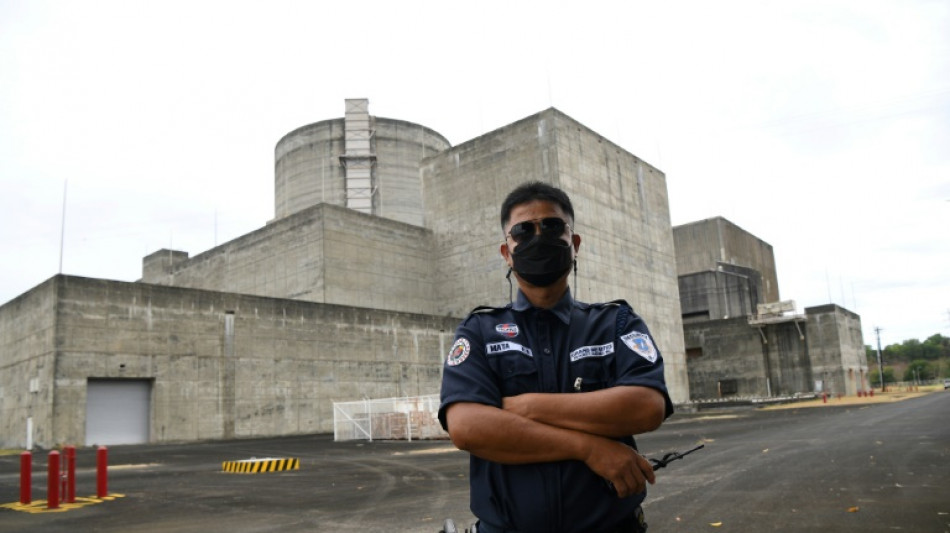
Philippines' Marcos in nuclear plant revival talks with S.Korea / Photo: Ted ALJIBE - AFP/File

 French firm Safran helps build aircraft wings of the future in UK factory

 World Bank warns of worsening food insecurity as commodity prices soar

 Billionaire Ambani's Jio soars in market debut after India's biggest IPO

 AI chip giant SK hynix posts seven-fold surge in quarterly operating profit

 S.African activists push back on data centre rush

 Billionaire Ambani's Jio to debut after record India IPO

 UK set for cautious budget as borrowing costs climb

 US Fed expected to hold rates steady ahead of key midterm elections

 AI chip giant SK hynix says quarterly operating profit soars 630%

 GA-ASI and Saab Perform Advanced AEW Flight Testing on Uncrewed MQ-9B

 Storied Paris department store seeks bankruptcy protection

 Boeing shares tumble after it releases cautious growth forecast
Philippine president-elect Ferdinand Marcos signalled his determination to adopt nuclear power Monday, holding talks with South Korea's envoy on possibly reviving a mothballed $2.2 billion plant built during his father's dictatorship.
The 620-megawatt Bataan Nuclear Power Plant was left dormant after the elder Marcos was toppled in 1986.
In the run-up to the May 9 presidential election, Marcos Junior spoke about the need for nuclear power to address exorbitant electricity costs in the country.
He left open the possibility of resuscitating his father's failed venture -- an idea he is now pushing ahead of his June 30 inauguration.
Marcos said he met South Korean Ambassador to Manila Kim Inchul on Monday to discuss a proposal on reviving the Bataan plant.
"Can we continue with it or do we need to build a new one? What are the things that we will have to do?" Marcos told a news conference after the meeting.
"So we revived the discussions on it, although they have come before. We will now study their recommendations and their findings, and we will see if we can still apply," he added.
Studies by South Korean and Russian experts showed it was possible to get the plant working again, Energy Secretary Alfonso Cusi told a Senate hearing in 2020.
But upgrading an ageing facility fitted with outdated analogue technology could take at least four years and cost another $1 billion.
There are also question marks on its design and location.
A monument to the greed and graft of the elder Marcos's era, the plant sits 80 kilometres (50 miles) west of Manila, near several volcanoes in a part of the Philippines regularly shaken by earthquakes.
"If we are going to industrialise post-pandemic, we are going to go through rapid industrialisation, then the power sector must be ready for that," Marcos said.
Building a new power plant from scratch would take three to seven years, he added.
Outgoing President Rodrigo Duterte issued an executive order earlier this year making nuclear power part of the country's planned energy mix.
The Philippines -- regularly affected by electricity outages -- relies on imported carbon-belching coal for more than half of its power generation.
Supporters of nuclear power say the technology offers a cleaner option to help meet demand.
But critics argue that renewable sources, such as wind and solar, are cheaper and safer to produce in a country hit by earthquakes, typhoons and volcanic eruptions.
P.Schmidt--CPN
