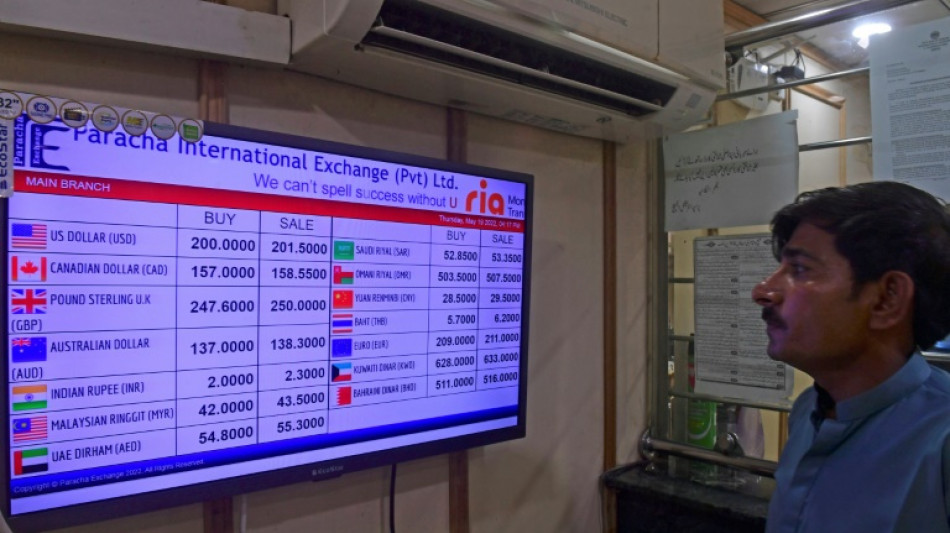
Pakistan bans import of luxury items to boost economy / Photo: Asif HASSAN - AFP

 French firm Safran helps build aircraft wings of the future in UK factory

 World Bank warns of worsening food insecurity as commodity prices soar

 Billionaire Ambani's Jio soars in market debut after India's biggest IPO

 AI chip giant SK hynix posts seven-fold surge in quarterly operating profit

 S.African activists push back on data centre rush

 Billionaire Ambani's Jio to debut after record India IPO

 UK set for cautious budget as borrowing costs climb

 US Fed expected to hold rates steady ahead of key midterm elections

 AI chip giant SK hynix says quarterly operating profit soars 630%

 GA-ASI and Saab Perform Advanced AEW Flight Testing on Uncrewed MQ-9B

 Storied Paris department store seeks bankruptcy protection

 Boeing shares tumble after it releases cautious growth forecast
Pakistan’s new government on Thursday said it would ban the import of over 30 luxury items including cars and fruit jams in an austerity move to help boost the country's faltering economy.
Cash-strapped Pakistan has been hit by a storm of crippling debt, dwindling foreign currency reserves and galloping inflation.
The national currency hit a historic low on Thursday, with 200 rupees fetching $1.
"My decision to ban (the) import of luxury items will save the country precious foreign exchange," Prime Minister Shehbaz Sharif tweeted.
The move was an effort to target the country's elite, with the banned goods including mobile phones and cars -- which make up the largest share of import bills on the list -- as well as cosmetics and jams.
"We will be able to save $6 billion by imposing a ban on import of the luxury items," information minister Marriyum Aurangzeb said at a press conference, adding that the ban would be effective immediately.
"The decision will give a boost to the local economy and industry".
However, business leaders said the country must seek consent from the World Trade Organization, which regulates international trade.
"I think it is a prudent step by the government… it would help save much needed foreign exchange to pay off our international trade debts," said Khalid Tawab, the former senior vice president of the Pakistan Chamber of Commerce.
"The government has not declared a financial emergency yet, but that is the situation we are facing, and so under such circumstances the WTO could be persuaded to relax its rules."
Pakistan's current trade deficit stands at $39.2 billion.
Former leader Imran Khan was ousted in a no-confidence vote last month, largely as a result of failing to reverse the soaring cost of living and prices of basic goods.
The announcement comes as Pakistan officials are locked in negotiation with the IMF in the Qatari capital Doha over the release of funds as part of an agreed loan programme.
A six billion dollar IMF bailout package signed by former prime minister Imran Khan in 2019 has never been fully implemented because his government reneged on agreements to cut or end some subsidies and to improve revenue and tax collection.
Islamabad has so far received $3 billion, with the programme due to end later this year.
Officials are seeking an extension to the programme through to June 2023, as well as the release of the next tranche of $1 billion.
A major sticking point is likely to be over costly subsidies -- notably for fuel and electricity -- and Finance Minister Miftah Ismail said he wants the two sides to "find a middle ground".
P.Petrenko--CPN
