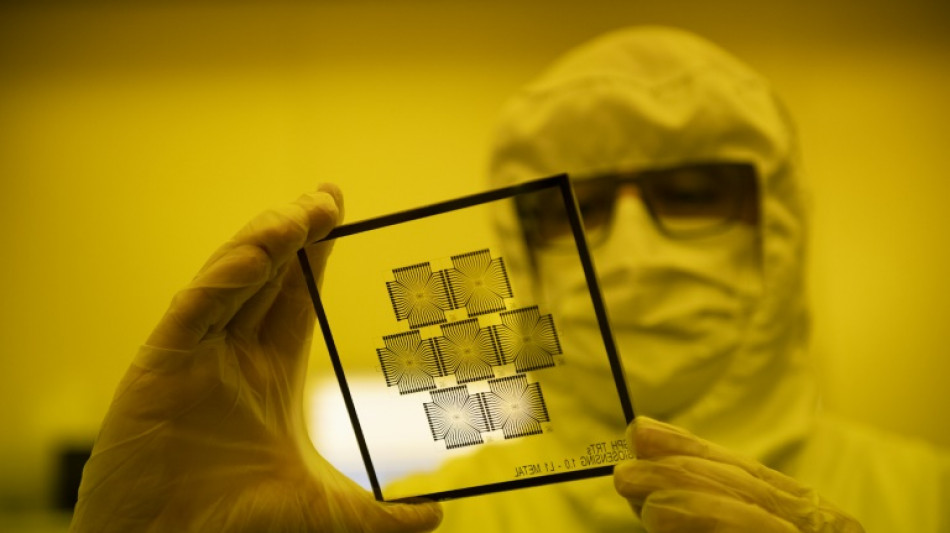
US, EU to ramp up chip making and raise pressure on Russia / Photo: Josep LAGO - AFP/File

 Nintendo producer 'all nervous' as Zelda classic remake hits shelves

 Three killed by storm in southern India

 Two hundred 'Cruise for life' passengers stranded in Cambodia

 Billionaire Ambani's Jio jumps 21% in market debut after record India IPO

 Sri Lanka's Tamil farmers fight to reclaim land after civil war

 'They don't care about us': Trump food aid cuts leave Americans struggling and angry

 Palestinian activist Khalil returns to Columbia after US detention

 Youths testify about 'despair' in unprecedented Canadian climate trial

 Storied Paris department store seeks bankruptcy protection
 Boeing shares tumble after it releases cautious growth forecast
The United States and the European Union announced on Monday a joint effort to boost microchip manufacturing and tackle Russian disinformation around the war in Ukraine.
The two sides met outside Paris as part of the Trade and Technology Council, a forum created last year aimed partially at countering China's increasingly powerful position in the technology sector.
But EU and US officials focused much of their efforts instead on the difficulties created by Russia's invasion of Ukraine, particularly with disinformation.
In its final statement, the council accused Russia of an "all-out assault on the truth" in Ukraine and promised an "early response framework" to tackle disinformation in future crises.
And it promised action over Russian disinformation elsewhere in the world, accusing Moscow of seeking to deflect blame over food supply shortages caused by its war in Ukraine.
"We see the damage from the Russian invasion spreading across the world," said Margrethe Vestager, the European Commissioner for Competition.
The council's statement said practical actions could include funding or other support to promote access to "trustworthy and fact-based information".
The council said its work had already been instrumental in limiting exports of advanced technology in aerospace and cyber-surveillance to undermine Russia's war effort.
- 'Early warning system' -
The forum's other main focuses -- on chip manufacturing and the supply of substances vital for the tech industry such as rare earths -- put it on a collision course with China.
"Companies from the European Union and the United States do not have prominent positions in the supply chain," said the final statement on rare earth magnets, vital for tech products including electric vehicles.
"Nearly all production stages are concentrated in China."
The forum pledged to give the chip industry the maximum possible subsidies.
"We hope to agree on high levels of subsidies -- that they will not be more than what is necessary and proportionate and appropriate," Vestager told reporters on Sunday.
The forum also announced an "early warning system" for disruptions in the supply of semiconductors, substances used to make chips, hoping to avoid excessive competition between Western powers.
- No 'subsidy race' -
The chip industry has suffered from a shortage of components for chipmaking blamed on a boom in global demand for electronic products and pandemic-snarled supply chains.
The aim is that "as both Washington and Brussels look to encourage semiconductor investment in our respective countries, we do so in a coordinated fashion and don't simply encourage a subsidy race", a US official said separately, speaking on condition of anonymity.
The United States already put in place its own early warning system in 2021 that looked at supply chains in Southeast Asia and "has been very helpful in helping us get ahead of a couple of potential shutdowns earlier this year," the US official said.
The official added that the two sides are looking ahead to supply disruptions caused by pandemic lockdowns in China -- the only major economy still hewing to a zero-Covid strategy.
The European Union and United States will also announce joint measures on fighting disinformation and hacking, especially from Russia, including a guide on cybersecurity best practices for small- and medium-sized companies and a task force on trusted technology suppliers, the US official said.
"It's not a European matter but a global matter," she said.
US Commerce Secretary Gina Raimondo and US Trade Representative Katherine Tai are visiting for the talks.
M.García--CPN

